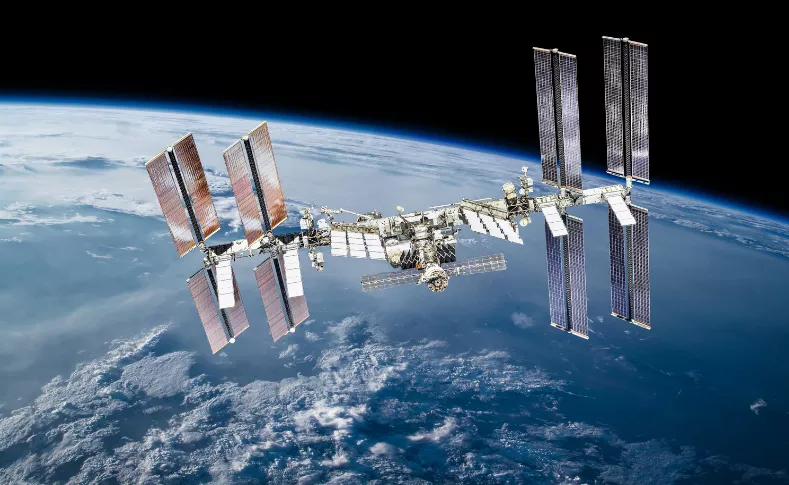
Astronauts aboard the International Space Station see the sun rise and set 16 times in a 24-hour period, once every 90 to 93 minutes, as the station circles Earth at roughly 28,000 kilometers per hour. No conventional time zone survives contact with that kind of speed. So instead of picking any single country’s local time, or any of the dozens of zones it crosses on a single orbit, the ISS runs entirely on Coordinated Universal Time, the same standard that anchors Greenwich’s clock on the ground.
The choice was not arbitrary. UTC sits close to the midpoint among the ISS’s mission control centers, which are spread across multiple continents and time zones, letting each team cover a share of the working day without any single one being forced into permanent night shifts. It is also the shared reference across the station’s international partnership, which today includes agencies from the United States, Europe, Japan, and Canada, among others, a group that would otherwise be scheduling experiments, dockings, and spacewalks across a patchwork of local clocks.
What Time Does the Clock on the ISS Actually Show
Every clock and computer system aboard the station is set to UTC, and has been continuously since long before the first resident crew arrived. The station itself orbits at an altitude of about 400 to 420 kilometers, completing one full circuit in 90 to 93 minutes, which works out to somewhere between 15.5 and 15.9 orbits in a calendar day. NASA rounds that to the memorable figure of 16 orbits and 16 sunrises daily, since 1,440 minutes divided by 90 comes out to an even 16.
Plugging in the ISS’s typical altitude of roughly 400 kilometers gives a period of about 92 minutes, matching NASA’s own published range almost exactly. That formula also explains why the station’s schedule can never be pinned to sunrise or sunset the way a ground-based clock can. Understanding what UTC actually measures matters here, since it is defined independently of any single location’s sun position, which is precisely the property that makes it usable 400 kilometers above every time zone at once.
Why No Ordinary Time Zone Could Ever Work in Orbit
A local time zone is built around the idea that noon roughly matches the sun’s highest point for the people living there. That concept collapses on a spacecraft moving at 7.66 kilometers per second. In the time it takes to read this sentence, the ISS has already moved several kilometers into the next nominal time zone on the map below. Picking any single mission control center’s local time would mean the “local” time onboard has no relationship whatsoever to what the sun is doing outside the window.
Aviation solved a similar problem decades earlier by adopting Zulu time for flight operations, the same UTC standard under a different name, so that pilots and controllers crossing dozens of zones in a single flight never had to convert times mid-conversation. The ISS inherited that same logic, just at orbital speed rather than jet speed.
The station also crosses the International Date Line roughly 16 times a day, which would turn a locally-referenced calendar into a moving target if the crew tried to track it that way. A single fixed clock sidesteps that problem entirely, since UTC has no date line to cross in the first place.
A Compromise Built for Mission Control, Not for Any One Country
UTC’s selection was a practical, shift-splitting decision rather than a tribute to any single nation’s clock. With flight controllers stationed on opposite sides of the globe, a shared neutral standard let each team plan its working hours around the same set of numbers instead of constantly converting between local times just to compare notes on the day’s plan. That kind of coordination matters for a station that has been continuously staffed since the first resident crew arrived on November 2, 2000.
UTC’s status as the direct successor to Greenwich Mean Time also made it a natural neutral ground, tied to no single partner’s territory. Distinguishing GMT from UTC is mostly academic for everyday purposes, but the ISS treats the two as effectively interchangeable, referring to station time as GMT in mission logs just as often as UTC.
How Astronauts Told Time Before the ISS Existed
Spaceflight did not always run on a shared universal clock. Earlier programs used systems built around the mission itself rather than any external time standard.
| Program | Timekeeping System | Reference Point |
|---|---|---|
| Apollo (1968-1975) | Ground Elapsed Time (GET) | Counted upward from launch, reported alongside Houston’s Central time |
| Space Shuttle (1981-2011) | Mission Elapsed Time (MET) | Counted upward from each individual launch |
| International Space Station (2000-present) | Coordinated Universal Time (UTC) | Fixed, permanent standard independent of any single launch or partner nation |
Apollo mission transcripts show controllers in Houston tracking events purely in ground elapsed time, counting “144 hours, 19 minutes” rather than any clock time, while separately noting the local Central Daylight Time for context. That approach worked for missions lasting days, but it made no sense for a station meant to house rotating crews indefinitely. Once the ISS became a permanent, continuously inhabited outpost rather than a single mission with a defined end, launch-relative counting became obsolete and a fixed calendar-based standard took its place.
A Typical Day Onboard, Scheduled Down to the Half Hour
NASA’s own mission status reports describe a standard ISS wake and sleep cycle of 6:00 a.m. to 9:30 p.m. GMT, a rhythm that holds steady for months at a time except when a crew or cargo vehicle docking forces a temporary shift. The day begins with roughly an hour of post-sleep time, followed by a morning planning conference where the crew and flight controllers in multiple countries confirm the day’s tasks together on the same UTC clock.
The middle of the day is split between roughly 6.5 hours of scheduled work, an hour for the midday meal, and 2.5 hours of mandatory exercise on a treadmill, a stationary bike, and a resistance device, all needed to slow the bone and muscle loss that comes with living in microgravity. In 2016, the station’s lighting system was upgraded to LEDs partly to help manage crew circadian rhythms, since a body accustomed to a 24-hour light cycle does not automatically adjust just because the window outside shows daylight every 45 minutes instead.
The Two Kinds of Time Distortion Every Astronaut Experiences
Even with a fixed UTC schedule, time does not pass identically for everyone involved in an ISS mission. Astronaut Scott Kelly spent a cumulative 520 days in orbit across his career, and at a 2016 conference his identical twin brother Mark, who remained on Earth, noted that their age gap had grown from the six minutes separating their births to six minutes and roughly five milliseconds, a real, measurable consequence of relativistic time dilation at orbital speed. At ISS velocities the effect stays far too small to notice without an atomic clock.
The second kind of disruption is psychological rather than physical: a 16-sunrise day gives the body no reliable cue for when to feel tired. NASA’s sleep research aboard the station, including the long-running SLEEP experiment that has tracked crew members’ light exposure and rest patterns for years, exists specifically because a fixed UTC clock does not automatically produce a fixed circadian rhythm when the environment outside contradicts it every 45 minutes.
UTC Itself Is About to Change, and the ISS Will Feel It
UTC is kept aligned with Earth’s actual rotation through leap seconds, occasional single-second adjustments layered onto the otherwise perfectly steady count kept by atomic clocks around the world. Twenty-seven leap seconds have been added since the system began in 1972, each one a small headache for any system, on Earth or in orbit, that has to log precise timestamps. In November 2022, the world’s timekeeping authorities voted to retire the practice entirely by 2035.
That timeline may move much sooner. Earth’s rotation has recently sped up rather than slowed down, raising the odds of an unprecedented negative leap second, one that removes a second rather than adds one, a scenario no software has ever been tested against. A draft resolution now heading to the General Conference on Weights and Measures in Versailles, meeting October 13 to 15, 2026, proposes ending leap second insertions from May 20, 2027, letting the gap between atomic time and Earth’s rotation grow for up to a century before any correction is needed at all. Whatever the outcome, it will not create new time zones for the ISS to worry about, but it will change how leap seconds work, the same mechanism every mission control room and every astronaut’s tablet on the station has depended on since the year 2000.
Beyond UTC: Why the Next Space Station Might Need a Different Clock Entirely
The ISS’s UTC solution worked because everything involved, the station, its crews, and its international partners, stayed in low Earth orbit, where relativistic effects are negligible enough to ignore for daily scheduling. That assumption breaks down on the Moon. Physicists at the National Institute of Standards and Technology calculated in 2024 that a clock on the lunar surface gains about 56 microseconds every day compared to an identical clock on Earth, a combined result of the Moon’s weaker gravity speeding clocks up and its orbital motion slowing them down. Left uncorrected, that drift would translate into navigation errors of many kilometers within weeks for any lander or rover trying to sync with Earth-based UTC.
In April 2024, the White House Office of Science and Technology Policy directed NASA to develop Coordinated Lunar Time, a new standard built on the same UTC foundation but adjusted for the Moon’s different relativistic environment, with a strategy due by the end of 2026, timed to arrive before NASA’s planned crewed lunar landing. Unlike the ISS’s answer, which simply borrowed Earth’s existing UTC wholesale, LTC will need its own hierarchy of lunar atomic clocks specifically because a single shared reference stops being physically accurate once humans start living somewhere with meaningfully different gravity. In that sense, the ISS’s quarter-century of UTC operation was the easy case, a reminder that the harder problem, keeping multiple worlds on speaking terms about what time it is, is only just getting started.