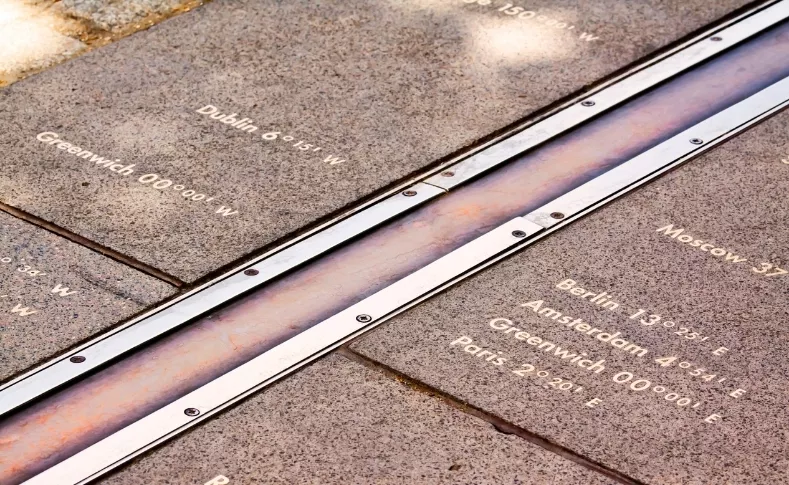
GMT stands for Greenwich Mean Time. UTC stands for Coordinated Universal Time. They are often used as if they mean the same thing, but they are not exactly the same. GMT is a historical time standard based on mean solar time at Greenwich in London. UTC is the modern global time standard used for science, technology, aviation, computing, time zones, and international coordination.
In everyday life, GMT and UTC often show the same clock time. For example, when it is 12:00 UTC, it is usually also 12:00 GMT. That is why people casually use them interchangeably. The difference is that GMT comes from astronomy and historical timekeeping, while UTC is maintained by atomic clocks and adjusted to stay aligned with Earth’s rotation.
This distinction matters because global time needs both history and precision. GMT explains why Greenwich became central to world time. UTC explains how the modern world keeps time accurately across countries, computers, satellites, financial markets, aviation systems, and communication networks.
The Short Answer: GMT Is Historical, UTC Is Modern
The simplest way to understand the difference is this: GMT is a time zone and historical reference, while UTC is a time standard. GMT is connected to Greenwich, the Prime Meridian, and the older system of mean solar time. UTC is the international reference used to keep modern time consistent worldwide.
GMT is still used in public language, especially in the United Kingdom, weather reports, broadcasting, and everyday descriptions of time. UTC is used when precision matters. Computer systems, time servers, scientific institutions, aviation schedules, and global databases generally use UTC because it is more exact and internationally maintained.
This is why the difference can feel confusing. The displayed hour may be the same, but the meaning behind the label is different. GMT tells you about a historical reference point. UTC tells you about the current technical standard used to coordinate time globally.
| Term | What it means | Main use |
|---|---|---|
| GMT | Greenwich Mean Time | Historical time reference and civil time label |
| UTC | Coordinated Universal Time | Modern global time standard |
| Key difference | GMT is linked to Greenwich and mean solar time | UTC is maintained by atomic timekeeping and international coordination |
If you already understand what UTC is and why it matters, GMT becomes easier to place. GMT is part of the history of global time. UTC is the system the modern world relies on now.
What GMT Means
GMT means Greenwich Mean Time. It refers to mean solar time at the Royal Observatory in Greenwich, London. The word “mean” matters because it does not refer to the exact apparent position of the Sun at every moment. It refers to an averaged solar time, smoothing out the small variations caused by Earth’s orbit and axial tilt.
Greenwich became central to global time because it was chosen as the reference meridian for longitude. Once the Prime Meridian was placed at Greenwich, time measured from Greenwich became a natural reference for navigation, maps, railways, shipping, and international communication.
Historically, GMT helped solve a practical problem. Local solar time worked when communities were small and travel was slow. But railways, ships, telegraphs, and global trade needed a shared reference. A world of many local times needed a central point from which time differences could be measured.
That is why GMT became so important. It was not only a clock reading. It was part of the system that allowed people to compare local times across distance. In that sense, GMT belongs to the same wider story as how global time works.
What UTC Means
UTC means Coordinated Universal Time. It is the modern standard used as the basis for civil time around the world. Time zones are usually expressed as offsets from UTC, such as UTC+1, UTC-5, or UTC+9.
UTC is not based simply on the Sun over Greenwich. It is built from highly precise atomic timekeeping and coordinated internationally so that the world has a stable time reference. This makes UTC more suitable for modern systems than GMT alone.
The modern world depends on this precision. Financial transactions, aviation systems, satellite navigation, internet servers, scientific measurements, databases, telecommunications, and security logs need timestamps that can be compared reliably across countries and systems.
That is why UTC is the standard used in technical contexts. If a server logs an event at 14:30 UTC, that timestamp can be converted into local time anywhere in the world. If a flight schedule, data feed, or software system needs a neutral time reference, UTC is usually the safest choice.
Why GMT and UTC Often Show the Same Time
GMT and UTC often show the same clock time because both are centered around the zero offset used as the reference for world time. In many everyday situations, GMT+0 and UTC+0 look identical on the clock.
This is why people say “GMT” when they really mean “UTC,” especially in casual speech. A person may say a meeting is at 10:00 GMT, while a technical system would label the same instant as 10:00 UTC. In many cases, no practical confusion occurs because the displayed hour is the same.
The problem appears when precision, legal definitions, daylight saving time, or technical systems matter. GMT can be used as a time zone label. UTC is a standard. A time zone can have local rules. A time standard is the reference used to calculate and compare times.
That difference is especially important when working with software, international schedules, financial markets, aviation, or scientific data. For casual conversation, GMT may be understood. For exact coordination, UTC is usually the better term.
Is GMT a Time Zone?
GMT can be used as a time zone, especially in the United Kingdom during winter. When the UK is not observing daylight saving time, civil time in London is GMT. But London is not always on GMT.
In summer, the United Kingdom uses British Summer Time, or BST, which is UTC+1. This is why saying “London time is GMT” is only correct for part of the year. In daylight saving time, London is one hour ahead of GMT.
This is one of the most common causes of confusion. People often treat GMT as if it always means the current time in London. That is not accurate. GMT is tied to Greenwich as a reference, but local civil time in London can change when daylight saving time is in effect.
The same issue appears in many countries. A place can have a standard time and a daylight time. The name people use casually may not describe the actual UTC offset on every date. This is why time zones need rules, not just labels.
Why UTC Is Better for Modern Timekeeping
UTC is better for modern timekeeping because it is precise, stable, and globally coordinated. It does not belong to one city in the same cultural sense that GMT belongs to Greenwich. Instead, UTC functions as the neutral reference for the world’s time systems.
This matters because modern time is not only read by humans. It is processed by machines. Computers need timestamps. Satellites need synchronization. Banks need ordered transaction records. Airlines need coordinated schedules. Scientific instruments need comparable measurements. A historical solar-based label is not enough for that level of precision.
UTC also helps avoid confusion when local clocks change. Countries may use daylight saving time, change their time-zone laws, or choose offsets that do not match geography perfectly. UTC gives systems a stable point of comparison even when local time rules vary.
This is closely connected to IANA time zones. A location such as Europe/London or America/New_York contains rules about daylight saving time and historical changes. UTC provides the neutral reference point. The IANA time zone tells software how local time should behave on a specific date.
GMT, UTC, and Time Zones
Time zones are usually described as offsets from UTC. For example, Eastern Standard Time is UTC-5, Central European Time is UTC+1, and Japan Standard Time is UTC+9. These offsets show how far a local clock is from the global reference.
GMT is sometimes used in the same way, especially in older language or public-facing material. People may say “GMT+1” or “GMT-5.” In many casual settings, this is understood. But technically, UTC is the cleaner reference because it is the modern standard.
This difference matters when explaining why time differs between countries. Countries do not simply follow the Sun in a perfect mathematical pattern. They choose legal time zones, sometimes use daylight saving time, and sometimes adopt offsets for political or practical reasons.
That is why a time-zone label alone is not always enough. UTC tells you the offset. The local time zone tells you the rules. GMT tells you the historical reference that helped build the system.
GMT vs UTC in Everyday Use
For most everyday situations, GMT and UTC can appear interchangeable because the clock time is usually the same at the zero offset. If someone says a livestream starts at 18:00 GMT and another source says 18:00 UTC, most people will treat that as the same time.
But in professional or technical contexts, UTC is safer. A programmer should use UTC. A database should store timestamps in UTC. A global trading platform should normalize time in UTC. An airline schedule or scientific record should use a precise standard rather than a casual label.
GMT still has value because it is familiar and historically meaningful. It is useful in public communication, especially when the intended meaning is clear. But UTC is the better term when accuracy matters.
| Situation | Better term | Why |
|---|---|---|
| Historical explanation | GMT | It connects timekeeping to Greenwich and mean solar time |
| Software timestamps | UTC | It is the modern technical standard |
| Time-zone offsets | UTC | Offsets are now best expressed from Coordinated Universal Time |
| Casual public communication | GMT or UTC | The displayed clock time is often the same, but UTC is more precise |
| London local time | Depends on the date | London uses GMT in winter and BST in summer |
The Main Difference Between GMT and UTC
The main difference is that GMT is historical and location-based, while UTC is modern and standards-based. GMT comes from Greenwich Mean Time and the older astronomical system of measuring mean solar time. UTC comes from international time coordination and atomic timekeeping.
In ordinary use, GMT and UTC often point to the same clock reading. But they are not the same idea. GMT explains where the world’s time reference came from. UTC explains how the world keeps time now.
That is the cleanest way to remember the difference: GMT belongs to the history of global time, while UTC is the working standard behind modern timekeeping. If you are writing for people, GMT may be familiar. If you are building systems, comparing time zones, or coordinating internationally, UTC is the term to use.