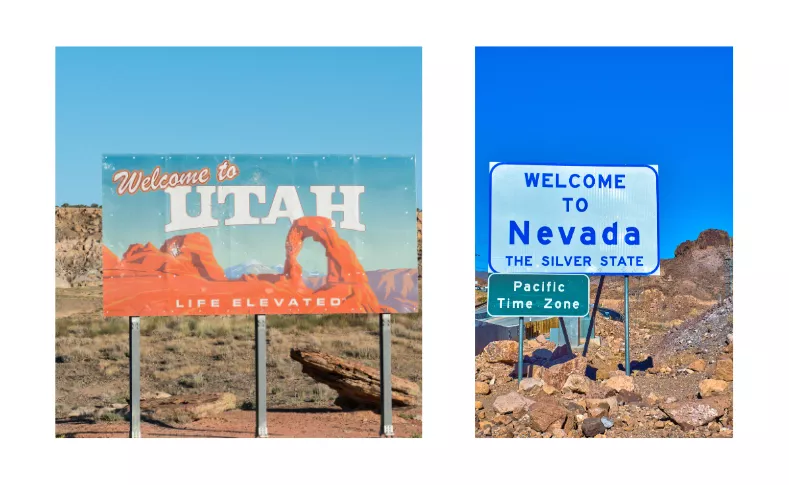
Nevada runs on Pacific Time. Utah runs on Mountain Time. The two states share a long, mostly straight desert border, yet anyone driving east from Ely, Nevada, toward Delta, Utah, loses an hour the moment they cross the line. This is not an accident of geography. It is the leftover of an 1883 railroad scheme, three separate 19th century land grabs that moved the Nevada-Utah border itself, and a federal agency that still redraws time zone boundaries today based on where people gamble, not where the sun sits. One tiny town on that exact border, West Wendover, Nevada, officially ignores its own state’s time zone entirely, and the reason has nothing to do with astronomy.
What Time Zone Nevada and Utah Are Actually In
Nevada sits almost entirely inside the Pacific Time Zone, UTC-8 in winter and UTC-7 during daylight saving time. The state observes daylight saving time as documented in the Uniform Time Act of 1966, with Pacific Standard Time running eight hours behind UTC and Pacific Daylight Time running seven hours behind. Utah sits in the Mountain Time Zone, one hour ahead of Nevada for most of the year. Utah operates on Mountain Daylight Time during summer and shifts to Mountain Standard Time, UTC-7, in November. The practical result: when it is noon in Las Vegas, it is 1 p.m. in Salt Lake City, all year round, with no exceptions in the seasonal switch since both states flip their clocks on the same two Sundays.
| Feature | Nevada | Utah |
|---|---|---|
| Time zone | Pacific (UTC-8 / UTC-7 DST) | Mountain (UTC-7 / UTC-6 DST) |
| Statehood | October 31, 1864 (36th state) | January 4, 1896 (45th state) |
| Standard meridian | 120°W | 105°W |
| Known exceptions | West Wendover (Mountain, official); Jackpot, Owyhee, Mountain City, Jarbidge (Mountain, unofficial) | None |
The Railroads Invented This Border Before Any State Line Mattered
Neither Nevada nor Utah chose Pacific or Mountain time. Private railroad companies did, decades before either state’s boundary was finalized. Charles F. Dowd first proposed a one-hour standard time zone system for American railroads in 1863, though it was never adopted. The railroads instead implemented a version designed by William F. Allen, editor of the Traveler’s Official Railway Guide, splitting the country into five zones: Intercolonial, Eastern, Central, Mountain, and Pacific. On November 18, 1883, every railroad clock in the country was reset at the same instant, even clocks that had already passed noon, a moment railroad workers called the Day of Two Noons.
Before that, the United States had no standard time zones at all, only some 100 conflicting locally established sun times that made railroad and telegraph scheduling close to unmanageable. The line the railroads drew between Mountain and Pacific time ran through the empty desert separating the Nevada mining camps from the Mormon settlements of Utah, and it has barely moved since.
How Nevada Carved Itself Out of Utah, One Degree at a Time
Before it had its own time zone problem, Nevada did not even have its own borders. The area was folded into Utah Territory in 1850, and the discovery of silver at the Comstock Lode in 1859 triggered a population boom that pushed Congress to split off Nevada Territory from western Utah Territory in 1861. That first Nevada Territory covered just over 63,000 square miles carved from six Utah counties, and its eastern line sat about a mile east of the railroad tunnel in Carlin Canyon, leaving the future site of Elko outside Nevada entirely.
Congress kept moving that line east, and each move took more land from Utah. In 1862 the territory expanded east by one degree of longitude, adding more than 18,000 square miles and finally placing Elko’s future townsite inside Nevada. Statehood in 1864 shifted the eastern border again, from the 39th to the 38th meridian, and in 1866 it moved once more, roughly 53 miles further east to the 37th meridian. One of those later shifts had an unusually petty motive. According to University of Utah historian W. Paul Reeve, a Southern Paiute guide led a Mormon settler to an outcropping rumored to hold a silver mountain inside Utah Territory, and when word reached Washington, Congress moved the boundary a full degree of longitude east specifically to keep that rumored mountain out of Mormon hands and inside Nevada. A final adjustment in January 1867 moved Nevada’s southern border down to the Colorado River, handing the state the western strip of Arizona Territory as well, and fixing Nevada’s boundaries as they still stand.
Silver, Not Geography, Decided Which Coast Nevada Would Follow
Nevada’s Pacific orientation was set economically long before 1883 made it official on paper. The Comstock Lode, discovered near Virginia City in 1859, produced more than $300 million worth of silver and gold ore between 1859 and 1882, reshaping Nevada’s entire economy around a single mining district. That ore needed to reach a port, and the nearest one was San Francisco, not Salt Lake City. The heavy volume of Comstock commerce, combined with federal incentives for a transcontinental line, directly justified routing the Central Pacific Railroad through the central Sierra Nevada rather than around it. When the transcontinental railroad was completed at Promontory Summit, Utah, on May 10, 1869, one of the ceremonial spikes driven alongside the famous golden spike was made of silver, sent specifically from Nevada.
The Virginia and Truckee Railroad, built starting in 1869 specifically to haul ore and mining supplies to the Comstock Lode, cemented Nevada’s freight and passenger traffic toward Sacramento and San Francisco rather than east toward Utah. Even Nevada’s most famous literary export sprang from that same mining boom: reporter Samuel Clemens lived in Virginia City from 1862 to 1864, and it was there that he first used the pen name Mark Twain. By the time the 1883 railroad zones were drawn, Nevada’s commercial gravity already pointed west, and the time zone map simply confirmed what the ore shipments had decided years earlier.
Congress Made It Federal Law in 1918, Then Handed Away the Pen
The railroad-built zone system remained an informal industry standard until March 19, 1918, when Congress passed the Standard Time Act, folding standardized time into federal law and giving the Interstate Commerce Commission authority to set the actual zone boundaries. That same act, sometimes called the Calder Act, took the railroads’ four zones, added a fifth for Alaska, and made the whole system official, while also introducing daylight saving time as a wartime fuel-conservation measure. Congress repealed the daylight saving provision in 1919, but the standard time zones themselves stayed on the books, and the ICC kept the power to redraw them.
That regulatory authority passed from the ICC to the newly created Department of Transportation in 1966, under the Uniform Time Act signed by President Lyndon B. Johnson, which aimed to end decades of patchwork local daylight saving rules. The Nevada-Utah time zone line was never fixed by an act of Congress describing exact coordinates. It is a DOT regulation, which means it can be, and occasionally is, moved.
The One Town That Got the DOT to Move the Line
West Wendover, Nevada, sits directly on the Utah border, right next to its twin city, Wendover, Utah. For decades it ran on Pacific time along with the rest of Nevada, an hour behind its neighbor across the street. In October 1999, the federal Department of Transportation moved West Wendover from Pacific time to Mountain time, stating the action was designed to facilitate commerce and reduce confusion. The town relies heavily on gaming and tourism, and the bulk of its casino customers come from Utah, which made the mismatch a genuine business problem rather than a curiosity.
The DOT’s own boundary language for the change reads almost comically precise: the line runs from the northeast corner of Nevada southerly along the Utah-Nevada boundary to the junction with the northern border of the city of West Wendover, carving out roughly 7.48 square miles of Mountain time inside an otherwise Pacific state. That single exception makes Elko County one of the few counties in the entire United States that is split between two time zones. A handful of nearby Nevada towns near the Idaho border, including Jackpot, Owyhee, Mountain City, and Jarbidge, unofficially keep Mountain time as well, mostly for the convenience of visitors and residents tied to Idaho communities across the line.
West Wendover has more history packed into its small footprint than the time zone quirk alone suggests. During World War II, the Wendover Army Air Field trained the 509th Composite Group under Colonel Paul Tibbets, the unit that flew the Enola Gay, and by 1943 the base had grown into the largest bombing and gunnery range in the world, with more than 23,000 personnel and 668 buildings spread across 1.8 million acres. The Enola Gay departed Wendover in late June 1945 on its route toward Guam, then Tinian, then Japan.
The Almost-Annexation That Would Have Erased the Border Entirely
For a few years, Nevada and Utah came close to solving the West Wendover time zone oddity by removing the border rather than the clock difference. On November 5, 2002, residents of West Wendover, Nevada, and Wendover, Utah, voted in a local referendum to approve merging the two cities. The following year, the Nevada Legislature authorized a formal study of the idea, and a subcommittee chaired by state senator Dean A. Rhoads spent 2003 and 2004 examining whether the state line itself could be redrawn so it looped around the Utah town, with Utah losing roughly 15 miles of territory to Nevada. Local, state, and federal lawmakers from both states initially backed the merger, and the idea moved forward for several years, though any actual change would have required a bistate compact and an act of Congress.
Nevada and Utah have redrawn their shared line five times since 1861, but every one of those moves came from Congress. The 2002 Wendover referendum is the only attempt on record where the residents living on the border tried to move it themselves. worldtimedata
In 2006, three Utah lawmakers changed their position, and the Wendover, Utah, City Council deadlocked on a final vote, with two members supporting the merger and two opposed. The tie was broken by Wendover, Utah, Mayor Brett Shelton, who voted to end the annexation process for good. Today the Nevada-Utah state line runs directly through the middle of a resort casino parking lot in Wendover, a physical reminder of the annexation that never happened.
Do the Math: How Far the State Line Sits From the Sun’s Own Boundary
Time zones are built around standard meridians, not the actual position of the sun, and the gap between the two is measurable. Mountain time is centered on 105°W. Pacific time is centered on 120°W. The natural halfway point between them, purely by geometry, sits at 112.5°W. The Nevada-Utah border near West Wendover runs at approximately 114°W, which is about 1.5 degrees further west than that theoretical halfway line, meaning the state border itself already leans slightly into Pacific territory by the numbers.
Applied to West Wendover at roughly 114°W: against the Pacific standard meridian of 120°W, the offset is 4 x (120-114) = 24 minutes, meaning true solar noon there arrives 24 minutes before Pacific clock noon. Against the Mountain standard meridian of 105°W, the offset is 4 x (114-105) = 36 minutes, meaning true solar noon arrives 36 minutes after Mountain clock noon. By the sun alone, West Wendover sits closer to Pacific time than to Mountain time, even though it has legally run on Mountain clocks since 1999. The DOT overruled the sun in favor of casino traffic patterns, and nobody has proposed changing it back.
Two States, Two Failed Clock Bills, and a Federal Wildcard in 2025 and 2026
Both states tried to simplify their relationship with daylight saving time recently, and both efforts collapsed. Utah’s HB120, sponsored by Rep. Joseph Elison, R-Toquerville, would have put the state on permanent standard time starting January 1, 2026, and passed the Utah House 52-23. The Senate Business and Labor Committee tabled the bill on a 7-1 vote in February 2025, effectively killing it for the session, even though Elison said it was the most tracked bill of the year. Utah’s older fallback law is still on the books: a 2020 bill would move Utah to permanent Mountain Daylight Time, but only once Congress amends federal law to authorize it and at least four other western states adopt year-round daylight time as well.
Nevada’s parallel effort met the same fate. Assembly Bill 81, the “Lock the Clock” Act sponsored by Assemblywoman Selena La Rue Hatch, D-Washoe County, cleared the Assembly 27-15 with bipartisan support but never received a hearing in the Senate and missed the committee deadline before the 2025 session adjourned on June 3. Had it passed, Nevada would have joined Arizona and Hawaii on permanent standard time starting in January 2026.
Meanwhile Congress moved further on the issue than it has in years. The Sunshine Protection Act of 2025, introduced by Rep. Vern Buchanan, R-FL, on January 3, 2025, passed the House on July 14, 2026, by a vote of 308-117. The bill would put the entire country on the schedule currently observed from March to November, unless a state exempts itself beforehand, and it now heads to the Senate, where a similar 2022 version stalled after Senator Tom Cotton, R-AR, objected over concerns about dark winter mornings in northern latitudes. As of this writing the Senate has not voted on it.
What Happens to the Nevada-Utah Gap If Congress Actually Finishes the Job
If the Sunshine Protection Act eventually clears the Senate and gets signed, it would not touch the Nevada-Utah boundary itself, but it would quietly resolve the messiest part of the current arrangement. Utah’s 2020 trigger law is written to activate permanent daylight time specifically when Congress authorizes it and enough western states follow, a condition the federal bill would satisfy on its own. Nevada has no such law queued up after AB81’s death, so it would likely need fresh legislation, or simply ride the new federal default like every other state that does not opt out.
The one place this genuinely complicates things is West Wendover. Its Mountain time status was granted by the DOT specifically to match Utah’s clock for casino customers. Under a national permanent daylight time regime, Utah would stop changing its clocks twice a year and settle permanently one hour ahead of a Nevada that, absent its own opt-out, would also stop changing but would still trail Utah by an hour year-round instead of the current seven-to-eight month stretch. The one-hour gap between the two states would not close. It would simply stop breathing in and out twice a year, which is the closest either state has come to actually settling the argument the railroads started in 1883.