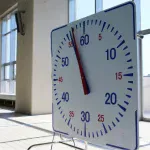
On June 30, 2015, at 23:59:60 UTC, the clock did something it almost never does. It counted a second that doesn’t exist on any calendar, doesn’t fit into a normal minute, and broke code at several major websites the moment it happened. That second was a leap second, and after more than fifty years of patching the gap between atomic time and the actual spin of the Earth, the world has decided to stop adding them.
The Mismatch Leap Seconds Were Built to Fix
Modern time isn’t measured by the sun anymore. It’s measured by atomic clocks, which count the vibrations of a cesium atom with extraordinary consistency. Atomic clocks measure time so precisely that they don’t lose a second in tens of millions of years.
The Earth is nowhere near that consistent. Its rotation is slowing down gradually due to tidal friction from the moon, and it wobbles unpredictably in the short term due to factors like earthquakes, melting ice caps redistributing mass, and shifts in the planet’s molten core. None of that matters for physics. It matters enormously for civil time, because civil time is supposed to track the sun. Noon is supposed to mean the sun is roughly overhead.
Left alone, atomic time and solar time drift apart. Slowly, but permanently. Leap seconds were the fix: an occasional extra second inserted into Coordinated Universal Time to keep it within 0.9 seconds of the Earth’s actual rotation.
How the Correction Actually Worked
Leap seconds were never on a schedule. The International Earth Rotation and Reference Systems Service monitored the gap between atomic time and solar time, and when it approached the 0.9 second threshold, it announced a correction, usually with about six months’ notice.
Between 1972, when the system started, and 2016, 27 leap seconds were added. Every single one added time. None ever subtracted it, because the Earth’s rotation has consistently been slightly slower than the atomic clock standard assumed when the system began. When a leap second is inserted, the last minute of June 30 or December 31 in UTC gets an extra tick: 23:59:60, a minute that runs 61 seconds instead of 60.
| Leap seconds added | Time period | Direction |
|---|---|---|
| 27 | 1972 to 2016 | All positive (time added, never removed) |
| 0 | 2017 to present | None needed; Earth’s rotation briefly sped up |
That second row matters. Since the last leap second at the end of 2016, the Earth has actually been spinning slightly faster than expected in several recent years, which is a big part of why the correction system has effectively gone dormant even before its official retirement.
Why This Broke Computers, Not Clocks
Human clocks handle a 61-second minute without any trouble. Computers handle it much worse, because most software assumes time only moves forward, one second at a time, with no repeats and no gaps. A leap second violates that assumption directly.
This is the same fragility behind Unix time, which counts seconds since January 1, 1970 and was never designed to account for a minute with an extra second in it. In 2012, the leap second inserted that June caused outages or slowdowns at Reddit, LinkedIn, Yelp, and several airline booking systems, largely because Linux servers running certain kernel versions choked on the repeated timestamp. The leap second at the end of 2016 caused a similar issue at Cloudflare’s DNS infrastructure.
A leap second doesn’t break time. It breaks the assumption, buried in almost every piece of software, that time only ever moves forward. worldtimedata
Leap Smearing: The Workaround Before the Ban
Rather than risk a repeated or skipped second, major infrastructure providers stopped implementing leap seconds the official way years before the practice was formally abolished. Google popularized an approach it called leap smearing: instead of inserting a sudden extra second at midnight, its servers slow down very slightly over a window of several hours before the leap second, spreading the one-second correction across thousands of tiny, imperceptible adjustments. By the time the official leap second occurs, Google’s clocks have already absorbed it gradually, and no single timestamp ever repeats or jumps.
Amazon and Microsoft adopted similar smearing strategies for their cloud platforms. The tradeoff is that during the smear window, these systems are technically a fraction of a second off from official UTC, in exchange for never producing an ambiguous or duplicate timestamp. For most applications, that tradeoff is an easy one to accept.
The 2022 Decision to Abolish Leap Seconds
In November 2022, the General Conference on Weights and Measures, the international body responsible for global time standards, voted to stop adding leap seconds altogether by 2035. The reasoning wasn’t that the mismatch between atomic time and Earth’s rotation stopped mattering. It was that the cost of the fix had grown larger than the problem it solved.
Financial systems, satellite navigation, and telecommunications networks all depend on precise, unambiguous timestamps, and leap seconds had become a recurring source of outages, patch cycles, and coordination headaches across an industry that increasingly measures transactions in microseconds. The new plan allows the gap between atomic time and solar time to grow well past the old 0.9-second limit, likely to at least a full minute, before a future, larger correction is decided on. No specific new correction mechanism has been finalized yet; the 2035 deadline is a commitment to phase out the old one first.
What This Means for Systems That Still Rely on the Sun
None of this changes how atomic clocks work or how a second is officially defined. It changes how the gap between atomic time and the planet’s actual rotation gets managed. Civil clocks, the ones on phones and computers, will simply drift further from solar noon over time, by seconds rather than the imperceptible fractions most people assume clocks are accurate to. For nearly every practical purpose, from work schedules to the length of a day itself, that drift will be too small to notice for decades. It matters far more to systems that require exact, unambiguous timestamps across networks than it does to anyone checking the time on a wall clock.
Two Clocks, Drifting Apart Again
Leap seconds existed because two definitions of time, one based on atomic vibrations and one based on the Earth’s spin, refuse to stay in sync. For fifty years, the fix was to occasionally insert an extra second and let the world’s computers deal with the consequences. Now the consequences have outweighed the benefit, and by 2035 the correction itself is set to disappear, leaving atomic time and solar time free to drift apart for the first time since 1972.