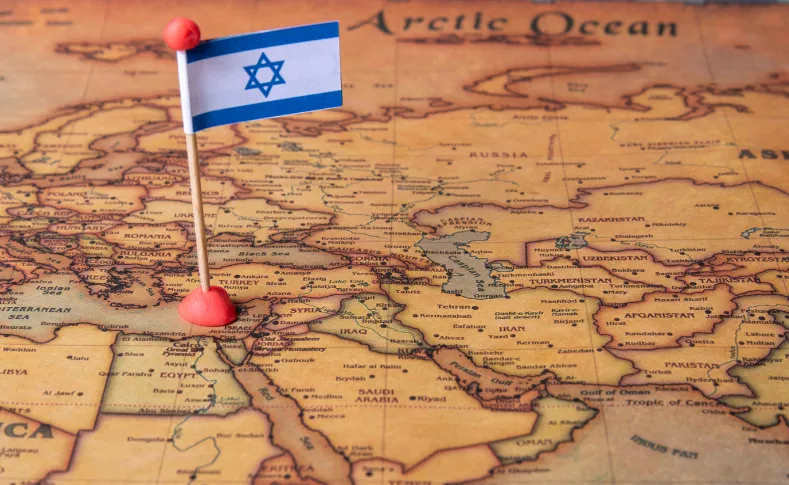
Israel’s clocks now fall back on the same day the European Union’s do, the last Sunday of October, a deliberate alignment written into a 2013 law. But the two systems still don’t match. Israel springs forward on the Friday before the EU’s last Sunday of March, switching roughly two days earlier each spring and about three weeks later than the United States, and it makes that switch at 2 a.m. on a Friday specifically because Saturday is the Jewish Sabbath and nobody wanted the changeover falling during it. For most of Israel’s history the mismatch with the rest of the world was far bigger than a few days: for decades, the country’s clocks moved not on a fixed calendar date at all, but on the Hebrew calendar, tied directly to the timing of Yom Kippur, sometimes shifting the entire changeover by as much as six weeks from one year to the next.
The Current Rule: Aligned at One End, Not the Other
Israel’s seasonal clock change is governed by the Time Determination Law, passed by the Knesset in 2013 after a November 2012 vote that replaced decades of year-by-year uncertainty with a fixed formula. Under that law, Israel Daylight Time begins at 2 a.m. on the Friday immediately before the last Sunday in March and ends at 2 a.m. on the last Sunday in October, when clocks fall back to 1 a.m. That end date is identical to the rule most of Europe uses for daylight saving, a deliberate choice the 2013 legislation made to stop Israel’s clock from drifting away from its largest trading partners for weeks at a time. The start date is where the two systems still diverge, by design as much as by accident of the calendar.
Even the European side of that comparison isn’t as uniform as it looks from a distance. The United Kingdom, for instance, keeps its own clock legislation separate from the EU’s, a distinction covered in more depth elsewhere on London’s own clock rules, which happens to land on the same dates as the EU today but isn’t bound to stay that way by any shared law.
| Region | DST Starts | DST Ends |
|---|---|---|
| United States | Second Sunday of March | First Sunday of November |
| European Union | Last Sunday of March | Last Sunday of October |
| Israel | Friday before the last Sunday of March | Last Sunday of October |
Run the formula forward and the pattern holds year after year. Daylight saving time in Israel returned on March 27, 2026, and is scheduled to end on October 25, 2026, the same last-Sunday-of-October date the EU observes, while the US made its own spring switch nearly three weeks earlier, on March 8. The gap isn’t a one-off quirk of any particular year. It’s the predictable output of a fixed formula that was specifically built to keep producing that exact three-week offset every single spring, indefinitely, without anyone having to revisit the question again.
Why the Switch Happens on a Friday
Every other detail of Israel’s 2013 law borrows directly from the European convention, except the day of the week. The EU shifts its clocks in the small hours of a Sunday morning, when traffic and disruption are lowest. Israel’s weekend runs Friday evening through Saturday, built around Shabbat, so a Sunday changeover would land the transition squarely inside the one period each week when observant Israelis are not meant to be using electricity or checking a clock at all. Moving the switch two days earlier, to Friday at 2 a.m., keeps the changeover on an ordinary working night and avoids scheduling a national time change literally in the middle of a religious observance.
The Religious Calendar That Used to Run the Whole System
Before 2013, Israel had no fixed rule at all. Daylight saving time operated under a 1992 law that required only a minimum of 150 days of summer time each year, leaving the exact start and end dates to the Interior Minister, subject to Knesset committee approval, and those dates became an annual political fight. Religious parties consistently pushed for summer time to end before Yom Kippur, so that the day’s sunset-to-sunset fast would effectively run one clock-hour shorter, while secular parties pushed to keep the lighter evenings for as long into autumn as possible. Because Yom Kippur’s date shifts every year on the lunar Hebrew calendar, falling anywhere between mid-September and mid-October, the country’s return to standard time moved with it, sometimes landing as much as six weeks before most of Europe made the same switch and leaving Israel on a wildly unpredictable seasonal clock that changed shape from one year to the next.
The scale of that unpredictability is easy to understate. In a year when Yom Kippur fell in mid-September, Israelis could find themselves back on standard time while London, Paris, and New York were still weeks away from their own autumn changeover, meaning Israel’s evening sunset effectively arrived an hour earlier, by the clock, than its trading partners’ for over a month at a stretch. Business calls, flight schedules, and even television broadcast times imported from abroad all had to be manually adjusted for a gap that shifted size every single year depending on where Yom Kippur happened to fall, a level of scheduling friction almost no other developed economy imposed on itself deliberately.
A Supreme Court Case Decided Who Actually Controls the Clock
The instability wasn’t just political theater. In 1980, the Interior Minister’s authority to set the dates was formally challenged in the Supreme Court, which ruled that while daylight saving time itself was not optional, the minister’s power to fix its exact dates was narrower than officials had been treating it. The Knesset responded by amending the law to explicitly give the minister authority to cancel summer time entirely in a given year if it chose to, adding yet another layer of year-to-year unpredictability rather than resolving it. The country briefly reinstated summer time in 1974 and 1975 in the aftermath of the 1973 global energy crisis that followed the Yom Kippur War, treating the extra daylight hour as an energy-saving measure during a period when regional conflict was quite literally shaping the clock alongside the calendar. For nearly two decades after that, proposals to fix the system permanently kept failing. One widely floated compromise would have started summer time on the second day of Passover and ended it on the weekend between Rosh Hashanah and Yom Kippur, guaranteeing religious observance a predictable place on the calendar, but lawmakers rejected it because it capped the entire daylight saving period at roughly five months, shorter than almost anywhere else in the temperate world. That rejected proposal nonetheless became the starting template for the eventual 2012-2013 compromise, stretched considerably longer once negotiators agreed the economic cost of a short summer clock outweighed the political convenience of tying it neatly to the High Holidays.
2012-2013: The Compromise That Finally Stuck
The unpredictability dragged on for years of failed compromises before the Knesset finally passed a durable fix. On November 5, 2012, lawmakers voted to extend Israel’s daylight saving period to 193 days, setting the start at the Friday before the last Sunday in March. The following year’s Time Determination Law refined the end date further, locking it to the last Sunday of October to match Europe exactly, which stretched the total period to roughly 212 days a year, the longest daylight saving stretch Israel had ever observed. Israeli officials at the time projected the extension would save the economy roughly 300 million shekels, about 78 million dollars, largely through reduced electricity demand during the additional weeks of evening daylight. Unlike Japan’s total rejection of the practice, or those that abandoned it outright, Israel chose the harder path of building a rule flexible enough to satisfy a genuine religious constituency while still converging with its neighbors’ calendars, similar in spirit to the trade-offs behind Arizona’s own exemption from the seasonal switch.
Two Clocks, One Small Stretch of Land
The 2013 law settled Israel’s own internal rule, but it didn’t settle the region. The Palestinian Authority sets its own daylight saving dates independently, and the two governments have repeatedly ended up on different clocks for a day or more when their switchover dates don’t align, occasionally with only short public notice of a change from either side. Residents and reporters in the area have documented phones automatically shifting to different times depending on whether the SIM card is registered with an Israeli or Palestinian carrier, even when the phone itself hasn’t moved location at all, producing exactly the kind of scheduling confusion a supposedly simple one-hour clock change is meant to avoid. It’s a small-scale, high-friction version of a mismatch most of the world only experiences between countries separated by an ocean and several real time zones, compressed here into a strip of land where two administrations can be an hour apart despite sharing the same sunset.
The Clock Behind the Clock
Underneath all the legislative history, Israel’s actual time is generated the same way any modern country’s is: not by decree, but by physics. The National Physics Laboratory, part of the Ministry of Economy and Industry, maintains Israel’s official time standard, designated UTC(INPL), using four atomic clocks that stay synchronized with the global network of atomic timekeeping institutions defining Coordinated Universal Time itself. That reference feeds Israel’s two-hour UTC offset the rest of the year, a standard time it shares with Egypt, Lebanon, and Cyprus, three neighbors with their own entirely separate daylight saving histories and none of them synchronized to Israel’s Knesset-set calendar. Every Knesset vote on when the clocks change is, in the end, a decision about which single moment those four atomic clocks get offset by exactly one hour, a purely political choice layered on top of a timekeeping system that, unlike the surrounding legislative history, has never once been up for debate.