By the year 1500, the clock at Wells Cathedral in England was already striking the quarter-hours for the whole town to hear. What it could not do was show a minute. There was no minute hand on any clock anywhere, because no clock mechanism was precise enough to make one worth building. For roughly a century and a half after that, “quarter past” and “half past” were not a quaint alternative to reading the exact minute. They were the only unit of time smaller than an hour that anyone could reliably communicate at all.
That history explains something modern time-telling apps and smart speakers still run into today: when someone says “quarter past three,” they are using a phrase older than the ability to say “3:15” ever was.
Why Clocks Only Had One Hand for Centuries
The Salisbury Cathedral clock, thought to date from 1386 and widely cited as the oldest surviving working mechanical clock in the world, had no dial at all. It was built purely to strike a bell on the hour, calling monks and townspeople to prayer. Reading the exact time was not the point; hearing which hour had arrived was. Early mechanical clocks used a verge-and-foliot escapement, a mechanism accurate to within about 15 minutes a day at best, which made a minute hand pointless. Displaying minutes on a clock that could drift by a quarter hour overnight would have been actively misleading.
The Quarter-Striking Clocks That Trained Ears Before Eyes
Wells Cathedral’s clock, built only a few years after Salisbury’s, solved the same problem differently: it added a mechanical figure known as the Quarter Jack, a carved man who struck a bell with a hammer every 15 minutes, dividing the hour into quarters long before anyone could read those quarters on a face. That pattern spread across medieval Europe. Church and civic clocks struck the quarters audibly, training entire towns to think in quarter-hour blocks the way modern people think in exact minutes. A townsperson in the 1400s did not need to see a clock face to know it was “half past” the hour; they simply counted the strikes.
Why the Clock Face Itself Is Built on Quarters
Once dials did appear, their geometry reinforced the same habit. A circular clock face divides naturally into quarters using the 12, 3, 6, and 9 positions, the same four points a compass or a sundial’s cardinal markers would use to cross a circle. The math lines up cleanly with how people already talked about time.
That clean division is also why the clock’s minute hand became such an intuitive visual shorthand once it finally existed: a hand pointing straight at the 3 or the 9 is unmistakable at a glance, in a way that a hand pointing at, say, 17 minutes past never quite is. The habit of reading position rather than counting minute marks is closely tied to the clockwise convention itself, since both trace back to how people already read shadows and dial positions before mechanical precision existed.
How the Pendulum Finally Made Minutes Readable, and Quarters Still Won
Precision arrived in 1656, when Dutch scientist Christiaan Huygens built the first working pendulum clock, improving accuracy from roughly 15 minutes of drift per day down to about 15 seconds. That leap in precision is what finally made a minute hand worth adding to a clock face at all. Clockmakers such as William Clement, working around 1680, built the long-case clocks, later nicknamed grandfather clocks, that housed these more accurate pendulum mechanisms.
By then, though, “quarter past” and “half past” had already been embedded in everyday speech for generations. When minute hands finally made it possible to say “17 minutes past,” the phrase had no real advantage over language that was shorter, easier to picture on a dial, and already universally understood. The vocabulary people used for pre-clock methods of tracking time simply carried over into the era when precision became available, because it was already good enough.
The Westminster Quarters and the Myth of Their Handel Origin
The most famous quarter-striking melody in the world, the four-note phrase now known as the Westminster Quarters, was composed in 1793 for the Church of St Mary the Great in Cambridge, commissioned from Joseph Jowett and widely credited to a young William Crotch, then still a teenage musical prodigy. It later spread to Big Ben’s Elizabeth Tower in 1859 and from there to countless clock towers and grandfather clocks worldwide.
A popular story claims the melody was lifted from Handel’s oratorio Messiah, specifically the aria “I know that my Redeemer liveth.” Musicologist Christopher Hogwood, writing to The Times in 2009, called that connection “very tenuous,” pointing out that the four-note phrase simply happens to share a shape with a different Messiah passage, “Now is Christ risen,” largely because both are built from the same four bells available at the Cambridge church in 1793. The chimes are not a quotation of Handel; they are a coincidence of a small instrument’s limited notes.
Why “Half Ten” Means Two Different Things Depending on the Country
| Language | Phrase for 10:30 | Literal Meaning |
|---|---|---|
| English (standard) | Half past ten | Half an hour after ten |
| English (British informal) | Half ten | Same as above, shortened |
| German | Halb elf | Half toward eleven |
| Czech | Půl jedenácté | Half toward the eleventh (hour) |
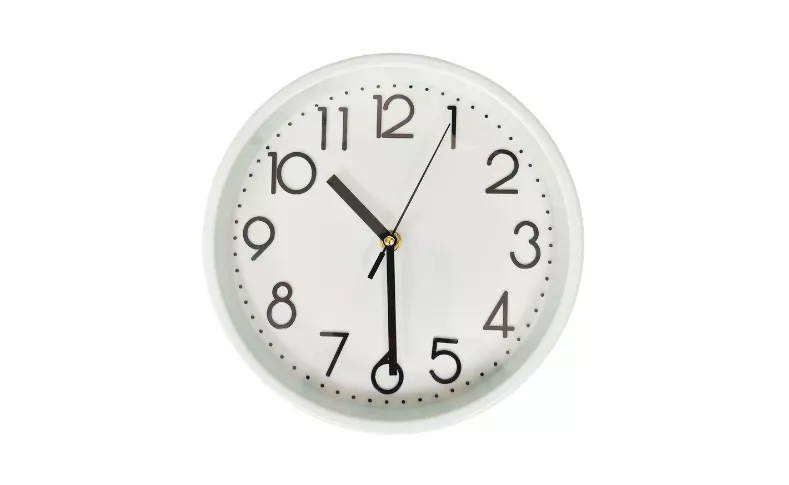
English speakers describe the half hour as something already completed, half past the current hour. German and Czech speakers describe the same 30 minutes as something still in progress, half of the way toward the next hour. Both systems land on the identical clock position, 10:30, but they organize the exact same 30 minutes around opposite reference points, which is why British “half ten” regularly confuses non-native English speakers who learned a language where “half” points forward rather than back.
What Happens When You Ask a Smart Speaker for the Time in Quarters
Voice assistants have to reverse-engineer centuries of this habit every time someone asks them a question. A person saying “set an alarm for quarter to seven” is using phrasing built for a one-handed clock from the 1300s, and modern natural-language processing has to translate that into 6:45 before it can do anything useful. The fact that “quarter past,” “half past,” and “quarter to” remain some of the most common ways people phrase time requests out loud, rather than defaulting to exact minute counts, is itself evidence of how durable pre-digital language habits are even in a fully digital interface.
What Digital Natives Are Doing to a 600-Year-Old Habit
In 2018, the UK’s Association of School and College Leaders reported that some British schools were swapping analog clocks for digital ones in exam halls, citing students who struggled to read a traditional clock face quickly enough during timed tests. The claim was widely exaggerated in social media retellings, as fact-checkers later clarified, but the underlying observation held up: a generation raised on phone and laptop screens has less daily practice reading a dial than any generation before it. A December 2025 report from New York City schools found the same pattern resurfacing there, after phone bans pushed students back toward classroom wall clocks some hadn’t needed to read in years.
A phrase built for people who could only hear the hour has outlived the mechanism that made hearing necessary, and now it may outlive the dial that made seeing it easy too. worldtimedata
Whether “quarter past” survives this shift the way it survived the arrival of the minute hand in the 1650s is an open question. Digital clocks display exact minutes by default, and voice assistants can just as easily read out “3:47” as translate a spoken quarter-hour. But the same efficiency argument existed 300 years ago, when precise minute hands first became available, and the older phrasing won anyway, not because it was more accurate, but because it was already how everyone thought about time. Earlier failed attempts to replace that intuition with something more “precise,” like the short-lived Swatch Internet Time of the late 1990s, suggest that efficiency alone rarely beats a habit that old.