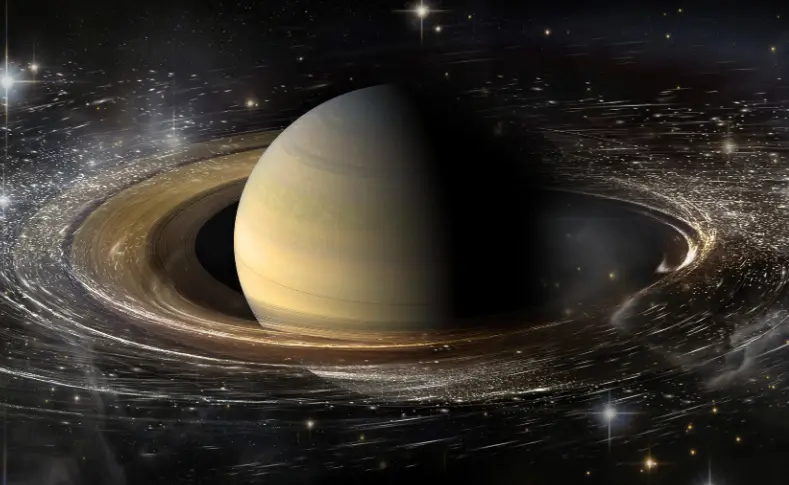
Saturn’s rings turned edge-on to Earth on March 23, 2025, at 12:04 p.m. EDT, and for weeks the planet looked like a plain yellow ball through backyard telescopes. This is not decay or destruction. It is a geometric alignment called a ring plane crossing, and it happens roughly every 13 to 15 years as Saturn’s 29.4-year orbit carries its tilted rings edge-on to our line of sight. The rings dipped nearly edge-on again on November 23, 2025, then started the slow seven-year climb back to full view, a process that will not look truly spectacular again until 2032. Galileo saw the same vanishing act in 1612 and had no idea what he was looking at.
The Geometry Behind the Disappearing Act
Saturn’s axis is tilted 26.7 degrees relative to its orbital plane, close to Earth’s own 23.5-degree tilt. Because the rings sit directly over Saturn’s equator, they share that tilt and swing between two extremes as the planet moves around the sun, the same underlying geometry that produces equinoxes and solstices here on Earth, just stretched over a much longer year. For about seven years we see the rings from above, wide open and dazzling. For the next seven we see them from below. In between, twice per Saturnian year, the sun and then Earth cross the exact plane of the rings, and the thin edge points straight at us. Since the rings are only about 30 feet (10 meters) thick in most places according to NASA, viewing them edge-on is like trying to see a sheet of paper from its side across a football field.
Saturn’s own rotation has nothing to do with this slow tilt cycle, and it is a mystery in its own right. Because Saturn is a gas giant with no solid surface to track, nobody has ever measured its rotation the simple way astronomers measure Earth’s. Voyager 2 clocked it at 10 hours 39 minutes in 1981 using radio signals; Cassini’s magnetometer measured 10 hours 47 minutes in 2006 by tracking the planet’s magnetic field instead, a full 8 minutes slower; a 2015 study using Saturn’s gravitational field settled on 10 hours 32 minutes. The length of a day on other planets gets harder to pin down the less solid the planet is, and Saturn is the extreme case in the solar system.
This geometry is the same underlying principle that governs solar and lunar eclipses on a much smaller scale, three bodies lining up on a shared plane at the right moment. The difference is that Saturn’s ring plane crossing lasts weeks rather than minutes, because Earth and Saturn are both still moving while the alignment holds.
March 23, 2025: The Exact Moment the Rings Vanished
According to In-The-Sky.org, the crossing peaked at 12:04 p.m. EDT (1604 GMT) as Earth passed directly through the ring plane. The timing was unlucky for observers. Saturn reached solar conjunction on March 12, just 11 days earlier, meaning the planet sat almost directly behind the sun from Earth’s perspective and was lost in daytime glare for the entire event. The rings themselves also went dark and unlit around this period for roughly 44 days, since sunlight was striking them edge-on too and reflecting almost nothing back. Saturn did not reappear in the pre-dawn sky until late April 2025, by which point the rings had already begun tilting open again, so almost nobody on Earth actually saw the pure edge-on silhouette in real time.
November 2025: The Second, Deeper Fade
Saturn’s tilt does not settle cleanly after the March crossing. It rebounds slightly and then swings back toward edge-on a second time before opening up for good. On November 23, 2025, the rings reached their narrowest apparent width of the year, visible as a thin line below the Great Square of Pegasus at roughly magnitude 0.9. This was not a second true zero-degree crossing, but it was the last, best chance in 2025 to see Saturn stripped down to something close to a bare, ringless sphere, and unlike March, Saturn was well placed in the evening sky for it.
Four Centuries of Confusion: How Astronomers Solved the Mystery
Galileo Galilei pointed his 20-power telescope at Saturn in July 1610 and saw something he could not explain: two smaller bodies flanking the planet like handles or ears. He guessed they were companion moons. Two years later, in 1612, those “moons” had simply vanished, and Galileo wrote that he did not know what to say about something so surprising and so novel. He had unknowingly witnessed a ring plane crossing without any concept that rings existed. The handles reappeared by 1616, then Galileo died in 1642 still unsure what he had found.
Christiaan Huygens solved it decades later. Using a telescope he built with his brother that magnified roughly 50 times, more than double Galileo’s power, Huygens proposed in 1655 that Saturn was surrounded by a thin, flat ring that nowhere touched the planet. He published the full argument in 1659 in Systema Saturnium. Even then the idea was controversial among his contemporaries, partly because rival astronomers Johannes Hevelius and Christopher Wren had each floated competing explanations involving attached crescents or coronas. Huygens also discovered Saturn’s largest moon, Titan, in the same period, just months before that era’s ring plane crossing.
The next breakthrough came from Giovanni Domenico Cassini, who in 1675 spotted a narrow, dark gap splitting the rings into two segments. That gap, now called the Cassini Division, measures roughly 2,920 miles (4,700 kilometers) across. Modern research traces its cause to Saturn’s moon Mimas: particles orbiting in that specific gap circle Saturn at exactly twice Mimas’s own orbital rate, a resonance that repeatedly tugs them out of the lane and clears it over time. James Clerk Maxwell later proved mathematically, in an 1859 Adams Prize essay, that the rings could not be a single solid or fluid sheet at all, since a rigid ring that size would be torn apart by Saturn’s gravity, and concluded they had to be made of countless independent particles. Astronomer James Keeler confirmed this spectroscopically just 36 years later, in 1895, by measuring how the inner and outer edges of the rings moved at different speeds, exactly as independent orbiting particles would and a solid disk never could.
Every Ring Plane Crossing Has Revealed a New Moon
Ring plane crossings are not just a curiosity for casual skywatchers. When the bright glare of open rings disappears, faint objects orbiting close to Saturn suddenly become detectable, and history shows that nearly every crossing since telescopic astronomy began has turned up something new. NASA’s own crossing archive credits this pattern directly to the loss of ring glare.
| Moon | Ring Plane Crossing | Discovered By |
|---|---|---|
| Titan | 1655-56 | Christiaan Huygens, 1655 |
| Iapetus | 1671-72 | Giovanni Cassini, 1671 |
| Rhea | 1671-72 | Giovanni Cassini, 1672 |
| Tethys and Dione | 1685 | Giovanni Cassini, 1684 |
| Mimas and Enceladus | 1789-90 | William Herschel, 1789 |
| Hyperion | 1848-49 | W. and G. Bond, William Lassell, 1848 |
| Janus | 1966 | Audouin Dollfus, 1966 |
| Epimetheus | 1966 | Richard Walker; confirmed by Fountain and Larson, 1978 |
The pattern held again in 1980, when the rings tilted edge-on and observers picked out three more small moons, Calypso, Helene and Telesto, within months of each other. Whether the 2025-2026 crossing turns up anything new depends on ground-based telescopes and the Hubble and Webb space telescopes catching the right moment, since no dedicated spacecraft is currently orbiting Saturn the way Cassini was during the 2009 crossing.
How Old Are Saturn’s Rings? Astronomers Still Don’t Agree
For most of the twentieth century, planetary scientists assumed Saturn’s rings were as old as the planet itself, roughly 4.5 billion years. That assumption cracked after NASA’s Cassini spacecraft, running low on fuel, performed 22 dives between Saturn and its rings during its 2017 Grand Finale. By measuring tiny changes in Cassini’s velocity as it fell through Saturn’s gravity field, Luciano Iess and colleagues directly weighed the ring system for the first time in 2019 and found it contains only about 40 percent the mass of the small moon Mimas. A ring system that light and that bright could not have survived billions of years of micrometeoroid pollution without darkening, so the team concluded the rings are young, probably between 10 million and 100 million years old, meaning they may have formed around the same time dinosaurs were walking on Earth.
That conclusion has not gone unchallenged. Planetary scientist Aurélien Crida at the Côte d’Azur Observatory and others have pushed back, arguing that a separate process called ring rain, in which icy ring material constantly drains into Saturn’s atmosphere, could be artificially cleaning the rings and making them look younger and brighter than their true age. If that is correct, the rings could in principle be far older than the 2019 estimate suggests, and the debate over the true age of Saturn’s rings remains genuinely unresolved among the researchers working on it.
Ring Rain: The Slow-Motion Ending
The mechanism behind that debate was first proposed from Voyager data in 1986 by NASA scientist Jack Connerney, who suggested that electrically charged icy particles from the rings get pulled along Saturn’s magnetic field lines and fall into the upper atmosphere, where they vaporize. In 2018, James O’Donoghue’s team confirmed the effect directly, using infrared observations from the Keck telescope in Hawaii to detect the glow left behind where the ring rain lands. Their published estimate: Saturn loses enough water from its rings every 30 minutes to fill an Olympic-sized swimming pool. Ring rain alone would empty the ring system within roughly 300 million years. Add in a separate stream of material Cassini detected falling straight into Saturn’s equator, and the rings may have less than 100 million years left, a small fraction of the solar system’s 4.5-billion-year lifespan.
What 2026 Looks Like as the Rings Reopen
The rings will not stay this narrow. Saturn reaches opposition, its closest and brightest point of the year, on October 4, 2026, shining at magnitude 0.3 in the constellation Cetus with a disk spanning about 19.7 arcseconds, its largest apparent size of the year. By that date the ring tilt will have opened to roughly 7.5 degrees as seen from Earth, still far from the dramatic wide-open view of past decades but a clear, measurable improvement from the edge-on line of 2025. Saturn’s southern hemisphere is now the side tilted toward us, a slow reversal from the northern-facing view that dominated the 2000s and 2010s. The rings will keep widening every year after that, reaching their next maximum tilt, close to 27 degrees, in 2032. Earth will not pass through the ring plane again after that until 2038, the next true ring plane crossing on Saturn’s calendar, timed by Saturn’s real trip around the sun rather than by the kind of star-referenced sidereal time astronomers use to fix a planet’s position for a single night.
Spoke Season: A Second, Separate Vanishing Act Happening in Parallel
A different and less publicized phenomenon overlapped with the 2025 crossing, and it involves an entirely different kind of alignment. Saturn’s own equinox, the moment the sun crosses directly over Saturn’s equator rather than Earth crossing the ring plane, fell on May 6, 2025, more than six weeks after the March 23 crossing that Earth experienced. These are two distinct events measured from two different vantage points, and mixing them up is one of the most common errors in casual reporting on this topic. NASA’s Hubble Space Telescope used its Outer Planet Atmospheres Legacy program to watch for what scientists call spoke season around that solar equinox: dark, radial smudges of fine dust that appear to levitate above the B ring under electrostatic charge, first spotted by Voyager 1 in 1980 and last studied up close by Cassini during Saturn’s previous equinox in 2009. Spokes fade out almost entirely during Saturn’s long solstices and only reappear in the years bracketing an equinox, a rhythm tied to Saturn’s roughly seven-year seasons, similar in spirit to the extreme seasonal light swings behind polar day and night here on Earth, just stretched across a planet whose year lasts almost thirty of ours. Scientists still cannot predict exactly when a given spoke season will start or how long it will run, and the leading theory ties the spokes to Saturn’s variable magnetic field rather than to sunlight angle alone, which means the rings were staging two independent disappearing tricks in 2025, one from geometry and one from electrostatics, and only one of them had anything to do with Earth’s own position in the sky.