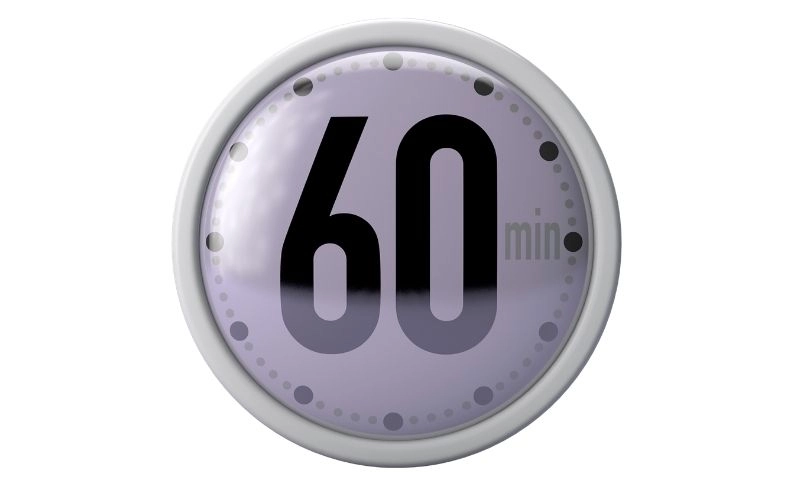
A minute has 60 seconds and an hour has 60 minutes because modern timekeeping inherited an old mathematical system that was practical long before mechanical clocks, atomic clocks, or digital screens existed. The number 60 may look arbitrary today, but historically it was one of the most useful numbers for dividing time, angles, and cycles into smaller parts.
This system did not survive because it was simple in the modern decimal sense. It survived because it was flexible. Sixty can be divided evenly by many numbers, which made it useful for astronomy, calendars, trade, measurement, and later clockmaking. Once that structure became embedded in how people measured the sky and divided the day, it became difficult to replace.
That is why our clocks still use a system that feels ancient and modern at the same time. The screen may be digital, the time signal may come from atomic clocks, but the basic pattern of 60 seconds and 60 minutes reaches back to older ways of organizing the sky.
The Number 60 Was Useful Before Clocks Existed
The historical root is the sexagesimal system, a base-60 way of counting associated with ancient Mesopotamian mathematics, especially Babylonian astronomy. Instead of organizing numbers around 10 as decimal systems do, this system made 60 a central unit for calculation and division.
Sixty is unusually convenient because it has many divisors. It can be divided evenly by 2, 3, 4, 5, 6, 10, 12, 15, 20, and 30. That matters when people need to split a whole into halves, thirds, quarters, fifths, sixths, or twelfths without producing awkward fractions.
For ancient astronomers and mathematicians, this flexibility mattered. The sky is full of cycles: sunrise and sunset, lunar phases, seasons, planetary motion, and the apparent movement of stars. Dividing those cycles into workable parts required a number system that handled fractions well.
This is why the story is not only about clocks. It is about the older problem of turning continuous motion into usable units. That same problem appears in why time is divided into hours, minutes, and seconds: time itself flows continuously, but human life needs repeatable divisions.
The 60-minute hour survived because it solved a practical problem: it divided time into many useful parts without forcing people into awkward fractions. worldtimedata
How Astronomy Helped Preserve the 60-Based System
The connection between 60 and time became stronger through astronomy. Ancient observers did not have modern instruments, but they were careful sky watchers. They tracked repeated patterns in the Sun, Moon, planets, and stars because those patterns mattered for agriculture, calendars, religion, navigation, and political authority.
Babylonian astronomers used base-60 mathematics to describe and calculate celestial motion. Over time, this way of dividing cycles influenced how people measured angles as well as time. The circle became divided into 360 degrees, a number closely connected with base-60 thinking and convenient for astronomical measurement.
That connection still exists today. A circle has 360 degrees, each degree can be divided into 60 arcminutes, and each arcminute into 60 arcseconds. Time keeps a similar pattern: an hour is divided into 60 minutes, and a minute into 60 seconds. The words are different, but the structure is related.
This matters because early timekeeping was deeply tied to the sky. Before precise clocks, the day was understood through the Sun’s movement, shadows, daylight, and night. Measuring time was partly a matter of measuring celestial position. A system that worked for astronomy could also work for time.
There is also a language clue. The word “minute” comes from the idea of a small part, and “second” comes from a second smaller division. In older mathematical language, the first small division of an hour was the minute, and the second small division was the second. The names reflect hierarchy: smaller and then smaller again.
Why We Did Not Switch to 100 Minutes and 100 Seconds
From a modern point of view, a decimal clock can seem more logical. If meters, kilograms, and many scientific measurements are decimal, why not make time decimal too? One hour could have 100 minutes, and one minute could have 100 seconds. The arithmetic would look cleaner.
The problem is that time is not only arithmetic. It is infrastructure, habit, astronomy, navigation, scheduling, law, technology, and culture. By the time modern decimal systems became powerful, the 24-hour day, 60-minute hour, and 60-second minute were already deeply embedded in clocks, calendars, navigation tables, religious schedules, public life, and later global communication.
Decimal time has been proposed and even briefly used in history, but it never replaced the older system in daily life. The reason is not that decimal time is impossible. The reason is that replacing time units would force society to rebuild too many connected systems for too little practical benefit.
Base 10 is convenient for counting with human hands. Base 60 is convenient for dividing a cycle into many useful parts. Timekeeping kept the older structure because daily time is built around repeated cycles, not just clean arithmetic.
This is also why time is different from many other measurements. A kilometer can be treated as a decimal distance without changing the structure of the day. But changing the hour or minute would affect clocks, schedules, transport, software, legal deadlines, markets, broadcasts, and ordinary habits at the same time.
How an Ancient Division Still Fits Modern Time
The important shift is that the modern definition of the second no longer depends on Babylonian mathematics or the movement of the Sun across the sky. Today, the SI second is defined using the frequency of radiation associated with the caesium-133 atom. Atomic clocks count an extremely stable physical process, which allows modern timekeeping to be far more precise than solar observation alone.
That creates an important distinction. Historically, seconds were subdivisions of larger astronomical cycles. In modern science, the second is the base unit, and minutes and hours are built from it. One minute is 60 seconds, and one hour is 3,600 seconds.
This is where old structure and modern precision meet. We still use inherited units from ancient time division, but we measure the smallest unit with atomic physics. The result is a system that looks historical on the clock face and scientific inside the time standard.
You can see that transition clearly in how atomic clocks measure time. Modern time is not kept by watching the Sun move across the sky. It is maintained by counting stable atomic oscillations and using those counts to define seconds with extraordinary precision.
That does not make the old 60-based structure obsolete. It only changes what supports it. The hour and minute remain familiar social units, while the second becomes the scientific anchor underneath them.
The Real Reason 60 Seconds and 60 Minutes Survived
The 60-second minute and 60-minute hour survived because base-60 mathematics moved from calculation into astronomy, from astronomy into timekeeping, and from timekeeping into daily infrastructure. The system was useful, widely adopted, and eventually too deeply connected to daily life to replace easily.
Its survival is not an accident. Sixty works well because it divides cleanly into many useful parts. It connects naturally with circular measurement. It helped astronomers describe motion in the sky. Later, mechanical clocks, public schedules, navigation, science, and global time standards reinforced the same structure.
That is why the modern clock is not purely modern. It carries layers of older mathematics inside it. Every time a digital display moves from 12:59 to 1:00, it is using a structure inherited from ancient attempts to divide the sky into numbers humans could work with.
The second is now defined with atomic precision, but the minute and hour still preserve a very old idea: time becomes useful when continuous motion can be divided into parts that people can count, share, and repeat.