On most nights of the year, the Moon rises roughly 50 minutes later than it did the night before. Around the Harvest Moon, that gap collapses to as little as 10 minutes in parts of the UK and Canada, and rarely more than 30 minutes across the northern United States. A Harvest Moon is simply the full Moon that falls closest to the autumnal equinox, but the reason it seems to rise on schedule for several nights straight has nothing to do with the Moon speeding up, growing bigger, or changing color. It comes down to the angle the Moon’s orbital path makes with the horizon at that specific point in the year, and that angle is the entire trick.
What a Harvest Moon Actually Is
A Harvest Moon is the full Moon nearest the September equinox and solstice cycle, falling around September 22 or 23 each year. In 2025 that Moon peaked at 11:47 p.m. Eastern time on October 6, and in 2026 it peaks at 12:49 p.m. Eastern time on September 26, four days after that year’s equinox on September 22. The Moon reaches its exact full phase at the same instant everywhere on Earth, so only the local clock reading changes by time zone, not the moment itself.
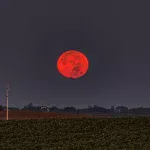
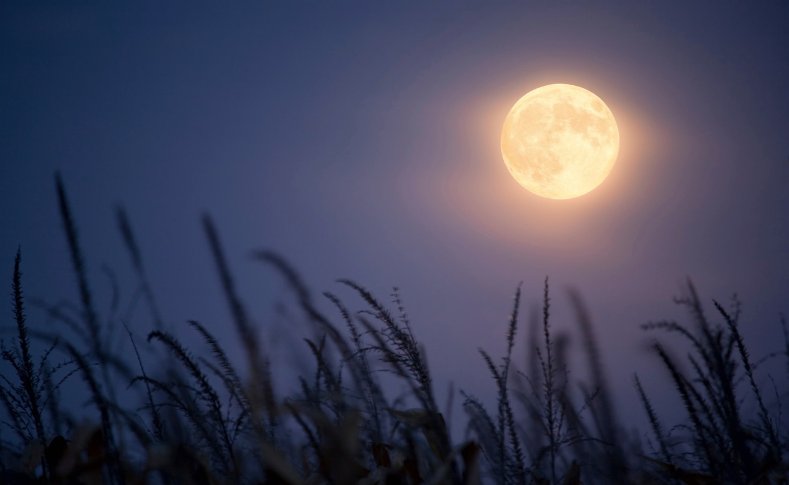
Physically, a Harvest Moon looks like any other full Moon. It is not larger, and any orange or amber tint comes from the same atmospheric scattering that colors a sunset, made more noticeable because the Moon sits low on the horizon for longer than usual, an effect closely tied to the moon illusion people notice on any low-hanging full Moon. What actually sets the Harvest Moon apart is timing, not appearance.
The Real Mechanics: Why the Moonrise Delay Collapses Near the Equinox
Every 24 hours, the Moon shifts roughly 12 degrees eastward against the background stars, a product of its own orbit within the broader lunar cycle combined with Earth’s rotation. Under most conditions, the Earth has to spin an extra stretch to catch up with that shift before the Moon clears the horizon again, adding close to 50 minutes to each night’s moonrise. Near the autumnal equinox, the section of sky the full Moon travels through makes an unusually shallow angle with the eastern horizon. Picture the Moon’s nightly path as a ramp: in spring that ramp climbs steeply away from the horizon, so each night’s 12-degree shift carries the Moon substantially higher before it appears, stretching out the delay. In autumn the ramp lies almost flat, so that same 12-degree shift barely changes the Moon’s height above the horizon, and it climbs into view only slightly later each evening.
Twelve degrees of eastward shift, multiplied by four minutes per degree, produces the familiar 50-minute average delay quoted for most of the year. Near the equinox that same 12-degree shift is reoriented, running more parallel to the horizon than perpendicular to it, so its effect on rise time shrinks even though the underlying orbital motion has not changed at all.
| Location | Typical delay per night around the Harvest Moon |
|---|---|
| Edinburgh, UK | About 10 minutes |
| New York City, US | About 25 minutes |
| 42°N latitude (Chicago, Boston) | As little as 23 minutes |
| Canberra, Australia (spring, opposite season) | About 58 minutes, wider than average |
The Canberra figure is a useful check on the whole idea. Canberra sits at 35.3 degrees south latitude, and in late September it is heading into spring, not autumn, so the shallow-angle effect that compresses moonrise times in the Northern Hemisphere is working in reverse there, and the gap between moonrises actually runs wider than the yearly average. The mechanism is tied to the angle of the ecliptic at a given time of year for a given hemisphere, not to any universal property of September itself.
When the Harvest Moon Isn’t in September
Because a Harvest Moon is defined by its distance from the equinox rather than by the calendar, it does not always land in September. Roughly once every three years, the September full Moon falls early enough in the month that the following full Moon in October ends up closer to the equinox and inherits the name instead, pushing the “Corn Moon” title back onto September’s Moon that year. Research using Jean Meeus’s astronomical tables, which calculate equinox and full Moon timing from 1970 through 2050, found that an October Harvest Moon occurs 17 times across those 80 years, though the actual gap between occurrences varies considerably: sometimes just three years apart, as in 2017 and 2020, and sometimes as long as eight years, as between 2020 and the next one expected in 2028. The earliest a Harvest Moon can fall is September 8, and the latest is October 7, a 29-day window that covers every possible date the name can attach to.
Some of those October years carry a second quirk. When October ends up hosting two full Moons, the earlier one takes the Harvest Moon title and the later one, arriving near Halloween, gets labeled a blue moon instead, stacking two unrelated full Moon traditions into a single month.
The Word’s Own History
The phrase “harvest moon” entered English recorded use in the early 1700s, with etymological dictionaries placing the first citation between 1704 and 1706, defined from the start as the full Moon occurring within roughly two weeks of the autumnal equinox. That predates the word’s common pairing today with “Corn Moon,” the name usually given to a September full Moon in years when the Harvest Moon designation slides into October instead. The two names describe the same lunar event on the calendar, but only one of them, in a given year, actually earns the “Harvest” label under the equinox rule.
Where the “Native American Names” Story Actually Comes From
Almanacs routinely attribute Harvest Moon and its monthly siblings, Wolf Moon, Strawberry Moon, Sturgeon Moon, and so on, to Algonquin tribal tradition stretching from New England to Lake Superior. The names themselves are genuinely old and reflect real seasonal markers used by Algonquian-speaking peoples, but the specific, standardized list printed in almanacs today has a much more recent and traceable publishing history than the framing usually suggests. The Maine Farmers’ Almanac appears to be the first almanac to print a fixed set of “Indian” full Moon names, doing so in the 1930s. An earlier and quite different list turns up in 1918, in Daniel Carter Beard’s The American Boy’s Book of Signs, Signals and Symbols, written for the Boy Scouts, where January was labeled “Difficulty, Black Smoke” and September was “Wild Rice, Red Plum,” names that bear no resemblance to the “Wolf Moon” and “Harvest Moon” labels in circulation now.
The 1918 Boy Scout version of these names and the modern almanac version barely overlap, which means the tidy monthly list handed out every year is less a single unbroken tradition than a 20th-century compilation that settled into its current form only after passing through at least two very different published sources. worldtimedata
Comparing tribal sources directly shows the same instability. Ojibwe naming for the same lunar months differs meaningfully from the Algonquin list most almanacs print, calling September’s Moon the “Leaves Turning Moon” rather than “Corn Moon,” and January the “Great Spirit Moon” rather than “Wolf Moon.” Naming practices varied by tribe, location, and which seasonal marker mattered most locally, which is consistent with oral tradition but sits awkwardly with the single authoritative-sounding table most calendars now reprint every year without noting any of that variation.
The Far North Paradox: Where the Moon Rises Earlier Each Night
The shallow-angle effect gets stranger the farther north an observer stands. Near the Arctic Circle, at roughly 66.7 degrees north latitude, the Moon rises at almost exactly the same clock time on successive nights around the Harvest Moon, the compression effect taken to its logical extreme. Push further north still, and the pattern flips entirely. At Resolute Bay, Nunavut, at 74.7 degrees north, moonrise around the Harvest Moon period has been recorded arriving progressively earlier each night rather than later, roughly 35 minutes earlier on average across successive evenings. At that latitude the geometry that normally delays each night’s moonrise reverses sign, and the Moon appears to rush the clock instead of lagging behind it.
Harvest Moon vs. Supermoon: Two Different Things That Sometimes Collide
A Harvest Moon and a supermoon describe two unrelated properties of the same object, one about timing relative to the equinox and one about the Moon’s distance from Earth in its elliptical orbit, and confusing them is common. A supermoon occurs when a full Moon coincides closely with perigee, the closest point in the Moon’s orbit, making it appear up to roughly 14 percent larger and about 30 percent brighter than a full Moon at apogee, the farthest point. A Harvest Moon carries no such requirement. Most years it is an entirely ordinary-distance full Moon that simply happens to fall near the equinox. Occasionally the two labels do overlap, producing what gets called a “Super Harvest Moon,” most recently discussed around the 2024 full Moon, but a Harvest Moon can just as easily be small, distant, and unremarkable in size while still displaying the short-delay rising pattern that defines it.
How Rare Alignments Actually Get
The Harvest Moon’s closeness to the equinox varies year to year, sometimes landing within hours of the equinox moment itself and sometimes drifting nearly two weeks away from it. A true coincidence, a full Moon occurring on the very night of the autumnal equinox, is uncommon enough that the last time it happened was 2010, and by most calculations of lunar and equinox cycles it will not recur until 2029. That 19-year gap is not arbitrary. It traces back to the Metonic cycle, a roughly 19-year period after which the phases of the Moon repeat on nearly the same calendar dates, first documented by the Greek astronomer Meton of Athens in the 5th century BC and still the reason why the earliest possible Harvest Moon date, September 8, has recurred in exactly the years 1972, 1995, 2014, and 2033, each separated by that same 19-year interval.