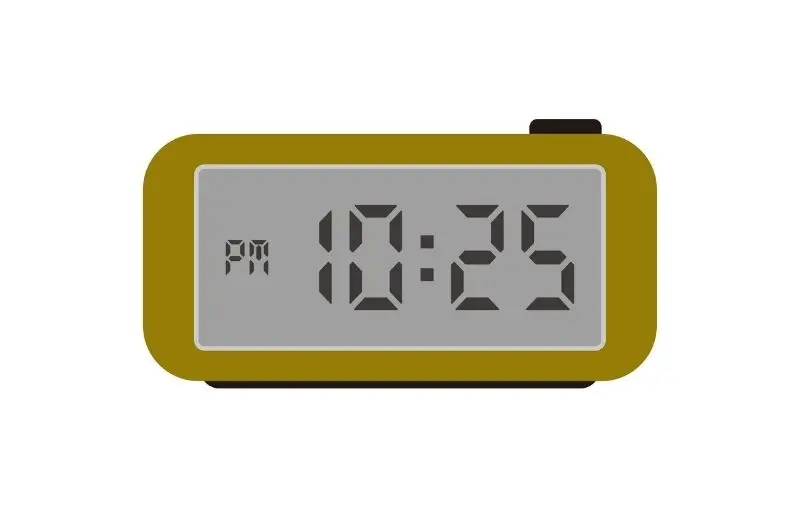
AM and PM are used in the 12-hour time format to divide the day into two distinct periods. They provide context for interpreting hours that repeat within a 24-hour cycle.
Without this distinction, a time like 08:00 would be ambiguous. It could refer to morning or evening. AM and PM resolve this by linking the value to a specific part of the day.
What AM and PM stand for
AM and PM come from Latin:
- AM – ante meridiem (before midday)
- PM – post meridiem (after midday)
The reference point is the meridian, the moment when the Sun reaches its highest position in the sky at a given location. This moment defines local solar noon.
This definition is not arbitrary. It is based on astronomical observation. The meridian represents a real physical alignment between the observer, Earth’s rotation, and the position of the Sun.
However, in modern systems, “noon” is no longer tied exactly to the Sun. Due to time zones and standardization, clock noon (12:00) can differ from true solar noon depending on location.
Despite this shift, AM and PM still follow the original logic: they divide the day relative to a central reference point.
AM covers the period from midnight up to noon. PM covers the period from noon to the next midnight.
How the 12-hour format works
The 12-hour clock divides the day into two cycles of 12 hours each. Instead of counting continuously from 0 to 23, it repeats the range from 1 to 12.
This repetition reflects an older approach to timekeeping, where the day was perceived as two separate phases rather than a single continuous interval.
In practical terms, each hour value must be paired with AM or PM to form a complete time expression. Without this context, the value is incomplete.
This creates the following mapping:
- 12:00 AM → midnight
- 01:00 AM → early morning
- 11:59 AM → just before noon
- 12:00 PM → noon
- 01:00 PM → afternoon
- 11:59 PM → just before midnight
The structure is easy to read but not symmetrical. The cycle does not start at zero, and the transition at 12 introduces a boundary condition that must be interpreted correctly.
From a system perspective, this format requires an additional layer of context. The hour alone is not sufficient. The AM/PM marker becomes part of the value rather than a simple label.
This is why the 12-hour format is convenient for human interaction but less suitable for precise processing, where a continuous scale is preferred.
Why 12:00 AM and 12:00 PM cause confusion
The labels AM and PM are defined relative to noon, but the transition point itself creates a logical edge case.
At exactly 12:00, the system switches from one 12-hour cycle to the other. This moment is neither clearly “before” nor “after” in intuitive terms, which leads to ambiguity.
- 12:00 AM is midnight, the start of a new day
- 12:00 PM is noon, the midpoint of the day
The confusion comes from the structure of the scale. The 12-hour format does not include a zero point and begins its cycle at 12, which breaks the expectation of a linear sequence.
As a result, the boundary between the two halves of the day cannot be expressed in a way that is both logically consistent and intuitive at the same time.
For this reason, many technical systems avoid using AM/PM at these exact values. Instead, they rely on unambiguous representations such as 00:00 for midnight and 12:00 for noon.
AM and PM vs the 24-hour format
The 24-hour system uses a continuous numerical range from 00:00 to 23:59. Each value appears only once, which removes the need for additional context.
This structure aligns with how time is processed in most systems. Values can be stored, compared, and sorted without interpretation.
For example:
- 08:00 → morning
- 20:00 → evening
In the 12-hour format, these become 08:00 AM and 08:00 PM, requiring an additional marker to define meaning.
This difference is not only about readability. It reflects two different approaches:
- the 12-hour format prioritizes human interpretation
- the 24-hour format prioritizes consistency and precision
This is why the 24-hour format is used in environments where ambiguity is unacceptable, including transport schedules, aviation systems, databases, and server infrastructure.
In these contexts, time must function as a precise value, not a value that depends on interpretation.
Where AM and PM are used
The 12-hour format with AM and PM is primarily used in everyday contexts, especially in regions where it has been historically established.
- United States and Canada
- parts of the United Kingdom
- consumer-facing interfaces
Its main advantage is readability. People tend to associate values like 7:00 AM or 8:00 PM with daily routines rather than with abstract time scales.
However, this convenience comes at the cost of precision. The format requires an additional marker and depends on correct interpretation, which makes it less reliable in structured environments.
For this reason, many systems internally use a 24-hour or UTC-based representation and convert to AM/PM only at the display layer.
Common mistakes and how to avoid them
The main issue with the 12-hour format is not the system itself, but how it is interpreted. Most errors occur at boundary values and during conversion to the 24-hour format.
The most frequent mistakes include:
- confusing 12:00 AM (midnight) with 12:00 PM (noon)
- converting 12 AM to 12:00 instead of 00:00
- omitting the AM/PM indicator when communicating time
These errors arise because the 12-hour format is not linear. It starts at 12 rather than 0, which conflicts with the structure used in most technical systems.
A simple rule helps avoid confusion: in the 24-hour system, the day starts at 00:00, not 12.
Another practical guideline is to avoid using 12:00 AM and 12:00 PM in critical contexts. Instead, use:
- 00:00 for midnight
- 12:00 for noon
This removes the need for interpretation and eliminates a common source of errors.
| 12-hour format | 24-hour format | Meaning |
|---|---|---|
| 12:00 AM | 00:00 | Midnight |
| 01:00 AM | 01:00 | Early morning |
| 12:00 PM | 12:00 | Noon |
| 01:00 PM | 13:00 | Afternoon |
| 11:00 PM | 23:00 | Late evening |
In systems where precision matters, such as transport schedules or server infrastructure, the 24-hour format is used exclusively. It removes ambiguity and ensures consistent interpretation.
In these environments, time must behave as a single unambiguous value. Any format that depends on context increases the risk of errors and is therefore avoided.
What this means in practice
AM and PM do not change the underlying value of time. They only provide context for interpreting a value that would otherwise be incomplete.
In modern systems, time is never stored in the 12-hour format. Instead, it is represented internally using a continuous 24-hour scale or a UTC-based timestamp.
When a system displays time, it converts this internal value into a format suitable for the user. The AM/PM notation is applied only at this final stage.
This separation is essential. It allows systems to maintain a single, unambiguous representation while still offering a familiar format at the interface level.
From a technical perspective, AM and PM are not part of time measurement. They are part of the presentation layer, similar to language, date format, or regional settings.
This is why time can be reliably stored, compared, and transmitted across different systems without ambiguity, even if it is displayed differently to users.
The practical implication is simple: the value of time remains constant, while its representation can change depending on context.
AM and PM do not define time. They define how time is displayed.
worldtimedata