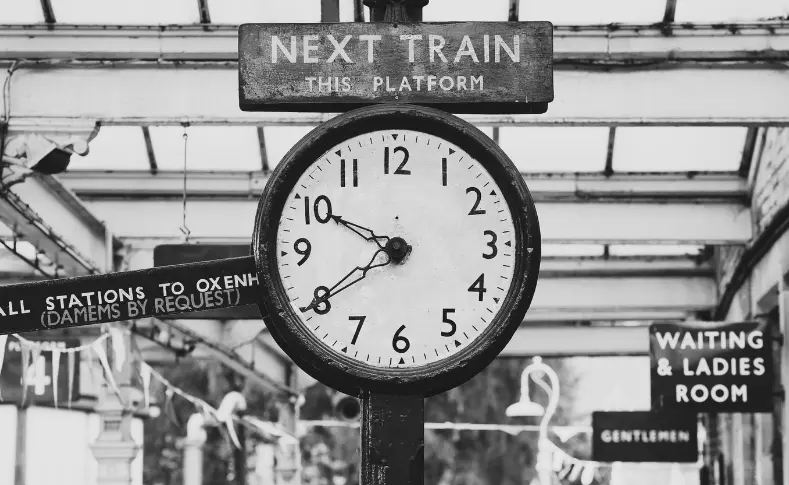
Before November 18, 1883, “what time is it” didn’t have one correct answer, even within a single American state. A conductor’s pocket watch, the clock on a station twelve miles down the line, and the time kept by the church steeple in the next town over could all legitimately disagree with each other, and none of them were wrong. Every one of them was keeping honest local time. The problem wasn’t that anyone had made a mistake. The problem was that hundreds of honest, correct, mutually contradictory clocks were about to try to share a train schedule, and it took a private industry group, not any government, to fix it in a single coordinated afternoon.
A Question With Hundreds of Different Answers
For most of the nineteenth century, a town’s official time was whatever a well-known local clock said it was, usually calibrated by a jeweler or astronomer to the moment the sun reached its highest point directly overhead that specific town. That moment shifts continuously with longitude, which meant two towns barely a dozen miles apart, east to west, could sit roughly a minute off from each other, and towns separated by a few hundred miles could differ by twenty minutes or more. Estimates of exactly how fragmented this got vary by source, but the scale wasn’t in dispute: one commonly cited count puts the number of distinct local times in use across North America above 144, while railroad companies specifically, each often keeping its own operating time based on its home city, ran on somewhere between roughly 50 and 100 separate standards of their own. A traveler changing trains at a major junction like Chicago could reportedly find half a dozen different “official” times posted on clocks inside the same station, each one correct according to a different railroad.
Why This Was Fine, Until Suddenly It Wasn’t
None of this mattered much before railroads, because nothing moved fast enough to make it matter. Local solar time had been the default method of tracking the day for most of human history, and a horse-drawn carriage simply couldn’t cross enough longitude in a single day for a few minutes of drift to cause real trouble. Trains changed the arithmetic entirely. A passenger boarding in Boston with a watch set to Boston time might check it against the station clock in Providence and find it already wrong by a couple of minutes, wrong again by New Haven, and by the time the train reached New York, have passed through four or five towns worth of quietly disagreeing versions of the same afternoon. For an individual traveler, that was mostly an annoyance. For a railroad dispatcher trying to keep two trains from occupying the same stretch of single track at the same moment, it was a genuine operational hazard, and missed connections and outright collisions were both attributed to the confusion.
The Men Who Tried, and the One Who Succeeded
Standard time wasn’t William F. Allen’s idea originally. Charles F. Dowd had been pushing a version of it since 1863, refining a pamphlet through 1870 and 1872 that proposed dividing the country into a handful of time belts, first based on the Washington meridian, later revised to Greenwich. None of it was adopted. Around the same period, Canadian railway engineer Sandford Fleming was independently building the case for a worldwide standard, and meteorologist Cleveland Abbe added his own institutional weight in 1879 with a formal report that helped push American railroad companies toward taking the idea seriously at all. What none of these men had was a direct line to the people who actually ran the railroads.
Allen did. As secretary of the General Time Convention, the railroad industry’s own coordinating body, and editor of the Traveler’s Official Railway Guide, he had spent years immersed in the actual, granular mess of conflicting schedules. Commissioned in 1881 to devise something workable, he synthesized Dowd’s, Fleming’s, and Abbe’s ideas into a plan built around practical negotiation rather than theoretical elegance, one designed to ask railroad operators to give up as little as possible while gaining the most.
Dowd had the right idea twenty years earlier. What he didn’t have was Allen’s talent for asking railroad men to give up almost nothing to get almost everything. worldtimedata
The Day of Two Noons
Allen presented his plan to the General Time Convention on October 11, 1883, at the Grand Pacific Hotel in Chicago, proposing four time zones, later expanded conceptually to five to account for parts of Canada, each anchored to a standard meridian fifteen degrees apart, an hour’s worth of longitude. The railroad officials in the room adopted it overwhelmingly, and the date was set: noon on Sunday, November 18, 1883.
That morning, as the new standard time reached each meridian in sequence, station clocks across the country were reset to match, and in towns where the shift ran backward, noon effectively arrived twice, once by the old local reckoning and once by the new standard, giving the day its lasting nickname, the Day of Two Noons. The synchronization itself ran over telegraph wire: a precise time signal, tied to the Allegheny Observatory’s own astronomical measurements, was transmitted out along the lines at the moment each standard meridian’s noon arrived, letting station agents across enormous distances reset their clocks against the same instant rather than trusting their own local calculation. The new arrangement was informally known for a while as Railroad and Telegraph Time, a name that credited both halves of what actually made the coordination possible. Public reaction to the change itself split. Railroads themselves adopted the change with what observers at the time called near-seamless coordination. Ordinary residents were less charmed; an Indianapolis newspaper’s condemnation of the whole idea has survived because it was simply too vivid to forget, warning that “people will have to marry by railroad time and die by railroad time,” as if the clock itself had usurped something that belonged to nature.
A Law Thirty-Five Years Later
What’s easy to miss in the story is that nothing about November 18, 1883, was law. The General Time Convention was a private association of railroad companies coordinating their own schedules, with no more legal authority to bind the rest of the country than any other industry group. Cities and states were free to keep local time if they wanted to, and some did, for years. Detroit refused standard time outright until 1900, briefly tried Central time afterward, switched its clocks more than half a dozen times over the next two decades, and only settled the question by popular vote in 1916, finally landing on Eastern time. The following year, the United States entered the First World War, and wartime coordination needs finally pushed Congress to act. The Standard Time Act, passed March 19, 1918, made the railroads’ 1883 arrangement into actual federal law, thirty-five years after the industry had already been running on it voluntarily, and handed regulatory authority over the zone boundaries to the Interstate Commerce Commission.
The international side of the story moved on its own track. In October 1884, at the request of President Chester A. Arthur, delegates gathered in Washington for the International Meridian Conference and settled a related but separate question: which meridian would serve as the zero point, the prime meridian, for a worldwide time system. The conference chose Greenwich, building directly on Fleming’s broader advocacy, and sketched out a conceptual 24-zone global framework that individual countries would spend the following decades adopting at their own pace, entirely independent of whatever the American railroads had already worked out for themselves the year before.
An Industry Standard Everyone Assumes Was Always Official
Almost nothing about how time zones actually work today required a government to invent it. A group of railroad executives, meeting in a Chicago hotel, solved a scheduling problem that was costing them money and occasionally costing lives, and the rest of the country eventually organized itself around their solution because there was no serious alternative left standing. The law caught up decades later, quietly ratifying an arrangement that had already become invisible through sheer familiarity. Most people who check the time on a phone today have no reason to know that the boundaries determining what that number reads were drawn not by scientists or lawmakers, but by an industry association trying to stop its own trains from running into each other.