Before mechanical clocks, people measured time by watching change. They followed the Sun’s movement, the length of shadows, the phases of the Moon, the rising of stars, the flow of water, the burning of candles, and the rhythm of daily life. Time was not something displayed on a screen. It was something read from the world.
This kind of timekeeping was not primitive in the sense of being careless. It was practical. People needed to know when to plant and harvest, when to pray or hold ceremonies, when to travel, when to open markets, and when night would return. The tools were different, but the problem was the same: turning continuous change into usable divisions.
That is the core idea behind what time means as a measurement. Time becomes useful when people can compare one moment with another, estimate duration, and coordinate action. Early societies did this long before precise clocks existed.
The Sky Was the First Timekeeper
The earliest and most universal timekeeper was the sky. The Sun gave people the day. Its height, direction, and shadow length showed whether it was morning, noon, or evening. The Moon gave a visible cycle that helped track longer periods. Stars and constellations helped mark seasons and guide agricultural or religious calendars.
This was not exact time in the modern sense. It did not tell someone that it was 9:42 AM, but it gave daily life a reliable structure. Sunrise could begin work. Midday could divide the day. Sunset could end travel. The changing length of daylight could signal seasonal movement.
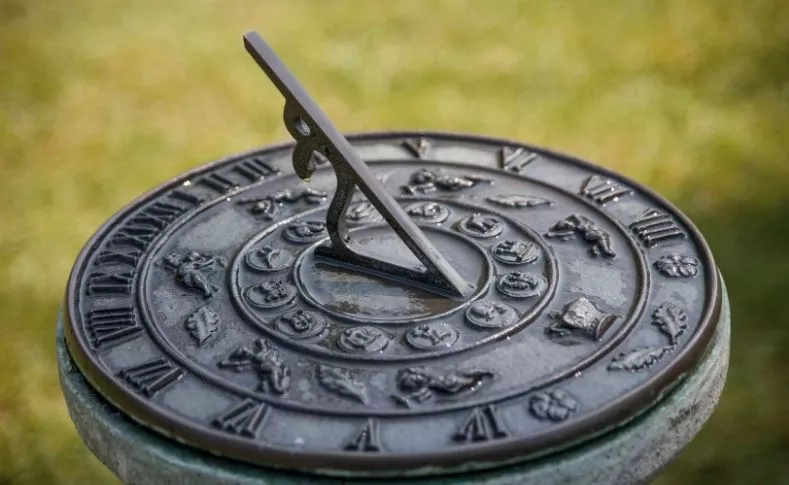
Shadow-based timekeeping turned this natural observation into a tool. A stick, pillar, obelisk, or marked surface could show time by the movement of a shadow. As the Sun moved across the sky, the shadow changed direction and length. This made it possible to divide daylight into parts and compare one part of the day with another.
Sundials later refined this idea. They worked because the Sun’s apparent motion across the sky follows a predictable pattern, but they also had limits. They depended on clear daylight, location, season, and correct alignment. A sundial could organize the daytime world, but it could not measure time at night or indoors.
Before clocks measured time mechanically, people measured it by reading patterns in nature: shadows, water, fire, stars, and repeated cycles. worldtimedata
How People Measured Time When the Sun Was Not Enough
The Sun was the most important natural timekeeper, but it was not always available. Clouds, night, indoor work, legal proceedings, religious rituals, and controlled tasks required other methods. This is where water clocks, candle clocks, incense clocks, and hourglasses became important.
Water clocks measured time by the controlled movement of water into or out of a container. They were among the earliest timekeeping devices that did not depend directly on observing the sky. A marked vessel could show how much time had passed as water rose or fell. This made them useful at night, indoors, and in settings where a specific duration mattered.
They were not perfect. Water flow could change with pressure, temperature, vessel shape, and design. But the principle was powerful: instead of asking where the Sun was, a water clock measured an interval. That shift matters because it moved timekeeping from observing position to measuring duration.
Candle clocks and incense clocks worked in a similar conceptual way. A candle marked with divisions could show elapsed time as it burned down. Incense clocks used the burning of incense to measure duration, sometimes with scents or markers that indicated the passage of set periods. These methods were especially useful where fire or ritual already had a cultural role.
Hourglasses used falling sand instead of water or flame. They were good for measuring fixed intervals, such as a task, a watch period, or a turn in a process. But an hourglass did not tell the time of day by itself. It measured how much time passed after it was turned over.
This distinction is important. A sundial helps answer “what part of the day is it?” A water clock or hourglass helps answer “how much time has passed?” Modern timekeeping needs both ideas: position in a day and measured duration. That is also why time is divided into hours, minutes, and seconds: people needed smaller units to organize changing conditions into repeatable measures.
Why Ancient Time Was Local and Uneven
Before mechanical clocks and standard time zones, time was usually local. Noon was connected to the Sun’s highest point in the local sky. That meant one town’s noon could differ from another town’s noon. For most of human history, this was not a major problem because travel and communication were slow.
Early hours were also not always equal in the way modern hours are equal. In some systems, daylight was divided into a set number of parts, and nighttime was divided separately. That meant a daytime hour could be longer in summer and shorter in winter. The hour was a social and astronomical division, not yet a fixed 3,600-second unit in everyday life.
This may sound strange now, but it made sense in a world organized around daylight. Work, travel, farming, and public activity depended more on the usable portion of the day than on equal abstract units. A summer day simply had more workable light than a winter day, so the lived experience of time changed with the season.
The move toward equal hours required better instruments and a different relationship to time. Mechanical clocks helped make hours uniform. Later, railways, factories, telegraphs, and global communication made local solar time less practical. But before that shift, time was not expected to be identical everywhere.
What Changed When Clocks Became Precise
The great change was not simply that clocks were invented. The deeper change was that time became detached from immediate natural signs. Instead of looking at the Sun, people could look at a device. Instead of estimating duration from water, fire, or shadow, they could rely on a mechanism that divided time more consistently.
Mechanical clocks made time more portable, more public, and more enforceable. Town clocks, church clocks, and later household clocks gave communities a shared reference. Work, prayer, markets, transport, and administration could be coordinated with increasing precision.
Modern timekeeping has gone much further. Today, the second is not defined by shadows, water, or candle marks. It is defined by atomic physics. Atomic clocks measure extremely stable oscillations of atoms, allowing time to be kept with a level of precision that ancient timekeepers could not have imagined.
That modern precision is explained in how atomic clocks measure time. But the basic goal is still familiar: to create a reliable way of comparing moments and measuring duration. The tools changed from sky and shadow to atoms and signals. The human need did not disappear.
The Oldest Timekeepers Were Patterns
People measured time before clocks by reading patterns in the natural world and turning those patterns into practical tools. The Sun gave the day. Shadows divided daylight. The Moon and stars helped track longer cycles. Water, fire, incense, and sand made it possible to measure intervals when the sky was not enough.
These methods were limited, but they were not random. They were built around repeatable change. That is the foundation of all timekeeping. A clock is useful because something changes in a regular way, whether that change is the movement of a shadow, the fall of water, the swing of a pendulum, the vibration of quartz, or the oscillation of atoms.
The history of timekeeping is therefore not a story of replacing nature with machines. It is a story of making natural patterns more precise, portable, and shared. Long before clocks, people were already doing the essential work of timekeeping: watching change, finding rhythm, and giving it a number.