Nepal runs on a clock that exists nowhere else in the world as an official national standard: not a half hour off UTC, not a full hour, but a quarter hour, UTC+5:45, precise enough that most of the planet has to do a small mental adjustment just to know what time it currently is in Kathmandu. It isn’t a rounding quirk left over from imprecise measurement. It’s the end result of a specific 1986 decision, stacked on top of decades of quieter history, that turned an odd number into a genuine statement about who gets to decide what time a country keeps.
Before There Was a Time Zone at All
Kathmandu had a precise local time long before it had a standardized one. Calculated from the city’s own position, local mean solar time worked out to 5 hours, 41 minutes, and 16 seconds ahead of UTC, accurate to the second but useless for coordinating with anyone outside the valley. In 1920, Nepal gave that up in favor of practicality, adopting Indian Standard Time, UTC+5:30, matching the much larger neighbor it depended on for trade, administration, and virtually every cross-border transaction of the era. Half-hour offsets like India’s already broke from the clean hourly pattern most of the world followed; Nepal, for the next several decades, simply borrowed that same break rather than inventing its own.
The Mountain That Sets Nepal’s Clock
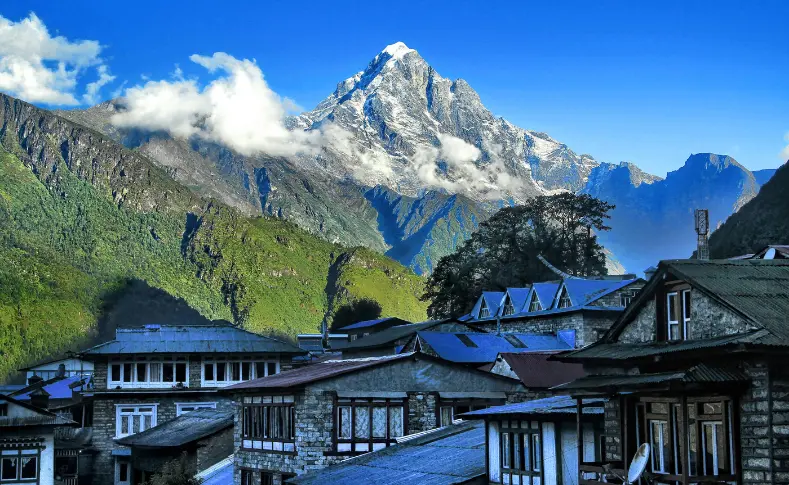
That changed in 1986, when Nepal adopted its own standard, moving the clock forward 15 minutes to UTC+5:45. The new reference meridian sits at 86.25 degrees east, a line that passes close to Gaurishankar, a peak considered sacred in Nepali culture, roughly 100 kilometers east of Kathmandu. The math behind the number is straightforward: divide a meridian’s longitude by 15, the number of degrees Earth rotates through in one hour, and 86.25 divided by 15 comes out to exactly 5.75 hours, or 5 hours and 45 minutes.
86.25°E ÷ 15 = 5.75 hours
0.75 hours × 60 = 45 minutes
Result: UTC+5:45
Nepal is also a genuinely long, narrow country, stretching roughly 850 kilometers east to west across about 8 degrees of longitude, which means a single meridian anywhere in that range is always going to be a compromise for the country’s far eastern and western edges. The Gaurishankar meridian happens to land close enough to the geographic middle that solar noon across much of central Nepal still falls within a few minutes of what the clock calls noon, giving the offset a real astronomical basis on top of whatever symbolism it also carries.
Fifteen Minutes That Say This Isn’t India’s Clock
The symbolism is real too, and it isn’t subtle. Fifteen minutes is a strange amount of distance to put between two neighboring countries’ clocks if the only goal is telling accurate solar time, and Nepal’s own explanations for the shift have never hidden that the gap from India was very much the point. Nepal is one of the few countries in the region never brought under colonial rule, sitting wedged between two vastly larger powers, India and China, and a clock fifteen minutes removed from its southern neighbor’s functions as a small, constant, entirely ordinary reminder that the country still sets its own terms, literally down to the minute, even while depending on India economically in countless other ways.
A country doesn’t need a dramatic time difference to make a point about independence. Nepal proved fifteen minutes is more than enough. worldtimedata
Not Quite Alone, But Almost
Nepal Standard Time is one of only two officially recognized 45-minute offsets used anywhere on Earth, sharing the distinction with New Zealand’s remote Chatham Islands, which run on UTC+12:45. A third pocket of 45-minute time exists only informally: a small Australian community near Eucla unofficially splits the difference between two official Australian zones, but that arrangement has no legal standing anywhere, unlike Nepal’s, which is written into national law and used for every government record, flight schedule, and bank transaction in the country.
| Location | Offset | Official status |
|---|---|---|
| Nepal | UTC+5:45 | National law |
| Chatham Islands, New Zealand | UTC+12:45 | Official regional time |
| Eucla area, Australia | UTC+8:45 | Unofficial local convention |
In the IANA time zone database that underlies nearly every computer and phone on the planet, Nepal’s zone is filed as Asia/Kathmandu, fully supported by every major operating system, though it tends to sit at the bottom of alphabetical time zone lists or inside an “unusual offsets” category, a quiet, permanent reminder in the world’s software that Nepal never agreed to round itself off to the nearest half hour.
Living With a Clock the Rest of the World Has to Convert For
The 15-minute gap from India is small enough to seem trivial and large enough to cause real, recurring friction. Cross-border calls, flights, and business deals between the two countries all require a deliberate conversion that a shared time zone would have made unnecessary, and software built without Nepal specifically in mind sometimes rounds the offset away entirely, defaulting travelers and schedulers to the wrong quarter hour unless someone catches it manually. Nepal’s own tourism industry runs directly into the same issue every day: flights to Lukla for Everest Base Camp treks typically depart Kathmandu in the early morning, and trekking schedules built around Nepal Time have to be explained separately to visitors used to thinking in round numbers, one more small translation layered onto an already complicated logistics chain. Nepal has never observed daylight saving time either, keeping the same UTC+5:45 offset year-round without exception, one less variable in a system that already asks the rest of the world to remember a number nobody else uses.
An Odd Number That Was Never an Accident
Nothing about UTC+5:45 happened by chance. It traces a real meridian near a real mountain, lands close enough to the geographic center of a long, narrow country to make practical sense, and sits exactly fifteen minutes clear of the one neighbor Nepal most wanted its clock to be distinguishable from. Being one of only two officially sanctioned quarter-hour offsets anywhere on the planet costs Nepal a small amount of daily inconvenience with every foreign call and flight schedule. It buys, in exchange, a fact about the country that a full hour or a clean half hour never could have: a time zone specific enough that it could only ever belong to Nepal.