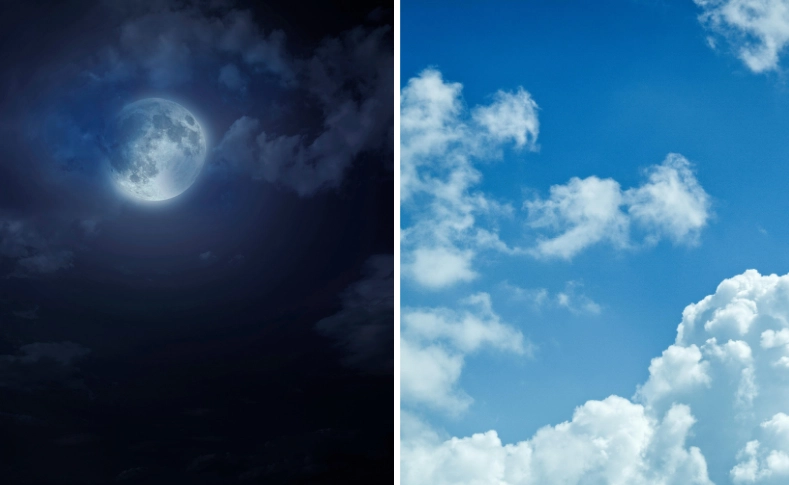
Sunlight is white. Air is, as far as anyone can tell by looking through a window, colorless. And yet every clear afternoon the same 400,000-kilometer column of gas above your head reads as a specific, saturated blue, then goes black within an hour of sunset. The physicist who finally nailed down why did so in 1871, got the mechanism slightly wrong on a technical point, and it took a Nobel Prize winner and then Einstein himself, forty years later, to close the gap completely.
The short version, air molecules scatter blue light more than red light, is true but incomplete enough to mislead. It doesn’t explain why the sky isn’t violet, since violet scatters even more strongly than blue. It doesn’t explain why sunsets turn orange instead of a deeper blue. And it says nothing about why the night sky isn’t simply blue with the brightness turned down, given that stars are scattered across it in every direction, an object of serious debate among astronomers for over 300 years.
What Sunlight Actually Does to a Nitrogen Molecule
Earth’s atmosphere is roughly 78% nitrogen and 21% oxygen, both gases made of molecules far smaller than the wavelength of visible light. When a beam of sunlight hits one of these molecules, the molecule doesn’t just let the light pass by, it absorbs the light’s energy for a fraction of an instant and re-emits it in a new, essentially random direction. This process is called scattering, and its efficiency depends enormously on wavelength.
A clear daytime sky is sunlight that never made it to the ground in a straight line, only the fraction that got knocked sideways by a nitrogen or oxygen molecule and happened to end up heading toward your eye instead of the pavement.
Short wavelengths, the blue and violet end of the visible spectrum, bounce off air molecules far more readily than long wavelengths like red and orange. Look straight overhead on a clear day and you’re seeing sunlight that originated from the Sun, got deflected by a molecule somewhere in the atmospheric column above you, and arrived at your retina from a completely different angle than the Sun itself. Look directly at the Sun’s disk, which isn’t advisable without protection, and the light reaching your eye has traveled in a mostly straight line and looks close to white or yellow, because relatively little of it was scattered out of the beam.
That inverse fourth-power relationship is the whole story in one line. Halve the wavelength and the scattering intensity increases sixteenfold. Blue light, at roughly 470 nanometers, scatters about five times more strongly than red light at roughly 700 nanometers, and violet light, at the very edge of visibility near 400 nanometers, scatters closer to nine times more strongly than red.
Tyndall Found the Clue, Rayleigh Did the Math, Einstein Closed the Case
The trail starts with Irish physicist John Tyndall in 1859. He was trying to purify air for infrared experiments and needed a way to check whether his samples still contained dust. He found that shining an intense beam of light through the air revealed faint blue sparkles wherever tiny particles remained suspended, a phenomenon now called the Tyndall effect. Tyndall correctly guessed that something similar was coloring the sky, but he assumed the scattering came from dust and water droplets, and he couldn’t explain mathematically why blue scattered more than other colors.
British physicist John William Strutt, better known by his title, Lord Rayleigh, picked up the problem in 1871 and published the mathematical formula for scattering intensity versus wavelength, the same inverse fourth-power law used today. In 1899 he extended the theory to show it applied not just to dust and droplets but to individual gas molecules themselves, which mattered because the sky stays reliably blue on perfectly clear, dust-free days, something pure particle-scattering couldn’t fully account for.
The final confirmation came from an unexpected source. In 1911, Einstein worked out the precise formula for how light scatters off individual molecules in a gas, and used the calculation as an independent way to verify Avogadro’s number, the count of molecules in a given quantity of gas. His results matched observation, and that closed a debate that had run for over 50 years: the sky is blue because of scattering by the gas molecules themselves, not primarily dust or water vapor, a common misconception that persists today.
The Question Rayleigh’s Math Couldn’t Fully Answer: Why Not Violet
If violet scatters more strongly than blue, the sky should look violet, not blue. It doesn’t, and three separate factors combine to explain the gap.
| Factor | Effect |
|---|---|
| Solar spectrum | The Sun emits noticeably less violet light than blue light to begin with, so there’s simply less of it available to scatter |
| Human eye sensitivity | The eye’s short-wavelength cone cells respond far more weakly to violet than the medium and long cones respond to blue and green |
| Ozone absorption | The stratospheric ozone layer absorbs a portion of the shortest visible wavelengths before they ever reach the lower atmosphere |
The human eye has three types of cone cells, loosely tuned to red, green, and blue wavelengths, and there’s no dedicated violet receptor. When the eye is hit with a mix of scattered blue and violet light, the brain’s color processing interprets the combination as blue rather than violet, since the blue-sensitive cones are doing most of the signaling. Take a rainbow as proof that violet light really is present in sunlight in meaningful amounts, since a prism separates wavelengths cleanly and violet shows up as a distinct, visible band.
Why the Same Physics Turns Sunsets Orange, Not Deeper Blue
At noon, sunlight travels through roughly the thickness of one atmosphere to reach the ground. At sunrise or sunset, with the Sun sitting near the horizon, the same light has to cut through a slanted path roughly 30 to 40 times longer. Over that much longer path, so much blue and violet light gets scattered away before reaching the observer that what’s left in the direct beam is dominated by the longer wavelengths, reds, oranges, and yellows, that scatter far less efficiently. That’s the same physics behind why red sunsets happen, and why the effect intensifies further with more dust, smoke, or pollution in the air, since larger particles scatter longer wavelengths more effectively than pure Rayleigh scattering does.
The soft, warm light photographers chase during golden hour is a direct, visible consequence of this longer atmospheric path length, not a separate optical phenomenon from the one that colors an ordinary sunset.
Why Night Is Black, Not Just Blue With the Lights Off
The everyday answer is straightforward: at night, there’s no direct sunlight hitting the atmosphere above the observer’s location to be scattered in the first place. Without a light source to scatter, air molecules have nothing to bounce toward your eye, so the sky reads black except for the individual points of starlight and planetlight that reach Earth directly across empty space.
But that raises an older and stranger question, one debated by astronomers since Johannes Kepler in 1610: if the universe contains something on the order of hundreds of billions of galaxies, each with hundreds of billions of stars, shouldn’t every line of sight eventually hit a star, making the entire night sky glow as brightly as a stellar surface? This is known as Olbers’ Paradox, named for German astronomer Heinrich Olbers, who formalized the argument in 1823, though the problem traces back through Halley, Cheseaux, and Kepler before him.
The resolution isn’t that distant starlight fades to nothing, and it isn’t that dust blocks the light either, since dust would eventually absorb enough energy to heat up and glow just as brightly itself. The actual answer is that the universe has a finite age, roughly 13.8 billion years, and it has been expanding for all of that time. Stars have only existed for a fraction of the universe’s history, starting a few hundred million years after the Big Bang, and light from the most distant visible galaxies simply hasn’t had time to reach Earth yet, even traveling at the speed of light for billions of years. The night sky is dark not because there isn’t enough starlight in principle, but because the universe hasn’t been around long enough to fill it in.
Olbers’ paradox gets solved by cosmology, but the visible stars overhead each night are close enough, within our own galaxy mostly, that their light has had plenty of time to arrive. Auroral displays like the northern lights are a good example, light that made the trip in a matter of hours after leaving the Sun.
Venus works the same way at a much shorter distance still, which is part of why it stays the brightest object in the sky after the Moon, its light reflected and reaching Earth in minutes rather than years.
What Astronauts See That You Don’t
Step outside Earth’s atmosphere entirely and the daytime sky problem disappears along with the atmosphere itself. Astronauts on the Moon, or in orbit outside a spacecraft, see a black sky at all times, including in full, blinding sunlight, because there’s no air up there to scatter anything. Without gas molecules to bounce photons around, sunlight travels in an uninterrupted straight line from source to surface, and everywhere off that direct path stays as dark as the vacuum it actually is. It’s a strange effect to witness firsthand: full daylight brightness on the ground, and pure black immediately above it.
Other Worlds Break the Rule in Opposite Directions
Mars offers the cleanest natural experiment for how much atmospheric composition and dust content matter. Mars’ atmosphere is thin, less than 1% the density of Earth’s at the surface, and made mostly of carbon dioxide. If that atmosphere were free of dust, Rayleigh scattering off carbon dioxide molecules would actually produce a pale blue daytime sky, similar in principle to Earth’s. In practice, Mars’ air is almost never free of dust. Fine, iron oxide-rich particles, small enough to stay permanently suspended, dominate the optical behavior of the Martian atmosphere. These particles absorb blue wavelengths and scatter the longer reds and yellows, producing the butterscotch or pinkish-tan daytime sky seen in every color-calibrated image sent back by the Viking and Mars Exploration Rover missions.
Mars inverts Earth’s rule at sunset too. Because the dust particles scatter light differently than gas molecules do, blue light scatters forward more efficiently around the Martian dust, producing a distinct blue glow around the setting Sun, the opposite of Earth’s red sunsets. A planet with a butterscotch daytime sky and blue sunsets is the mirror image of Earth’s blue day and red evening, driven by exactly the same underlying physics applied to a different mix of particles.
| World | Daytime sky color | Cause |
|---|---|---|
| Earth | Blue | Rayleigh scattering off nitrogen and oxygen molecules |
| Mars | Butterscotch / pinkish-tan | Iron oxide dust absorbing blue, scattering red and orange |
| Uranus and Neptune | Cyan-blue | Methane in the atmosphere absorbing red light |
| Titan (Saturn’s moon) | Orange haze | Thick hydrocarbon smog scattering nearly all wavelengths |
| The Moon | Black, even in daylight | No atmosphere to scatter light at all |
The pattern holds across the solar system: an atmosphere’s chemistry and particle content, not its distance from the Sun or the planet’s size, decides the sky’s color. A day on any given world, from Mars’ roughly 24.6-hour rotation to Jupiter’s under 10 hours, defines when that sky color cycles through its version of morning and evening, a rhythm covered in more detail in the piece on how long a day on other planets actually lasts.
A Yellow Sky That Shouldn’t Exist
Beyond the solar system, the pattern gets stranger. Researchers combining data from the Hubble Space Telescope, TESS, and the ground-based Magellan II telescope analyzed WASP-79b, a scorching hot Jupiter roughly 780 light-years from Earth with an atmosphere reaching near 3,000 degrees Fahrenheit. Their results, first published in December 2019 and detailed further in a NASA press release the following April, found no detectable signature of Rayleigh scattering at all, and a sky that appears yellow rather than blue. On a planet that hot and that large, the physics that reliably paints Earth, Mars, and even the ice giants with predictable colors simply doesn’t produce the expected result, and the lead researcher on the study has said openly that it points to some unknown atmospheric process not yet accounted for in existing models. It’s a reminder that the tidy inverse-fourth-power law explaining the sky above your head right now is a description of one specific planet’s atmosphere, not a universal law every sky in the galaxy has to obey.