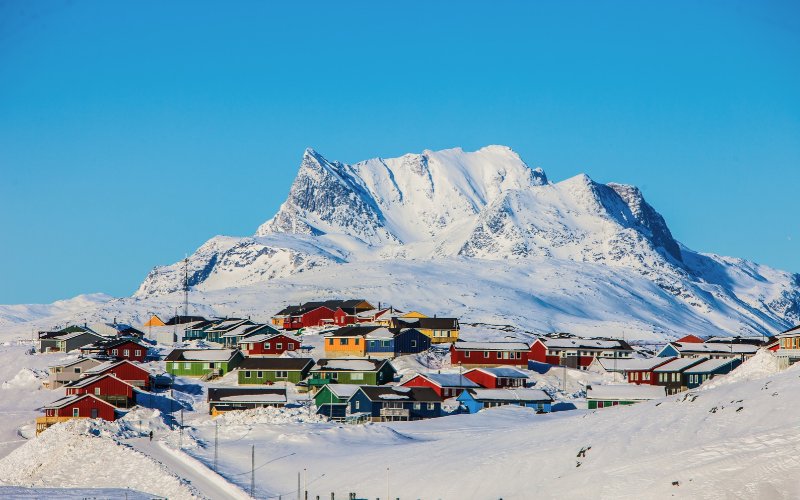
On the evening of Saturday, March 25, 2023, most of Greenland set its clocks forward one hour, as it had every spring for more than four decades. The difference came in October: the clocks never went back. With that non-event, Nuuk moved its standard time from UTC−3 to UTC−2 and cut the gap to Copenhagen from four hours to three. It was the first change of standard time decided in Nuuk rather than in Copenhagen.
Three and a half years later, the decision is being reversed. On Thursday, November 12, 2026, Greenland’s parliament, Inatsisartut, voted to return to UTC−3 on October 31, 2027, when the clocks will go back by two hours at once. Below: why the 2023 move happened, what it did to daylight in a capital at 64° north, why so much international coverage reported it wrongly, and what the 2027 reversal means for anyone who schedules across the North Atlantic.
What actually changed on March 25, 2023
The legal change was short. Inatsisartut’s Act on the Regulation of Time, passed on November 24, 2022, states in its first section that the standard time for Greenland shall be UTC−2. A second clause lets the cabinet, Naalakkersuisut, put specified areas on a different zone, and a third lets it make rules on summer time. The act took effect on March 25, 2023 at 22:00 and repealed the 1989 home-rule law on daylight saving time.
The timing meant the switch itself went unnoticed. As readers of the act on the IANA time zone mailing list pointed out, standard time became UTC−2 at the moment daylight saving would have moved the clocks to UTC−2 anyway. People set their clocks forward that Saturday night as usual. The real change came seven months later, when they did not set them back.
| Period | Nuuk in winter | Nuuk in summer | Difference from Copenhagen |
|---|---|---|---|
| 1980 to March 2023 | UTC−3 | UTC−2 | 4 hours all year |
| March 25, 2023 to March 2024 | UTC−2 (no fall-back in October 2023) | UTC−2 | 4 hours in summer 2023, 3 hours in winter 2023/24 |
| March 2024 to October 30, 2027 | UTC−2 | UTC−1 | 3 hours all year |
| From October 31, 2027 (voted November 2026) | UTC−3 | UTC−2, if daylight saving continues | 4 hours all year |
Apart from the transitional year of 2023, the gap to Denmark stays constant through the year, because Greenland follows the European Union’s daylight saving dates. Whatever difference exists in winter also exists in summer. That is why the decision was framed in Nuuk as moving an hour closer to Europe, not as a debate about summer time.
The “permanent daylight saving time” story that wasn’t
In late March 2023, several major international outlets reported that Greenland had ended clock changes and would stay on daylight saving time forever. AP described it as the last time Greenlanders would move their clocks forward, and Bloomberg, NPR, and others ran the same story. It was wrong. The government’s own announcement, sent to the IANA time zone database in March 2023, laid out a different schedule: UTC−2 as standard time from March 25, 2023, then daylight saving again from 2024, with summer time at UTC−1 on the EU calendar.
Paul Eggert, coordinator of the time zone database, flagged the conflict on April 1, 2023. The news reports said clocks would neither spring forward nor fall back during 2024, while the database, following the government’s information, had Nuuk springing forward on March 30, 2024 at 23:00. The government’s version held. In March 2024 Nuuk moved to UTC−1 for the summer, and it has changed twice a year since. The error came from confusing two different things: a permanent change of standard time, which happened, and permanent daylight saving time, which did not.
Why Nuuk wanted to be an hour closer to Copenhagen
The change was possible only because the authority had just been handed over. Until May 11, 2022, setting Greenland’s official time was a Danish responsibility. The power passed to Nuuk in a ceremony that drew little attention, and the government of Múte B. Egede proposed the new zone that same year. Its argument was the working day. Most of Greenland’s administrative, financial, and trade contacts are in Denmark and the rest of Europe, and a four-hour gap leaves little overlap between offices.
| Nuuk compared with | Before 2023 (UTC−3/−2) | 2024 to October 2027 (UTC−2/−1) | After October 31, 2027 (UTC−3/−2) |
|---|---|---|---|
| Copenhagen | Nuuk 4 h behind | Nuuk 3 h behind | Nuuk 4 h behind |
| Reykjavik (UTC+0, no DST) | 3 h behind in winter, 2 h in summer | 2 h behind in winter, 1 h in summer | 3 h behind in winter, 2 h in summer |
| Halifax | 1 h ahead | 2 h ahead | 1 h ahead |
| New York | 2 h ahead | 3 h ahead | 2 h ahead |
The arithmetic shows the trade-off. With 9:00 to 17:00 office days in both cities, Nuuk and Copenhagen share five working hours when the gap is three hours, and four when it is four. Parliament’s committee report described the UTC−2 period as placing Greenland midway between the North American east coast and western Europe, three hours from each. The hour gained on the European side was taken from North America. For the Danish side of the equation, see how CET and CEST work in our guide to Europe’s time zones.
What the sun says about Nuuk’s clock
The political argument ran into geography. Nuuk lies at 51.7°W, so its mean solar time is UTC−3 hours 27 minutes. UTC−3 was already 27 minutes ahead of the sun. UTC−2 put the clock nearly an hour and a half ahead in winter, and UTC−1 in summer almost two and a half hours ahead. We calculated sun times for Nuuk under each offset:
| Nuuk | On UTC−3 | On UTC−2 | On UTC−1 |
|---|---|---|---|
| Dec 21, 2026: sunrise | 10:21 | 11:21 | 12:21 |
| Dec 21, 2026: solar noon | 12:24 | 13:24 | 14:24 |
| Dec 21, 2026: sunset | 14:27 | 15:27 | 16:27 |
| Jun 21, 2027: sunrise | 01:53 | 02:53 | 03:53 |
| Jun 21, 2027: solar noon | 12:28 | 13:28 | 14:28 |
| Jun 21, 2027: sunset | 23:03 | 00:03 (next day) | 01:03 (next day) |
Nuuk gets about four hours of daylight at the winter solstice. In December 2026, with standard time at UTC−2, the sun rises at 11:21 and sets at 15:27. The entire morning, including the school run, is dark, and the sun is highest at 13:24. On UTC−3, sunrise would come at 10:21. In summer the offset hardly matters: with sunrise before 4 a.m. and sunset after 1 a.m. even on UTC−1, there is daylight at every waking hour. That asymmetry is the core of the case against UTC−2. The afternoon hour it adds is most useful in summer, when there is light all day anyway, while the morning hour it removes is most missed in winter. The general mechanism, clock noon drifting away from the sun as an offset moves east of a city’s meridian, is explained in our article on solar noon.
Opponents of UTC−2 used the same argument. The Naleraq party’s bill to reverse the change said that on UTC−3 without summer time, the clock would read 12:00 when the sun is highest. That is approximately right: over 2027, solar noon in Nuuk on UTC−3 falls between about 12:10 and 12:41, with the seasonal wobble of the equation of time.
Four clocks on one island
“Greenland time” has never been a single offset. The 2022 act sets one standard time for the country but allows exceptions, and the IANA time zone database tracks four separate zones for the island:
- America/Nuuk covers almost the entire population, including Nuuk, Sisimiut, and Ilulissat. It runs on UTC−2/−1 with EU daylight saving dates until October 2027.
- America/Scoresbysund (Ittoqqortoormiit) was on UTC−1/+0, one hour ahead of Nuuk, until 2024. On the government’s instructions it fell back in October 2023 and did not spring forward in March 2024, which put it on Nuuk’s clock from March 31, 2024. The change was recorded in database release 2023d.
- America/Danmarkshavn, a weather station in the northeast, stays on UTC+0 all year.
- America/Thule (Pituffik Space Base) uses Atlantic Time on US and Canadian daylight saving dates. In 2027 it switches on March 14 and November 7, not on the European dates.
The map may get more complicated. The 2026 committee report notes that separate zones could also be set for places such as Qaanaaq and Tasiilaq. This is why software should store a location such as America/Nuuk rather than a bare offset, the core argument of our explainer on the IANA time zone system. A meeting stored as “UTC−2” will be wrong for most of the year after October 2027. One stored as “America/Nuuk” will be right once the database is updated.
Why the change is being reversed
Complaints started soon after the switch. According to the parliamentary committee report on the 2026 bills, many residents found the new zone problematic. In April 2024 a two-week petition collected about 2,700 signatures in favor of returning to UTC−3 and ending daylight saving time. Bills followed: Naleraq proposed going back to UTC−3 and abolishing summer time, and Siumut submitted its own bill on the regulation of time. The government leaned the other way. In May 2026 the Copenhagen Post reported that it supported ending daylight saving from January 1, 2028 and keeping most of Greenland on UTC−2 permanently.
Parliament decided otherwise. Siumut’s amended bill passed its third reading on November 12, 2026, with 16 votes in favor and 7 abstentions, according to Sermitsiaq. Greenland’s standard time becomes UTC−3 from October 31, 2027. The legal affairs committee recommended keeping daylight saving time for now. Premier Jens-Frederik Nielsen, who had argued in the debate against moving back because of the economic cost to trade with Europe, said afterwards that he respected the decision and that the government would focus on the zone change rather than alter the summer-time rules in the near future.
The result restores the pre-2023 arrangement: UTC−3 in winter, UTC−2 in summer on EU dates, and a four-hour gap to Denmark all year. Whether Naalakkersuisut later uses its power to drop summer time remains open. If it did, Nuuk would stay on UTC−3 in summer and the gap to Copenhagen would widen to five hours from late March to late October.
October 31, 2027: a two-hour fall-back on a Saturday night
Greenland’s clock changes follow the EU moment, 01:00 UTC, rather than a local hour. At UTC−2, that moment falls at 23:00 local time on Saturday. The 2024 summer-time rules spell it out: in spring the clock jumps from Saturday 23:00 to Sunday 00:00, and in autumn it goes back from Sunday 00:00 to Saturday 23:00. Unlike most of the world, Greenland changes its clocks across midnight.
Autumn: Sunday, October 31, 2027, 01:00 UTC = Sunday 00:00 at UTC−1
The same instant on the new standard time, UTC−3: Saturday, October 30, 22:00
Result: clocks go back 2 hours; 22:00 to 24:00 on Saturday happens twice, and that Saturday lasts 26 hours
Tim Parenti described this transition on the IANA mailing list on the day of the vote: from 00:00 at UTC−1 on October 31 to 22:00 at UTC−3 on October 30. Any system that assumes clocks move by exactly one hour, or only early on a Sunday morning, will mishandle that night. The same family of bugs shows up every year around Europe’s twice-yearly clock changes.
The North American offsets shift as well. From October 31 to November 6, 2027, Europe is back on standard time while the United States and Canada are still on daylight time. That week Nuuk (UTC−3) will be only one hour ahead of New York (UTC−4) and level with Halifax. From November 7, the usual gaps of two hours and one hour return.
What needs updating before October 2027
Time zone software only knows what has been published. In tzdata release 2026f, the version we tested on November 20, 2026, America/Nuuk still moves from UTC−1 to UTC−2 on October 31, 2027 and stays on the UTC−2/−1 rule afterwards. Once the law takes effect, that rule will be an hour off in winter. IANA normally issues a new release after a government enacts a change, and devices get it through operating-system updates. With the switch almost a year away there is time for that, but rarely patched systems, such as embedded devices, old servers, and offline kiosks, may keep the wrong rule.
Anyone setting up recurring events in Greenland after October 2027 should store them in local Greenland time with the America/Nuuk identifier and check them again once the updated tzdata arrives. Calendar entries already converted to UTC under the current rules will land an hour off from November 2027. That includes flight connections, shipping schedules, and video calls with Copenhagen, Reykjavik, or North America.