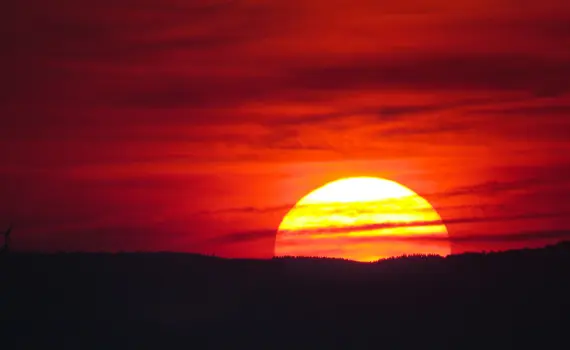
A sunset can look calm, dramatic, red, orange, pink, purple, or almost golden, but the reason is not that the Sun itself changes color at the end of the day. The Sun is still producing the same broad range of visible light. What changes is the path that sunlight takes before it reaches your eyes.
When the Sun is high in the sky, its light travels through a shorter section of the atmosphere. Near sunset, the Sun sits low above the horizon, so its light must pass through a much longer layer of air. That longer path changes what remains visible. Shorter blue and violet wavelengths are scattered away more strongly, while longer red, orange, and yellow wavelengths are more likely to reach the observer.
This is why sunset color is not just a beautiful detail of the evening sky. It is a visible result of Earth’s atmosphere filtering sunlight by wavelength.
Why Sunlight Changes Color Near the Horizon
White sunlight is made of many wavelengths of visible light. Blue and violet light have shorter wavelengths, while red and orange light have longer wavelengths. Earth’s atmosphere does not treat all of those wavelengths equally.
As sunlight passes through air, it interacts with molecules and tiny particles. Shorter wavelengths scatter more easily in many directions, which is why the daytime sky often appears blue. By the time sunlight reaches the horizon at sunset, much of that shorter-wavelength light has already been scattered out of the direct path to your eyes.
The remaining direct light is richer in longer wavelengths. That is what gives many sunsets their red, orange, or golden appearance. The lower the Sun sits, the longer the atmospheric path becomes, and the stronger this filtering effect can be.
This also explains why sunset is different from midday sunlight. At noon, sunlight usually travels through less atmosphere, so the direct light looks brighter and whiter. Near the horizon, the atmosphere acts more like a thick optical filter.
A red sunset is not a change in the Sun. It is sunlight changed by the long path it takes through Earth’s atmosphere. worldtimedata
Why Red and Orange Light Dominate at Sunset
The key process behind most sunset color is scattering: light is redirected by molecules and tiny particles in the atmosphere. Shorter wavelengths, especially blue light, scatter much more efficiently than longer red and orange wavelengths.
During the day, scattered blue light reaches us from many directions, which makes the sky appear blue. At sunset, the direct beam has crossed so much more air that much of that blue light has already been scattered away.
Red and orange wavelengths are less strongly scattered, so they can travel farther through the atmosphere. By the time the sunlight reaches your eyes, those longer wavelengths dominate the color of the Sun and the surrounding sky.
This does not mean every sunset will be bright red. The exact color depends on air clarity, clouds, dust, humidity, pollution, smoke, altitude, and the angle of the Sun. The physics is consistent, but the atmosphere is never exactly the same from one evening to the next.
Why Some Sunsets Are More Dramatic Than Others
The most vivid sunsets often happen when the atmosphere has enough particles or cloud structure to scatter and reflect color, but not enough haze to block the light completely. Thin clouds, dust, aerosols, volcanic particles, or smoke can scatter and reflect sunlight in ways that intensify color. That is why some evenings produce only a pale yellow glow, while others turn the entire horizon deep orange or red.
Clouds matter because they can catch sunlight from below after the Sun has dropped close to the horizon. High clouds are especially good at this because they remain lit after the ground is already in shadow. When those clouds reflect red or orange light back toward the observer, the sky can appear much more colorful than the Sun itself.
Clean air can create sharp golden sunsets. More particles in the air can sometimes deepen red tones, but too much haze or pollution may make the sunset dull instead of dramatic. The best sunset color usually comes from balance: enough particles or cloud structure to scatter and reflect light, but not so much that the light is blocked completely.
Two sunsets from the same location can therefore look completely different on consecutive days. The Sun follows a predictable path, but the atmosphere changes hour by hour.
How Sunset Color Connects to the Sun’s Position
Sunset color is strongly connected to geometry. The Sun’s position near the horizon determines how much atmosphere its light must cross. That path changes with time of day, season, latitude, and local geography.
The same changing position of the Sun also affects when sunrise and sunset happen through the year. The details are explained in why sunrise and sunset times change, but the basic idea is that Earth’s tilt and orbit change the apparent path of the Sun across the sky.
That changing path affects not only the time of sunrise and sunset, but also how long twilight lasts and how the evening light feels. In some places, sunset can be quick and sharp. In others, especially at higher latitudes, twilight can stretch for a long time, giving the atmosphere more time to produce layered colors.
This is one reason sunset is not only a weather event or a visual effect. It is also an astronomical event shaped by Earth’s rotation, orbital geometry, atmospheric depth, and the observer’s position on the planet.
Why the Sky Can Turn Pink, Purple, or Gold
Red and orange are the most common sunset colors, but they are not the only ones. Pink, purple, and gold can appear when scattered sunlight mixes with clouds, haze, and remaining blue light in the atmosphere.
A golden sunset often happens when yellow and orange wavelengths dominate but the light remains relatively clean and bright. Pink can appear when red light is scattered or reflected by clouds and mixed with softer background sky color. Purple tones are more complex, often involving a combination of red light, remaining blue light, cloud shadows, and atmospheric conditions.
The colors people see also depend on where they are looking. The area closest to the Sun may glow orange or red, while the opposite side of the sky may show softer pink, violet, or blue tones. Sunset is not one color. It is a changing gradient created by light moving through different layers of air.
This broader idea also applies to how the Moon changes appearance. What we see in the sky often depends on light, angle, position, and the path that light takes before it reaches us.
Why Sunset Is Both Atmospheric and Astronomical
A sunset feels like a simple daily event, but it brings together several systems at once. Earth rotates, the Sun appears to move toward the horizon, sunlight passes through a longer atmospheric path, molecules scatter shorter wavelengths, and clouds or particles reshape the remaining light.
That is why sunset is a good example of how sky events connect measurement with human experience. Astronomically, sunset depends on the Sun’s apparent position relative to the horizon. Visually, it depends on the atmosphere between the observer and the Sun. Emotionally, people experience it as the visible transition from day to evening.
This is the kind of everyday event where astronomical time becomes visible in ordinary life. The clock may tell you when sunset occurs, but the atmosphere decides what that sunset looks like.
Why Red Sunsets Still Feel Different Every Day
The basic physics behind a red or orange sunset is stable: low-angle sunlight travels through more atmosphere, blue light scatters away more strongly, and longer wavelengths dominate the light that remains. But the result is never perfectly identical because the atmosphere is never identical.
Cloud height, air pollution, humidity, dust, smoke, sea air, mountain air, and seasonal weather patterns all influence the final color. Even small changes in the atmosphere can turn a quiet yellow sunset into a deep red one, or a dramatic orange sky into a muted gray evening.
That is what makes sunset so familiar and still unpredictable. The physics is stable, but the final image depends on local conditions in that moment. A red sunset is not magic, and it is not random. It is the visible signature of sunlight taking the long way through Earth’s atmosphere.