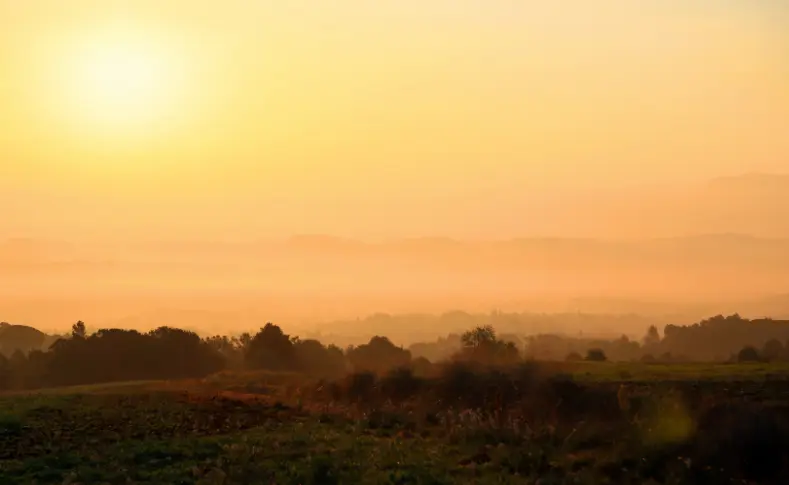
Golden hour is the period shortly after sunrise or shortly before sunset when sunlight looks warmer, softer, and less harsh than it does during the middle of the day. Photographers value it because faces, landscapes, buildings, and natural scenes often look more dimensional and balanced in this light. But golden hour is not just a photography trick. It is a physical effect created by the Sun’s low position in the sky.
When the Sun is high overhead, its light reaches the ground more directly. Shadows are shorter, contrast is stronger, and bright areas can look harsh. During golden hour, the Sun is closer to the horizon. Its light travels through more of Earth’s atmosphere before reaching your eyes or a camera lens. That longer path changes the color, direction, and intensity of the light.
This is why golden hour often feels visually calmer than midday. The light is still coming from the Sun, but it has been filtered, scattered, and softened by the atmosphere and by the low angle at which it enters the scene.
Why Golden Hour Happens
Golden hour happens because the Sun sits low above the horizon. Instead of falling almost straight down, sunlight arrives from the side, passing through a thicker slice of atmosphere and spreading across surfaces at a shallower angle.
The result is a different kind of illumination. Midday sunlight often creates hard shadows under eyes, trees, buildings, and objects because the light is strong and steep. Golden-hour sunlight comes from a lower direction, which makes shadows longer and often softer around the edges. It also lights surfaces from the side, revealing texture and shape more clearly.
The atmosphere also matters. As sunlight travels through more air, shorter blue wavelengths scatter more strongly, while warmer red, orange, and yellow tones become more dominant in the direct light. This is related to the same atmospheric process that explains why sunsets are red or orange, although golden hour is usually less intense than the final colors of sunset.
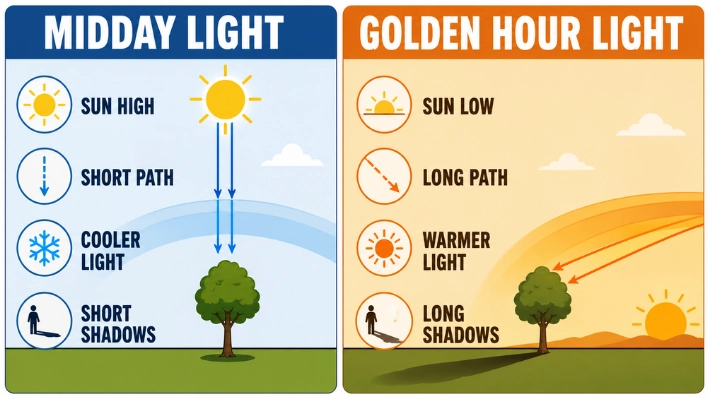
The word “golden” comes from that warmer color balance. The light often shifts away from the cooler white or blue tone of midday and toward a warmer appearance. The effect can be subtle or dramatic depending on the air, clouds, humidity, dust, pollution, altitude, and the exact position of the Sun.
Golden hour looks soft because sunlight reaches the scene from a low angle after passing through more atmosphere, reducing harsh contrast and warming the color of the light. worldtimedata
Why Golden Hour Light Looks Softer
Soft light is not only about brightness. It is about contrast, direction, shadow edges, and how evenly light wraps around objects. During golden hour, the Sun is still a strong light source, but its low angle changes the way that light interacts with the ground, buildings, faces, trees, and clouds.
At midday, sunlight often comes from above. That creates a strong separation between lit areas and shadowed areas. A face can have bright highlights and deep shadows at the same time. A street can look flat in one place and harsh in another. A landscape can lose depth because the Sun is too high to create long directional shadows.
During golden hour, the light travels sideways through the scene. It can skim across surfaces, creating gentle highlights and longer shadows that make shapes easier to read. This is why mountains, fields, architecture, and portraits often look more textured and layered during this period.
The atmosphere also reduces some of the intensity of direct sunlight. Because the light travels through more air, more scattering and filtering happen before it reaches the ground. The result is often lower glare and a more comfortable balance between highlights and shadows.
This does not mean golden hour is always perfectly soft. On a very clear day, low sunlight can still produce strong directional shadows. In hazy or cloudy conditions, the light may become more diffused. The key point is that golden hour usually reduces the harshness of midday light and changes the color and direction in a way that feels more natural to the eye.
Why Golden Hour Does Not Last Exactly One Hour
The name “golden hour” is useful, but it is not always accurate. The period can be shorter than an hour or longer than an hour depending on where you are, the season, and how quickly the Sun’s angle changes near the horizon.
Near the equator, the Sun often rises and sets more steeply. That can make golden hour relatively short because the Sun moves through low angles quickly. Farther from the equator, especially in higher latitudes, the Sun can move at a shallower angle near the horizon. Golden-hour conditions may last longer, especially during certain seasons.
This is why golden hour can feel brief in one place and extended in another. In northern or southern regions, the Sun may linger low in the sky for a long time. In some seasons, the light can stay soft for much longer than people expect. In other places, the transition from bright daylight to sunset can happen quickly.
The timing also changes throughout the year. Sunrise and sunset do not happen at the same time every day, and the Sun’s path through the sky shifts with the seasons. That is why understanding why sunrise and sunset times change helps explain why golden hour is not fixed on the clock.
A calendar app may estimate golden hour, but the real visual effect depends on local conditions. Hills, buildings, mountains, clouds, sea haze, or forest cover can make the Sun disappear earlier or soften the light before the official sunset time. Golden hour is therefore both an astronomical period and a local visual condition.
Why Golden Hour Feels Different From Place to Place
Golden hour is not identical everywhere because light does not travel through the same atmosphere in every location. Air clarity, humidity, dust, smoke, cloud cover, and altitude all affect how the light looks. The same Sun angle can produce clean golden light in one place, hazy orange light in another, and muted gray light somewhere else.
Coastal areas often have moisture and haze that can soften light, especially near sunrise or sunset. Desert regions may produce strong warm tones when dust is present. Mountain areas can create dramatic shadows because terrain blocks and reflects low-angle sunlight. Cities add another layer: glass, concrete, walls, streets, and pollution can all change the way golden light appears.
This is why golden hour is not just a fixed time slot for photographers. It is a relationship between the Sun’s position and the local environment. The same time before sunset can look completely different depending on the surface, air, weather, and horizon.
Clouds can strengthen or weaken the effect. Thin clouds may diffuse sunlight and make the scene softer. Low clouds near the horizon may block the Sun completely. High clouds can catch warm light and reflect it across the sky, creating a wider glow. Golden hour is predictable in timing, but not fully predictable in appearance.
Golden Hour as Astronomical Time You Can See
Golden hour is one of the clearest examples of astronomy becoming visible in daily life. You do not need a telescope or special instrument to notice it. The effect comes from the Sun’s position relative to the horizon, the observer, and Earth’s atmosphere.
That makes it part of astronomical time, not just photography language. The changing light is a direct result of Earth’s rotation and the Sun’s apparent movement across the sky. Morning golden hour happens because the Sun is climbing from a low angle. Evening golden hour happens because the Sun is descending toward the horizon.
The reason it feels visually special is that the Sun is low enough to soften and warm the light, but still high enough to illuminate the world directly. After sunset, direct sunlight disappears from the ground and twilight begins. Before sunrise, the sky may brighten, but direct golden light has not yet fully reached the scene. Golden hour sits between those states.
This is why it has such a distinctive look. It is not full daylight, and it is not twilight. It is the transition zone where sunlight is still direct, but the atmosphere and angle reshape it before it reaches the surface.
Why Golden Hour Matters
Golden hour matters because it changes how the world is visually structured. It reduces some of the harshness of overhead sunlight, adds warmth, creates longer shadows, and makes depth easier to see. This is why it is useful for photography, filmmaking, landscape observation, architecture, outdoor design, and even simple visual experience.
Its beauty comes from physics, not mystery. The Sun is lower. The path through the atmosphere is longer. Blue light scatters more. Warm tones become stronger. Shadows stretch. Contrast changes. Surfaces that looked flat at noon can suddenly gain texture and shape.
That is also why golden hour cannot be reduced to one exact clock time. It depends on latitude, season, weather, terrain, and local atmosphere. The clock can tell you when to expect it, but the sky decides what it will look like.
Golden hour is a reminder that time is not only counted. It is seen. The same hour on a clock can feel completely different when the Sun changes angle, the atmosphere filters the light, and the landscape begins to glow.