Every time a supermoon rises, the same statistic gets repeated: 14% bigger, 30% brighter. It’s in almost every news segment and nearly every listicle, and it’s also a comparison almost nobody in the audience will ever actually witness, because it measures the single closest possible full moon against the single farthest possible one, two events that don’t happen in the same year, let alone the same night. The full moon you’ll actually see this November is closer to 7% bigger and 15% brighter than an average full moon, a difference most people can’t detect without a side-by-side photo.
None of that makes supermoons fake or unworthy of looking up. It just means the term describes something more subtle, and considerably older, than the headlines suggest. The Moon has been swinging closer to and farther from Earth on the same elliptical path for roughly 4.5 billion years. The word “supermoon” itself has existed since 1979, and it didn’t come from an astronomer.
The Actual Definition: A Full Moon Near Its Closest Point
The Moon’s orbit around Earth isn’t a circle, it’s an ellipse, so its distance from Earth changes constantly over a roughly 27.55-day cycle called the anomalistic month. The closest point in that orbit is called perigee; the farthest is apogee. A supermoon is simply a full moon that happens to fall at or near perigee. The formal astronomical name, favored by astronomers who find “supermoon” a little embarrassing, is perigee-syzygy, syzygy being the term for when the Sun, Earth, and Moon line up, which happens at every full and new moon regardless of distance.
Average apogee distance ≈ 405,500 km
Maximum variation ≈ 12%
Because the Moon’s apparent size in the sky is directly tied to how far away it is, and its apparent brightness scales even more steeply with distance, that roughly 12% swing in distance at the extremes translates to a noticeably larger jump in both size and brightness, which is where the 14%-larger, 30%-brighter figure comes from. It’s a real number. It just describes the gap between the absolute closest possible full moon and the absolute farthest possible one, a comparison known as supermoon versus micromoon, not supermoon versus an ordinary Tuesday night full moon.
An Astrologer Coined the Word, Not an Astronomer
The term “supermoon” was invented by American astrologer Richard Nolle in a 1979 article for Dell Horoscope magazine. His original definition was broad and, by his own later admission, imprecise: a new or full moon occurring within 90% of its closest approach to Earth in a given orbit. Nolle also claimed supermoons increased the risk of severe weather and earthquakes, a connection that has never been supported by any seismological or meteorological evidence and has been explicitly rejected by geological agencies that have studied the claim.
The word barely appeared outside astrology circles for three decades. It only entered mainstream science journalism and popular use around 2011, when a particularly close perigee full moon coincided with heavy media coverage, and NASA and other scientific institutions began using the term as shorthand, despite its origins, because “perigee-syzygy” was never going to trend on social media.
Why Different Sources Give You Different Supermoon Counts
Nolle never specified exactly what counted as “near” perigee, and different astronomers and outlets have filled that gap with their own thresholds ever since, which is why one website’s list of a year’s supermoons doesn’t always match another’s.
| Source | Threshold used |
|---|---|
| Sky & Telescope | Full moon closer than 358,884 km |
| TimeAndDate | Full moon closer than 360,000 km |
| Fred Espenak (NASA astrophysicist) | Full moon within 10% of that month’s closest perigee-to-apogee range |
| Richard Nolle (original, 1979) | Within 90% of the year’s closest approach |
Espenak’s version, widely cited because of his NASA background, tends to produce the shorter, more conservative lists that outlets increasingly rely on for consistency.
What You’ll Actually See in the Sky
The honest version of the size difference is subtle enough that most people cannot reliably spot a supermoon without a reference point, a photograph of a regular full moon taken from the same location with the same lens for direct comparison. Overhead, high in the sky, a supermoon looks like a slightly bigger, slightly brighter version of an ordinary full moon, and that’s genuinely hard for the eye to judge without help.
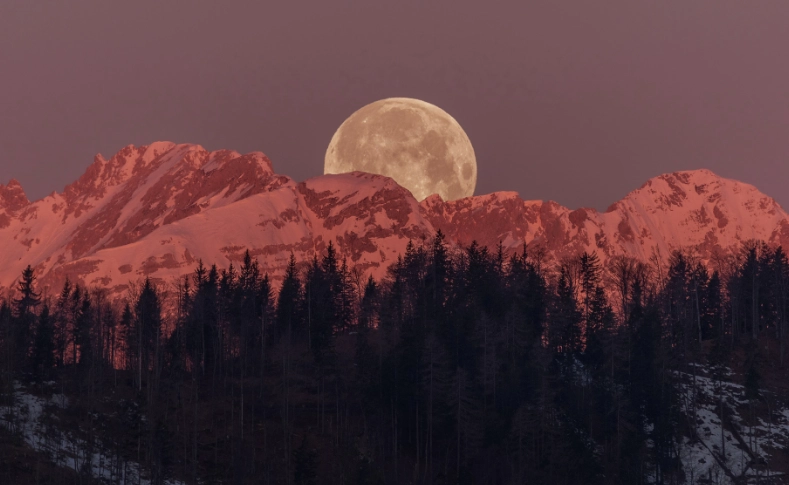
The dramatic-looking supermoons in photographs almost always catch the Moon low on the horizon, just after moonrise, and that added drama has almost nothing to do with perigee. It comes from the moon illusion, a well-documented perceptual effect where the brain judges a Moon near the horizon, with buildings, trees, or hills for scale, as far larger than the identical Moon high overhead with nothing nearby to compare it to. That separate phenomenon happens every month regardless of distance. A supermoon photographed low on the horizon is really two effects stacked together, a real but modest size increase from perigee, layered on top of an illusion that would make any full moon look enormous in that position.
When the Next Supermoons Actually Happen
2026 has three full moons commonly listed as supermoons under the more widely used definitions: January 3, November 24, and December 24. Since January has already passed, the next two are what matter looking forward.
| Date | Traditional name | How much bigger/brighter | Notes |
|---|---|---|---|
| November 24, 2026 | Beaver Moon | ~6.5% larger, ~13.5% brighter than average | Falls two days before U.S. Thanksgiving |
| December 24, 2026 | Cold Moon | ~356,700 km from Earth, the closest of the year | The largest and brightest full moon of 2026; falls on Christmas Eve |
December’s Cold Moon supermoon carries an extra layer of rarity beyond distance: a full moon landing on December 24 is itself unusual, since the exact date of any given full moon cycles slowly through the calendar, and the same alignment of a Christmas Eve full moon won’t recur until 2045.
The One Effect That’s Actually Real: Tides
Unlike earthquakes and severe weather, tides genuinely do respond to the Moon’s distance. Ocean tides are driven by the Moon’s gravitational pull, and that pull is stronger when the Moon is closer to Earth. When a full moon at perigee coincides with the Sun, Earth, and Moon already aligned at syzygy, which produces the twice-monthly spring tides, the two effects compound into what’s called a perigean spring tide, producing higher-than-normal high tides and lower-than-normal low tides for a day or two around the event. The mechanics behind this ordinary tidal cycle, separate from the perigee boost, are covered in the piece on how tides actually work. Coastal areas prone to flooding sometimes see measurably higher water levels during a supermoon’s perigean spring tide, which is the one popular supermoon claim that holds up under actual measurement.
Super Blue Moons and Super Blood Moons
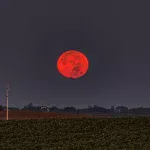
Two rarer combinations occasionally stack on top of a standard supermoon. A super blue moon happens when a perigee full moon also happens to be a blue moon, the second full moon to fall within a single calendar month, an event covered in more detail in the article on how rare blue moons are. A super blood moon happens when a perigee full moon coincides with a total lunar eclipse, during which Earth’s shadow turns the Moon a deep coppery red rather than blocking its light entirely, a mechanism explained in the piece on why lunar eclipses happen. Both combinations are considerably rarer than an ordinary supermoon simply because they require two independent lunar cycles to line up on the same night rather than one.
The Closest Supermoon Most People Alive Today Will Never See
The Moon’s orbit is itself slowly evolving, and astronomers have already calculated exactly how close a future perigee full moon will get. The closest supermoon of the 21st century is projected for December 6, 2052, when the Moon will sit approximately 356,429 kilometers from Earth, barely 1,000 kilometers beyond the theoretical extreme limit of its orbit. It’s a date circled on very few calendars today, but the math behind it was fixed the moment the Moon settled into its current orbit, long before anyone had a word for what a supermoon even was.