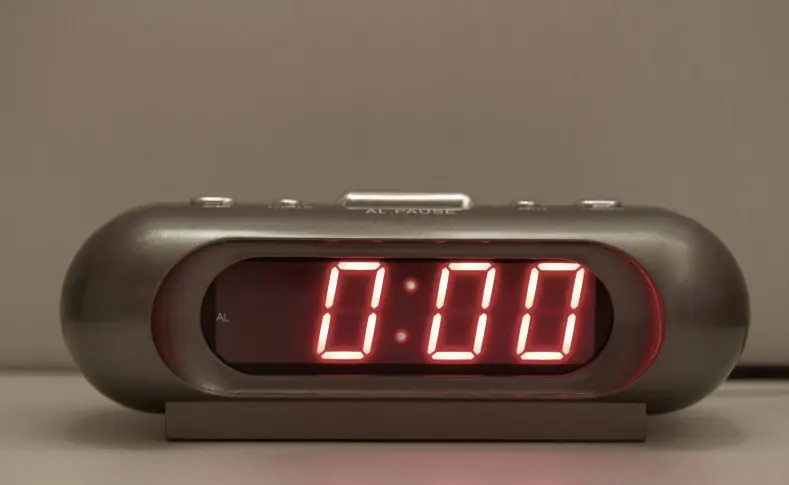
Midnight sits exactly on the seam between two calendar days, and that single fact has quietly forced lawyers, hospital administrators, train dispatchers, and software engineers to each independently decide something the clock itself refuses to settle: does midnight belong to the day that’s ending, or the day that’s beginning? Most digital clocks answer with 00:00 and move on. But the more interesting story is that an internationally recognized standard once allowed both 00:00 and 24:00 on purpose, treated them as genuinely different notations for the same instant, and then, fifteen years later, changed its mind.
A Boundary With No Natural Side
The instant of midnight is a single point in time, but a calendar date is a span, a full 24-hour block with a beginning and an end. That mismatch is the entire source of the problem. If you’re marking the start of a new day, midnight is naturally written as 00:00, the first second of the date that’s about to unfold. If you’re marking the close of a day that’s finishing, that same instant is more naturally described as the last moment of the day just ending, which is where 24:00 comes from. Nothing about the physical moment changes. What changes is which direction you’re looking from, and the international standard built to remove exactly this kind of ambiguity from dates and times had to make a real decision about it.
What ISO 8601 Actually Said, and Later Unsaid
The widely implemented ISO 8601:2004 standard didn’t pick a single winner. It explicitly permitted both notations, with a specific division of labor: 00:00 represents the first instant of a calendar day, and 24:00 represents the last instant of a calendar day, which is, by definition, the identical moment as 00:00 of the following day. Written out, “2026-05-03T24:00:00” and “2026-05-04T00:00:00” describe precisely the same point on the timeline. The standard wasn’t confused about this. It was giving date-and-time notation a way to say not just when something happened, but which day’s story it belonged to.
In practice, 00:00 became the default almost everywhere anyway. Digital clocks display 00:00, not 24:00. Most software that stores a single timestamp needs exactly one canonical way to represent any given instant, and having two valid strings for the same moment complicates sorting, comparison, and storage for no benefit in a system that doesn’t care which “side” of midnight a boundary conceptually sits on. That practical pressure eventually caught up with the standard itself. The 2019 revision, ISO 8601-1:2019, deprecated 24:00 outright, and RFC 3339, the internet engineering profile of ISO 8601 used across web protocols and APIs, forbids it entirely. Most modern date libraries, including the ones behind JavaScript, Python, and PostgreSQL, simply reject a 24:00 timestamp if one shows up. A notation designed specifically to resolve an ambiguity had, itself, become one more thing implementers had to agree to ignore.
ISO 8601 tried to solve midnight’s ambiguity by giving it two names. Fifteen years later, the standard’s own revision decided that had just created a second ambiguity to manage. worldtimedata
Where 24:00 Still Earns Its Keep
Deprecated in the formal standard doesn’t mean abandoned in practice, and a handful of fields still lean on the 00:00/24:00 split precisely because it does something 00:00 alone can’t: it tells you unambiguously which calendar day an event is anchored to, even when the event happens at the exact boundary.
| Context | Convention used | Why it matters |
|---|---|---|
| ISO 8601:2004 | Both 00:00 and 24:00 valid | Distinguishes the start of an interval from its end |
| ISO 8601-1:2019 and RFC 3339 | 00:00 only | Removes a second valid notation for the same instant |
| Train and bus timetables | 00:00 for departures, 24:00 for arrivals | Keeps the last service of the night tied to the correct day |
| Legal contracts | Start date at 00:00, end date at 24:00 | Removes disputes over which day a boundary belongs to |
| Hospital medication schedules | 0000 and 2400 both used deliberately | Prevents dosing errors at the day boundary |
Transit schedules are the clearest everyday example. Some bus and train timetables list 00:00 as a departure time but 24:00 as an arrival time on the same printed schedule, which looks inconsistent until you realize the point: a service that departs at 00:00 is clearly the first run of a new day, while a service that arrives at 24:00 is unmistakably the last run of the day just ending, even though both times describe the same clock position. Legal contracts follow the identical logic for the opposite reason, specifying that an agreement runs from a start date at 00:00 to an end date at 24:00, precisely so neither party can argue later about whether the contract was still active during the boundary instant itself. The 24-hour clock format that makes this distinction possible is also why hospitals lean on it for medication schedules: some medication administration records mark 2400 as the last scheduled dose of a calendar day and 0000 as the first dose of the next, a distinction with real stakes if a nurse is trying to determine whether a dose was already given.
Japan Solved It by Refusing to Reset the Clock
No system takes the “which day does this belong to” question further than Japan’s so-called 30-hour clock. Rather than resetting to 00:00 at midnight, certain industries simply keep counting: 1:00 a.m. becomes 25:00, 2:30 a.m. becomes 26:30, and the numbering continues up to 29:59 before finally resetting at 6:00 a.m. The idea traces back to postwar Japanese railway timetables published by Kotsu Shimbunsha, which listed overnight departures as 24:00 and beyond specifically so a Thursday night’s last train wouldn’t get visually confused with Friday morning’s first one. Broadcasting adopted the same logic in the 1960s; when Nippon Broadcasting System launched the late-night radio show “All Night Nippon” in 1967, its own listings ran from 25:00 to 27:00, and television schedules across the country followed suit soon after.
The convention is still very much alive in ordinary commercial signage. The Dondon Donki convenience store chain posts opening hours as “8:00 to 25:00,” meaning 8 a.m. to 1 a.m. the following morning, a choice made specifically so customers don’t misread the closing time as 1 p.m. Okinawa’s Ryukyu Broadcasting Corporation goes even further with its own 28-hour version, starting its programming day at 4 a.m. and closing it out at 28:00, which is 4 a.m. the next calendar morning. Different broadcasters, different reset points, same underlying instinct: the early hours after midnight feel, culturally and operationally, like a continuation of the previous day rather than the opening of a new one.
That instinct isn’t uniquely Japanese, even if Japan is the only place that turned it into a formal numbering system. American late-night television runs on the identical assumption without ever writing a number past 24. Saturday Night Live airs live starting around 11:30 p.m. Eastern time and runs roughly 90 minutes, meaning a meaningful share of the broadcast actually happens on Sunday morning by the clock. Nobody calls it Sunday Night Live. The early hours after midnight get filed under the night that came before them almost everywhere; Japan is simply the place that gave that filing system an actual number.
Why Computers Mostly Just Avoid the Question
Underneath all of this, most computer systems don’t experience midnight as a boundary at all. Unix time counts a single, continuously increasing number of seconds from a fixed starting point, with no concept of days, calendars, or boundaries built into the raw count itself. A timestamp is just a number; the idea that it falls “at midnight” or “belongs to Thursday” only appears once something converts that number into a calendar using a specific time zone. Systems built on that kind of continuous count have no practical use for a second notation whose entire job is signaling which side of a boundary an instant conceptually belongs to, because the boundary isn’t really part of the underlying data to begin with. That’s a large part of why 00:00 has become the default nearly everywhere computing is involved: the question 24:00 was designed to answer simply doesn’t arise inside a system that never treated midnight as a seam in the first place.
One Instant, Filed Under Different Days
Midnight never changed. What changed, repeatedly, is who needed to know which day owned it. ISO 8601 tried giving it two official names before deciding one was enough. Transit schedules and contracts still use both, on purpose, because the ambiguity has real consequences for them. Japanese broadcasters solved it by simply not resetting the clock until dawn. And most software solved it by refusing to treat midnight as a boundary at all. The instant is identical in every case. Only the bookkeeping around it ever had to change.