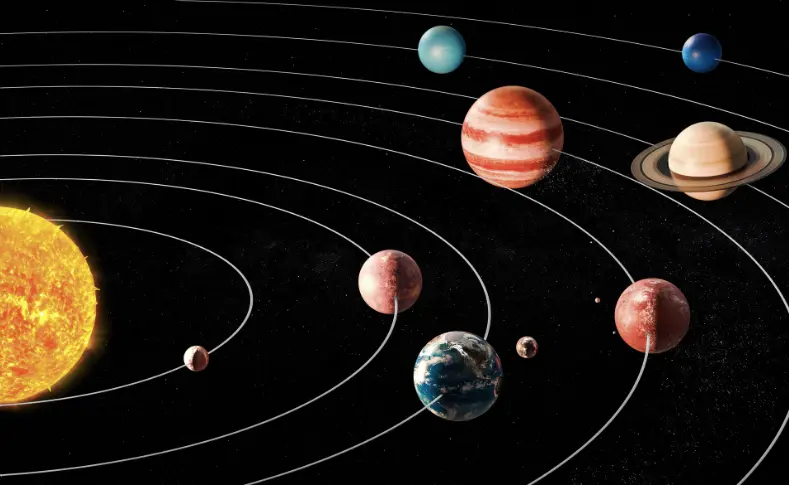
Venus takes 243 Earth days to spin once on its axis, and only 225 Earth days to complete a full orbit around the Sun. Its day is longer than its year, a fact that sounds like it should be impossible and isn’t. The stranger part is what happens next: measure Venus’s day the way people actually experience daylight, sunrise to sunrise rather than one full spin relative to the stars, and the number drops to about 117 days, shorter than its own rotation period by more than half. Neither figure is wrong. They’re answering two different questions, and once that distinction is clear, the rest of the solar system’s day lengths stop looking like a random grab bag of numbers and start looking like the same handful of rules playing out in very different circumstances.
Two Different Kinds of Day
A sidereal day measures how long a planet takes to rotate once relative to the distant, effectively fixed stars. A solar day measures something more practical: how long it takes for the Sun to return to the same position in the sky, noon to noon. On Earth these are close but not identical. A full Earth rotation actually takes about 23 hours and 56 minutes, four minutes short of 24 hours, because in the time Earth spins once, it has also moved along its orbit, and the extra four minutes are what it takes to turn that little bit further before the Sun lines up in the same spot again. For Earth, that gap is trivial. For a planet that rotates far more slowly, or that spins backward relative to its orbit, the same simple mechanism produces wildly different results.
Mercury’s Triple Spin
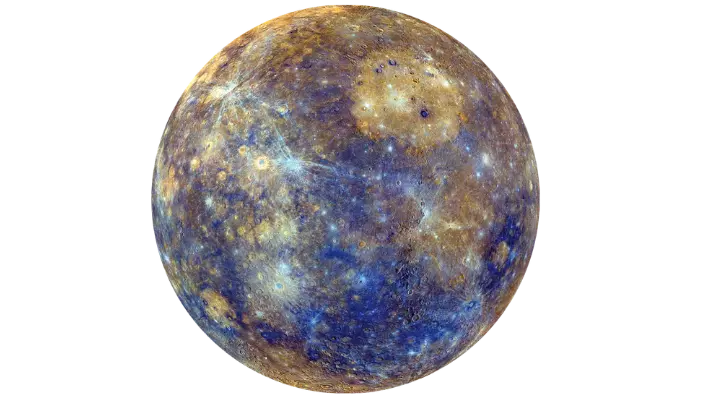
Mercury rotates once every 58.6 Earth days, and orbits the Sun in 88 Earth days, locked into a 3:2 spin-orbit resonance: it completes exactly three rotations for every two trips around the Sun. That relationship, combined with Mercury’s slow spin and tight, fast orbit, stretches its solar day out to roughly 176 Earth days, very close to two full Mercury years. Stand on Mercury’s surface and a single sunrise-to-sunrise cycle would outlast two complete orbits of the planet you’re standing on.
Venus, Where the Sun Rises in the West
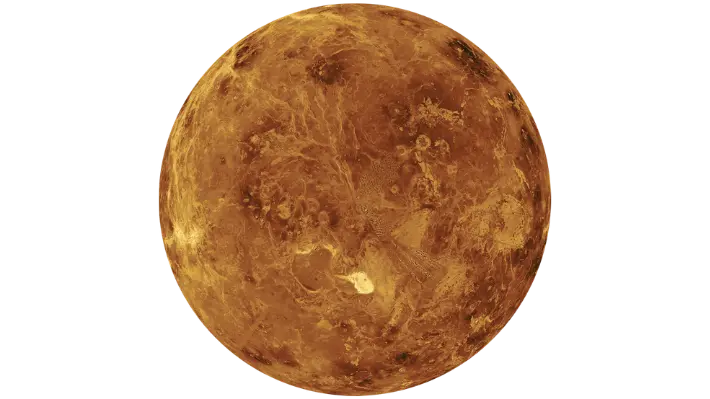
Venus is the solar system’s one true outlier: the only planet whose sidereal day is longer than its own year. It’s also one of only two planets, along with Uranus, that rotates retrograde, spinning backward relative to the direction it orbits the Sun. That backward spin is why a Venusian sunrise happens in the west and sunset in the east, the reverse of every other planet with a meaningfully observable day-night cycle.
The retrograde direction is also exactly why Venus’s solar day comes out shorter than its sidereal day rather than longer. On a normal, prograde-rotating planet, a day’s rotation and the sunward-facing point have to “catch up” to each other, stretching the solar day out slightly past the sidereal one, the same small effect that gives Earth its four extra minutes. On Venus, the retrograde spin and the planet’s orbital motion work in opposite directions, so the two effects partially cancel rather than add, and the sunrise-to-sunrise cycle comes out shorter, around 117 Earth days, than the 243-day sidereal rotation. Combine that with a 225-day year, and fewer than two full Venusian solar days pass in a single Venusian year.
Mars, the Closest Thing to a Twin
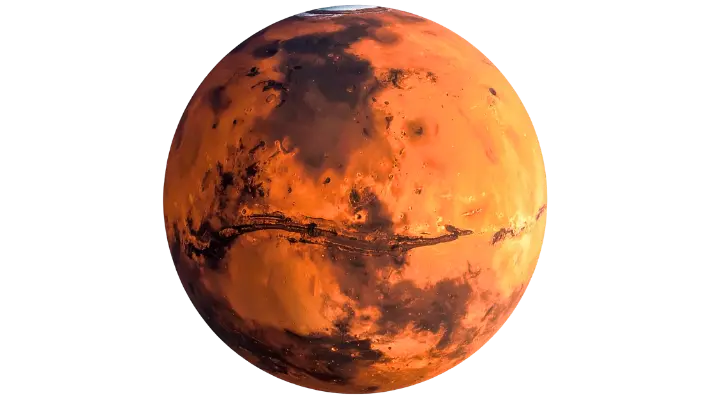
After Mercury and Venus, Mars is almost anticlimactic, and that’s exactly what makes it worth pausing on. Its solar day, which mission planners call a sol rather than a day specifically to avoid confusing it with an Earth day, runs about 24 hours and 39 minutes, barely 40 minutes longer than Earth’s own. Mars rotates prograde, in the same direction as its orbit, at almost the same rate Earth does, which is part of why the offset between Martian and Earth days is small enough that NASA rover teams can simply track the accumulating drift over a multi-week mission rather than treat it as a fundamentally different clock. Not every planet needs an exotic mechanism to explain its day. Mars is the reminder that sometimes the numbers line up by coincidence, not design.
The Gas Giants Don’t Even Agree With Themselves
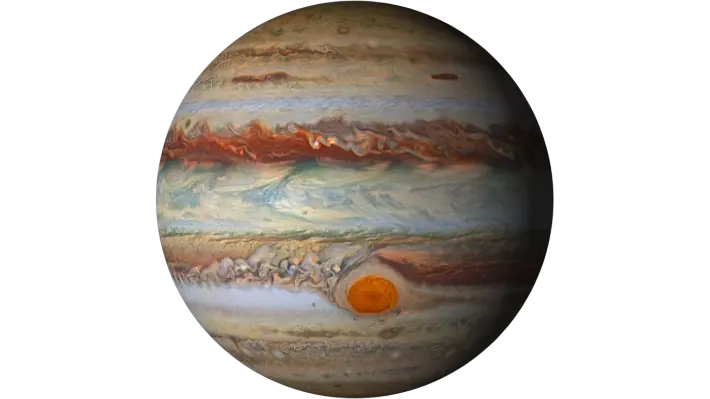
At the opposite extreme, Jupiter completes a full sidereal rotation in about 9 hours and 55 minutes, the fastest of any planet in the solar system, and its solar day is barely different, since Jupiter’s orbit is so slow relative to its own spin that the correction is negligible. That speed has a physical cost: Jupiter spins fast enough to bulge at its equator by roughly 7 percent, visibly flattening the planet into an oblate shape rather than a true sphere. Saturn spins almost as fast, completing a rotation in a little over 10 hours, with a solar day only about 1.5 seconds longer than its rotation period, a correction so small it’s barely worth mentioning next to Venus or Mercury’s. Neptune keeps pace with its fellow gas giants at roughly 16 hours, though pinning that number down took decades: astronomer Erich Karkoschka only calculated it precisely by tracking two cloud features across 20 years of Hubble images, since a fluid, differentially rotating atmosphere doesn’t offer a fixed surface marker the way a solid planet would.
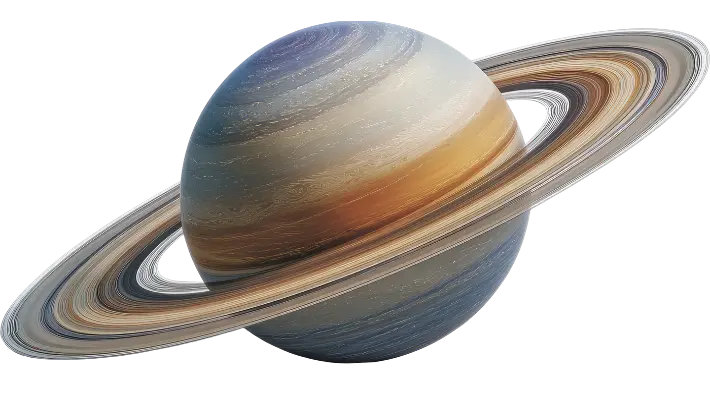
Both planets complicate the idea of “day length” in a different way entirely. Jupiter and Saturn aren’t solid, and they don’t rotate as a single fixed body the way Earth or Mars does. Their equatorial regions spin faster than their polar regions, a phenomenon called differential rotation, which means there’s no single, exact number that describes “a day” on either planet. The commonly quoted figures describe the equator; measure closer to the poles and the rotation period stretches out longer, because the whole idea of a uniform planetary day assumes a rigid body, and a gas giant simply isn’t one.
Uranus Rolls Instead of Spinning
Uranus rotates once every 17 hours and 14 minutes, retrograde like Venus, but what actually defines its day is its axial tilt, roughly 98 degrees, tipped so far that the planet effectively orbits the Sun on its side rather than spinning upright like the rest of the solar system’s planets. Earth’s own axial tilt is the entire reason seasons exist; Uranus simply takes the same mechanism to its extreme. The result isn’t a normal day-night cycle near the poles at all. Because of the tilt, each Uranian pole spends roughly 42 uninterrupted years in continuous sunlight, followed by roughly 42 years of continuous darkness, a cycle tied to the planet’s 84-year orbit rather than to its 17-hour rotation. Uranus technically has both a short, ordinary rotational day and, layered on top of it near the poles, a light-and-dark cycle that unfolds on a completely different, decades-long timescale.
Pluto Isn’t a Planet Anymore, But Its Day Is Worth the Detour
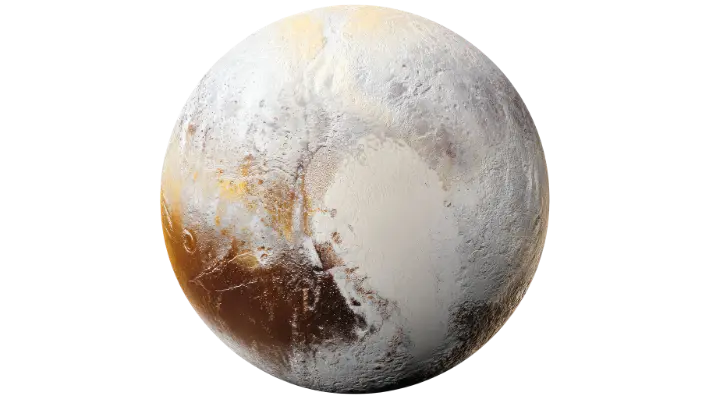
The International Astronomical Union reclassified Pluto as a dwarf planet in 2006, so it no longer belongs on an official list of “the planets.” Its day is still worth a mention, because it does something none of the eight actual planets do. Pluto rotates retrograde, like Venus and Uranus, once every 6.387 Earth days, tipped on its side at roughly 112 degrees the way Uranus is. What makes it unique is its relationship with its largest moon, Charon: Charon orbits Pluto in exactly 6.387 days too, the same length as Pluto’s own rotation, and the lock runs both directions. Charon always shows Pluto the same face, the ordinary kind of tidal lock the Moon has with Earth, but Pluto also always shows Charon the same face back, a mutual lock found nowhere else among the solar system’s larger bodies. Stand in the right spot on Pluto and Charon never rises or sets. It just hangs in the same point in the sky, permanently, for as long as anyone could stand to watch.
Every planet answers the question “how long is a day” honestly. They just aren’t always answering the same question. worldtimedata
Laid out side by side, the sidereal and solar days covered above look like this:
| Planet | Sidereal day | Solar day | Rotation |
|---|---|---|---|
| Earth | 23h 56m | 24h 00m | Prograde |
| Mercury | 58.6 days | ~176 days | Prograde |
| Venus | 243 days | ~117 days | Retrograde |
| Mars | ~24h 37m | ~24h 39m | Prograde |
| Jupiter | ~9h 55m | ~9h 55m | Prograde |
| Saturn | ~10h 14m | ~10h 14m | Prograde |
| Uranus | 17h 14m | ~17h 14m* | Retrograde |
| Neptune | ~16h 00m | ~16h 00m | Prograde |
| Pluto** | 6.387 days | 6.387 days | Retrograde |
*Uranus’s rotational solar day stays close to its sidereal one; its extreme tilt affects the poles’ light cycle on an entirely separate, 84-year timescale, not the rotation itself. **Reclassified as a dwarf planet by the IAU in 2006; included here for its mutual tidal lock with Charon, unmatched among the eight official planets.
Why the Same Few Rules Produce Such Different Answers
Every planet in the solar system is governed by the identical basic relationship: rotation speed, orbital speed, and rotation direction combine to produce whatever a resident would experience as a day. Earth’s rotation is fast and its orbit is comparatively slow, so the two barely interact and its solar day sits almost exactly at 24 hours, with Mars landing in nearly the same place for nearly the same reason. Mercury and Venus rotate slowly enough that their orbital motion meaningfully distorts the result, stretching Mercury’s day out and, because of Venus’s backward spin, compressing Venus’s day down. Jupiter, Saturn, and Neptune spin so quickly that their slow orbits barely register at all, while also rotating as fluid bodies rather than solid ones, undermining the very idea of a single day length. Uranus adds an axial tilt so extreme that its day and its seasons stop being separate concepts near the poles. Pluto, no longer even counted among the planets, adds a variable none of the eight actual planets have to deal with: a moon large enough to lock its own rotation in return. None of it is arbitrary. It’s the same handful of variables, rotation rate, orbital rate, spin direction, and axial tilt, recombined in whatever proportions each body happened to end up with.