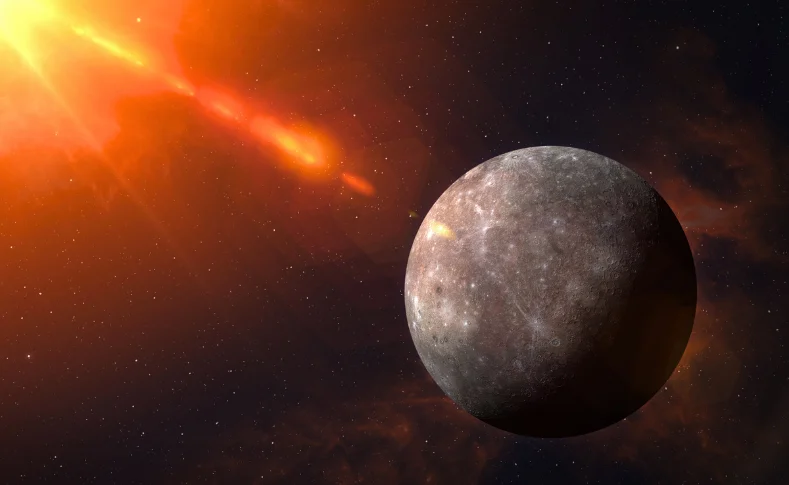
Mercury retrograde generates millions of searches every time it happens, and almost none of that content stops to explain what’s actually occurring in space. The phenomenon itself is completely real, observable, and predictable centuries in advance. What isn’t real is nearly everything attached to it afterward. Separating those two things turns out to be a far richer story than either the astrology sites or the dismissive eye-rolls usually bother telling, and it involves ancient astronomers who thought Mercury was two different gods, a discovery that overturned a century of assumptions about the planet in 1965, and a genuinely strange kind of retrograde motion that has nothing to do with Earth at all.
What’s Actually Happening: An Illusion of Perspective
Mercury never reverses direction in its orbit around the Sun. What astronomers call “apparent retrograde motion” is a trick of relative speed, the same effect as watching a slower car appear to drift backward when you overtake it on a highway. Because Mercury completes a full lap around the Sun in just 88 days, at speeds up to 47.8 kilometers per second, far faster than Earth’s own orbit, it periodically laps us on the inside track. As it passes, its position against the distant background stars appears to slow, stop, and briefly move backward before resuming its normal path. The planet’s actual motion through space never changes. Only the angle we’re watching it from does.
Why Mercury Does This More Than Any Other Planet
Mercury completes a full orbit in just 88 days, compared to Earth’s 365, which means it overtakes Earth far more often than any other planet does. That translates into Mercury going retrograde three to four times every single year, each episode lasting roughly three weeks.
| Planet | How Often It Retrogrades | How Long Each Episode Lasts |
|---|---|---|
| Mercury | 3 to 4 times per year | About 19 to 24 days |
| Venus | About once every 1.5 years | About 40 to 43 days |
| Mars | About once every 2.1 years | About 58 to 72 days |
The pattern is consistent: the farther a planet orbits from the Sun, the less frequently it appears to retrograde, but the longer each individual episode lasts. Mercury sits at the extreme frequent-but-brief end of that scale simply because it’s the fastest, closest planet in the solar system.
The Ancient Puzzle And Its Real Answer
Babylonian astronomers documented Mercury’s backward loops on clay tablets as far back as the 7th century BCE, describing the exact slow-stop-reverse pattern still visible today. Before that, the planet caused an even more basic confusion: because Mercury only ever appears near the Sun, briefly in the morning sky and then, weeks later, briefly in the evening sky, ancient Greek observers initially treated it as two separate objects, calling it Apollo when it rose before dawn and Mercury when it set after dusk. It took until roughly the 5th century BCE for Pythagoras to point out that morning Mercury and evening Mercury were the same body, just caught at different points in its short orbit.
Explaining the backward loops themselves proved much harder. Working from an Earth-centered model of the universe, Greek astronomers had no simple way to account for retrograde motion and resorted to increasingly elaborate systems of circles-within-circles called epicycles, refined over centuries and eventually catalogued in Ptolemy’s Almagest, to force the observations to fit a stationary Earth. The actual explanation didn’t arrive until the 16th century, when Nicolaus Copernicus proposed that the Sun, not Earth, sat at the center of the solar system. Once planets were correctly understood as objects orbiting the Sun at different speeds, retrograde motion stopped being a mystery and became simple geometry.
Mercury’s Own Bizarre Clock
For most of the 20th century, astronomers assumed Mercury was tidally locked to the Sun the same way the Moon is locked to Earth, always showing the same face. Radar observations in 1965 overturned that entirely, revealing that Mercury actually rotates three times for every two orbits it completes, a genuinely rare configuration called a 3:2 spin-orbit resonance. One rotation takes about 59 Earth days, but because Mercury is simultaneously racing around the Sun, a full day-night cycle on its surface, sunrise to sunrise, stretches to about 176 Earth days, nearly two full Mercury years. Combined with its almost nonexistent atmosphere, that slow, extended exposure produces the most extreme temperature swings of any planet in the solar system, surface highs above 430°C during the long day and lows near minus 180°C during the long night.
The Retrograde That’s Actually Real, On Mercury Itself
Here’s the detail almost no astrology content ever mentions: an actual, physical version of retrograde motion does happen on Mercury, just not the kind anyone on Earth experiences. Mercury’s orbit is the most eccentric of any planet, and its orbital speed changes dramatically depending on distance from the Sun, fastest at perihelion, slowest at aphelion. For about four days on either side of perihelion, Mercury’s orbital speed briefly exceeds its rotational speed. From specific points on Mercury’s surface, an observer would watch the Sun rise partway above the horizon, pause, reverse course and sink back down, then rise again a second time before finally continuing its normal path across the sky. At other longitudes, the same effect happens in reverse at sunset. It’s the only place in the solar system where a planet’s own star genuinely appears to move backward in its sky, a real optical event happening on real ground, rather than a matter of one planet’s position relative to another from millions of kilometers away.
Why “Mercury” Governs Communication in Astrology
The specific link between this planet and communication, technology, and travel doesn’t come from any physical property of Mercury itself. It comes from Roman mythology. Mercury was the messenger god, depicted with winged sandals, tasked with carrying information quickly between gods and mortals. Astrology inherited that symbolism directly and assigned the planet named after him rulership over exactly those domains, the same naming logic behind zodiac symbolism generally. It’s a mythological inheritance, not an observed physical effect.
Does It Actually Affect Anything?
Physicists have run the actual numbers on planetary influence more than once, and the results aren’t close. Carl Sagan calculated that the gravitational pull of the obstetrician in a delivery room exceeds the gravitational pull of Mars on a newborn baby, and Mercury, with less than half of Mars’s mass, exerts even less measurable influence than that comparison already implies. No mechanism, gravitational, electromagnetic, or otherwise, has ever been demonstrated to connect Mercury’s sky position to events on Earth. The most rigorous direct test of astrology’s core claims came in 1985, when physicist Shawn Carlson published a double-blind study in Nature, designed collaboratively with professional astrologers who agreed in advance it was a fair test: 28 astrologers tried to match natal charts to personality profiles for over a hundred subjects, and their success rate came out statistically indistinguishable from random guessing. A later statistical reanalysis of Carlson’s raw data disputed some of his methodology and found a few marginally significant patterns in subsets of the results, though even that reanalysis stopped well short of confirming astrology’s predictive claims. What does happen, reliably, is a well-documented cognitive pattern: once someone is told to expect miscommunications and delays during a specific three-week window, they start noticing every glitch, delay, and typo that occurs during it, while the same ordinary volume of mishaps during the other 49 weeks of the year goes uncounted.
Mercury is the only planet where the sky genuinely does, four days a year, what astrology has always claimed it does to us the rest of the time. worldtimedata
How Much of Your Life Is Technically “In Retrograde”
Run the math on Mercury’s own frequency and the number gets surprisingly large. At roughly 3.5 episodes a year averaging about 21 days each, Mercury spends close to a fifth of every calendar year appearing to move backward.
The next window lands from October 24 to November 13, 2026. Whether that stretch of any given year feels more chaotic than the other four-fifths of it has never been the astronomical question. It’s always been a question about which weeks a person was told to start counting, and about a planet that, four days a year on its own surface, actually does what everyone on Earth only imagines it’s doing the rest of the time.