Ask an astronomer and a warehouse manager what today’s Julian date is, and you will get two different numbers. For Wednesday, November 18, 2026, the astronomer says 2461363, meaning the Julian Day count that begins at noon Universal Time. The warehouse manager says 322, because November 18 is the 322nd day of the year 2026. Both are using the phrase correctly within their own field, and that is the problem. “Julian date” names two unrelated systems, and neither one has anything to do with the Julian calendar people learn about in history classes.
The first system is a continuous count of days that astronomers have used since the 19th century. The second is the ordinal date: a year plus a day-of-year number, which shows up on egg cartons, in manufacturing lot codes, and in enterprise software. Below is where each one comes from, how to calculate both, and how to tell which one a given number is.
Two different numbers with the same name
| Astronomical Julian Day (JD) | Ordinal “Julian” date | |
|---|---|---|
| What it counts | Days since noon UT, January 1, 4713 BC (proleptic Julian calendar) | Days since the start of the current year |
| Resets? | Never | Every January 1 |
| November 18, 2026 | 2461362.5 at midnight UT, 2461363.0 at noon UT | 322 (ISO form: 2026-322) |
| Day boundary | Noon UT | Local midnight |
| Fractions of a day | Yes (0.25 = 6 hours) | No |
| Typical users | Astronomers, satellite operators, geodesists, software libraries | Food packers, factories, logistics, ERP systems |
Calling the ordinal number a “Julian date” is technically a misnomer, but it is so widespread that even the U.S. Department of Agriculture uses it. In the rest of this article, “Julian Day” or JD means the astronomical count, and “ordinal date” means the day of the year.
Scaliger’s 7,980-year period, and the name everyone gets wrong
The astronomical count starts with Joseph Justus Scaliger, a French scholar who published De emendatione temporum in 1583, one year after the Gregorian calendar reform. Scaliger did not invent a count of days. He invented a cycle of years, which he called the Julian Period. He multiplied three cycles already used for dating and for calculating Easter:
× 19-year lunar cycle (Golden Number; moon phases return to the same dates)
× 15-year indiction cycle (a Roman tax cycle used in document dating)
= 7,980 years, or 7,980 × 365.25 = 2,914,695 days
Year 1 of the period: 4713 BC, when all three cycles were at year 1
2026 = year 6739 of the period: solar cycle 19, Golden Number 13, indiction 4
Each combination of the three cycle numbers occurs only once in 7,980 years, so the three numbers together identify a year exactly. The period’s starting year, 4713 BC, is the last time all three cycles stood at 1 together. The next time comes in AD 3268.
Popular accounts say Scaliger named the period after his father, the scholar Julius Caesar Scaliger. His own text says otherwise: he wrote that he called it Julian because it was fitted to the Julian year. The years he counted were Julian calendar years of exactly 365.25 days, which is why the period’s length in days comes out as a whole number. That is the only real link between the Julian Day and the Julian calendar: the epoch, January 1, 4713 BC, is a date in the Julian calendar extended backward, a convention known as the proleptic Julian calendar.
Turning Scaliger’s cycle of years into a running count of days came much later. Historians of astronomy credit Sir John Herschel, who proposed it in his textbook Outlines of Astronomy in 1849. Herschel’s reasoning was practical. An astronomer comparing an eclipse recorded in a Babylonian lunar calendar, a Roman date, and a modern observation can convert all three to one day number, subtract, and get the interval in days without worrying about month lengths, leap-year rules, or the ten days dropped in 1582.
Why the astronomical day starts at noon
A Julian Day begins at 12:00 UT, not at midnight. The reason is the observing night. An astronomer working in Europe would cross a midnight date change in the middle of a session, so observations from one night would carry two different dates. Starting the day at noon keeps an entire European night under a single day number. Nineteenth-century writers on chronology describe exactly this inconvenience: astronomers having to record one night’s observations under two different dates.
The consequence is a half-day offset that trips up anyone converting by hand. Midnight UT on any calendar date always ends in .5. Midnight on January 1, 2027 is JD 2461406.5, and noon that day is JD 2461407.0. An integer Julian Day Number (JDN) refers to the day that starts at noon, so the calendar date of a JDN is the date of its noon.
Julian Days in practice: big numbers, simple arithmetic
The values are large, so a few milestones help. All of them were calculated with a standard Gregorian-to-JD algorithm:
| Moment (UT) | Julian Date | Why it matters |
|---|---|---|
| Noon, Jan 1, 4713 BC (Julian calendar) | 0.0 | Epoch of the count |
| Midnight, Oct 15, 1582 | 2299160.5 | First day of the Gregorian calendar |
| Midnight, Nov 17, 1858 | 2400000.5 | Epoch of the Modified Julian Date |
| Midnight, Jan 1, 1970 | 2440587.5 | Unix epoch |
| Noon, Jan 1, 2000 | 2451545.0 | J2000.0, the standard reference epoch in astronomy |
| Midnight, Nov 18, 2026 | 2461362.5 | Today |
| Noon, Aug 31, 2132 | 2500000.0 | The count reaches 2.5 million |
Once dates are numbers, intervals become subtraction. From midnight on November 18, 2026 to midnight on March 28, 2027 (Easter Sunday) is 2461492.5 − 2461362.5 = 130 days. The weekday also comes from simple arithmetic: (JDN + 1) mod 7 gives 0 for Sunday through 6 for Saturday. For JDN 2461363, which covers November 18, 2026, the result is 3, Wednesday.
Precision depends on the decimals. A Julian Date given to five decimal places resolves time to 0.864 seconds, which is why ephemerides and variable-star observations often list six or more. At that level the time scale matters. A JD can be counted in Universal Time or in Terrestrial Time, the uniform scale used for planetary positions, and the two currently differ by 69.184 seconds (37 leap seconds plus the fixed 32.184-second offset between TT and TAI). Professional catalogs therefore name the scale explicitly, sometimes as “JD(TT)” or “JDE.”
The astronomical Julian Day never resets and never cares about months; the “Julian date” on an egg carton resets every January 1 and only counts days of the year. They share a name and nothing else. worldtimedata
Shortened versions: MJD, TJD and the Sputnik connection
Seven-digit numbers with a .5 attached are awkward for computers and for people, so several shortened versions exist. The most important is the Modified Julian Date:
MJD 0 = midnight UT, November 17, 1858
November 18, 2026, 00:00 UT = MJD 61362
NASA Goddard explains the subtraction simply: for some three centuries after November 17, 1858, every Julian Day falls between 2400000 and 2500000, so the leading “24” carries no information. Subtracting the extra 0.5 moves the day boundary back to midnight. The MJD is generally credited to the Smithsonian Astrophysical Observatory, which adopted it in 1957 to track Sputnik on an IBM 704. Digital Equipment Corporation’s documentation notes that an 18-bit field could hold MJD values up to 262,143, about seven centuries’ worth, which runs out on August 7, 2576. The same date became the zero point of the VAX/VMS and OpenVMS clocks, which is why those systems treat November 17, 1858 as the beginning of time.
Other variants trim the number further. NASA’s Truncated Julian Day counts from May 24, 1968 (JD 2440000.5). For programmers, the most useful conversion is the one to Unix time: JD = Unix seconds ÷ 86,400 + 2440587.5. Midnight UT on November 18, 2026 is Unix time 1794960000, which gives exactly JD 2461362.5. Like Unix time itself, this conversion ignores leap seconds.
The ordinal date: day 001 to day 365 (or 366)
The second meaning is far more common in everyday life. An ordinal date numbers the days within a year from 001 to 365, or 366 in a leap year. ISO 8601 standardizes it as YYYY-DDD, so November 18, 2026 is 2026-322, a less familiar sibling of the YYYY-MM-DD form described in our guide to ISO date formats.
The trap is February 29. Every ordinal date after February is shifted by one day in a leap year:
| Ordinal day | 2026 | 2027 | 2028 (leap year) |
|---|---|---|---|
| 059 | Feb 28 | Feb 28 | Feb 28 |
| 060 | Mar 1 | Mar 1 | Feb 29 |
| 061 | Mar 2 | Mar 2 | Mar 1 |
| 322 | Nov 18 | Nov 18 | Nov 17 |
| Last day | 365 | 365 | 366 |
Any lookup table that assumes a 365-day year will be off by one for ten months of 2028. A printed chart is only safe if it states which year it applies to.
Why egg cartons carry a three-digit day number
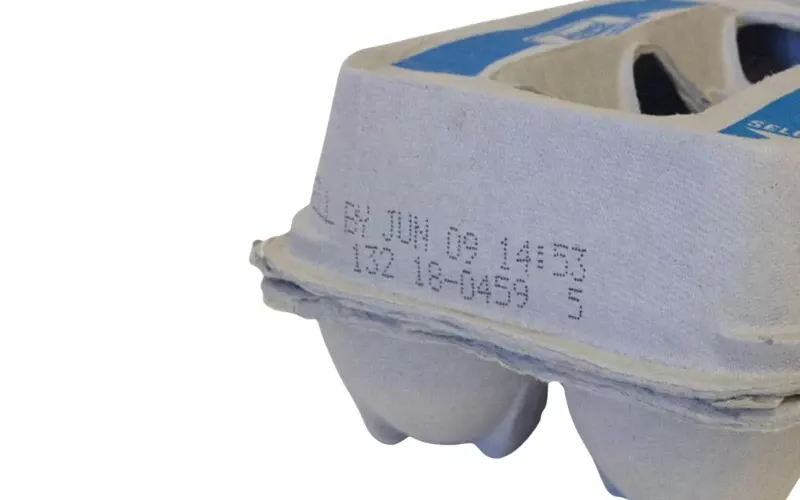
The best-known ordinal code in the United States is printed on egg cartons. USDA explains that each carton of USDA-graded eggs must show the packaging date and the processing plant number, and that the pack date is a three-digit code running from 001 for January 1 to 365 for December 31. In a leap year the count runs to 366. USDA grading itself is a voluntary service that producers pay for, so the federal requirement applies to cartons that carry the USDA grade shield. Some states impose the same rule on all eggs. Illinois, for example, requires each consumer carton to carry a three-digit Julian code at least 1/8 inch high showing the day the eggs were graded and sized.
Reading the code is a matter of counting days. A carton stamped 322 in 2026 was packed on November 18, 2026. USDA advises that fresh shell eggs can be refrigerated in their cartons for four to five weeks beyond that date. The “sell by” date is a separate number, and the pack date is the better guide to the eggs’ age.
Most other foods have no such rule. According to USDA’s Food Safety and Inspection Service, federal regulations do not require product dating on any food except infant formula. The codes stamped on cans and boxes are “closed” or coded dates that manufacturers use for stock rotation and recalls. Many contain an ordinal date, often combined with a one-digit year, a plant number, and a shift code. Each manufacturer chooses its own layout, so the key for one brand of soup will not decode another.
Business “Julian” formats: YYDDD, CYYDDD and the one-digit year
Enterprise software adds century handling to the ordinal date. Oracle’s JD Edwards documentation defines its Julian format as CYYDDD, where C is added to 19 to give the century. So 0 means the 1900s and 1 means the 2000s:
| Date | YYDDD | CYYDDD (JD Edwards) | One-digit-year lot code |
|---|---|---|---|
| Dec 31, 1999 | 99365 | 099365 | 9365 |
| Nov 18, 2026 | 26322 | 126322 | 6322 |
| Jan 1, 2027 | 27001 | 127001 | 7001 |
Each format trades space for ambiguity. YYDDD repeats every century, which is why it became a Y2K problem. CYYDDD covers 1900 to 2899 in six digits. The one-digit-year lot code repeats every ten years, which is fine for a can of beans with a two-year shelf life and useless for anything archived. Oracle’s database also has a separate “J” date format that returns the astronomical Julian Day Number, so “Julian” can mean two different things within a single software stack.
In a spreadsheet, each conversion takes one line (assuming a date in cell A1 and a code in B1):
Date → CYYDDD: =(YEAR(A1)-1900)*1000+(A1-DATE(YEAR(A1),1,0))
CYYDDD → date: =DATE(1900+INT(B1/1000),1,0)+MOD(B1,1000)
Date → astronomical JD at 00:00 UT: =A1+2415018.5 (Excel 1900 date system, dates from March 1, 1900)
The last formula works because Excel’s serial number 1 is January 1, 1900. Excel also counts a nonexistent February 29, 1900, a bug kept for compatibility with Lotus 1-2-3, so the offset is valid only from March 1, 1900 onward.
Telling the two apart from the number alone
- Seven digits starting with 24, often with a decimal: an astronomical Julian Date. Values from 2400000 to 2500000 cover 1858 to 2132.
- Five digits with a decimal fraction, roughly 40000 to 70000: almost certainly an MJD. An integer five-digit value is ambiguous: 61362 is both today’s MJD and a valid YYDDD code for day 362 of 2061. Context has to decide.
- Three digits from 001 to 366: an ordinal day, usually with the year implied by context, as on egg cartons.
- Six digits starting with 1 and the current two-digit year, such as 126322: a JD Edwards-style CYYDDD date.
- Four digits whose last three are 001 to 366: a one-digit-year lot code. The decade has to come from the product’s age, not from the code.