2026 is shaping up to be one of the best years in more than a decade to actually see the aurora, and most people chasing it can already recite the basic ingredients without necessarily knowing why they only combine the way they do at the poles. Solar wind, Earth’s magnetic field, glowing gas: the pieces are common knowledge. What’s less obvious is why that mechanism draws a ring around the poles rather than lighting up the whole sky evenly, why the exact spot over each pole is often quieter than the glowing band surrounding it, and why one of the strongest storms in twenty years happened to arrive carrying the name of the scientist who spent her career trying to predict exactly this kind of event.
The Journey From the Sun
The sun constantly sheds a stream of charged particles called the solar wind, typically moving somewhere between 300 and 800 kilometers per second, faster and denser during a coronal mass ejection, a burst of solar material hurled outward from an eruption on the sun’s surface. Earth isn’t defenseless against it. The planet’s magnetosphere acts as a shield, and as the supersonic solar wind slams into that shield, it slows abruptly at a boundary called the bow shock before meeting the magnetopause, the outer edge of Earth’s magnetic protection. Most of the time, that’s where the story ends: the solar wind gets deflected around the planet, and nothing much happens.
The Switch That Decides Whether Anything Happens
Whether that deflection holds depends on one specific detail: the orientation of the magnetic field the solar wind is carrying with it, specifically its north-south component, which physicists call Bz. When Bz points northward, roughly aligned with Earth’s own field at that boundary, the solar wind slides past with minimal interaction, and the aurora stays faint and confined. When Bz tips southward, pointing opposite to Earth’s field, something closer to two bar magnets snapping together happens instead: the fields reconnect, briefly tearing open a channel in the magnetosphere and letting energy and particles flood directly into it. Southward Bz is effectively the master switch for the entire process, and it’s the single factor space weather forecasters watch most closely to know whether a given night will produce a quiet arc or a full-sky display.
Why the Poles Specifically, and Not Exactly at Them
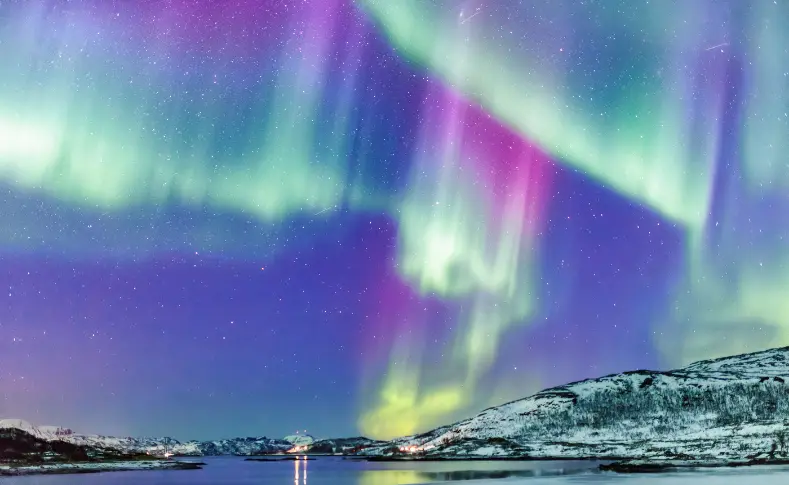
Once particles are inside the magnetosphere, Earth’s own magnetic field lines take over, and those lines converge at the magnetic poles the same way lines of longitude converge at the geographic ones. Particles trapped in the magnetotail get accelerated and funneled down those converging lines, arriving in the upper atmosphere in a ring-shaped zone called the auroral oval, centered on the magnetic pole rather than sitting directly over it. The distinction matters: the patch of sky right above the magnetic pole is often comparatively quiet, while the real activity forms a glowing band around it, typically far enough out that it’s the horizon-to-overhead view from high-latitude cities like Tromsø or Fairbanks rather than something visible only from the exact pole itself.
The magnetic poles this oval centers on aren’t quite where most people picture them, either. The northern geomagnetic pole sits near northwestern Greenland, and its southern counterpart lies off the Antarctic coast south of Australia, both offset from the geographic poles and from each other in ways the planet’s tilted, imperfectly symmetric magnetic field simply produces. Earth’s rotational axis points at a fixed spot in the sky, but the magnetic axis the aurora actually answers to is a separate, messier thing entirely, and during a strong storm, the oval doesn’t just glow brighter, it expands, pushing the visible aurora dramatically closer to the equator than its usual high-latitude home.
The Colors Come From Specific Altitudes
What color a given curtain of aurora shows depends almost entirely on which gas the incoming particles hit and how high up the collision happens. Oxygen produces the most familiar green glow between roughly 100 and 300 kilometers up, the altitude band responsible for the vast majority of aurora photos, and shifts to red above about 240 kilometers, where the atmosphere is thin enough that excited oxygen atoms take longer to release their light and a different transition dominates. Nitrogen takes over below 100 kilometers, adding the blues and purples that show up along the lower fringes of a bright display. A single storm can trigger all three simultaneously at different altitudes, which is part of why the most intense auroras don’t look like one uniform color so much as a layered curtain shifting from purple at the base through green and into red toward the top.
When the Whole System Overloads
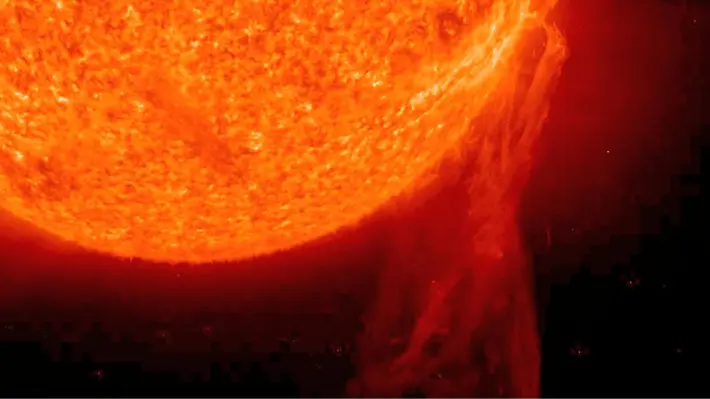
On May 10, 2024, a sunspot region larger than Earth itself, catalogued as AR13664, produced an X8.7 solar flare, the most powerful of the current solar cycle, and launched a rapid sequence of coronal mass ejections that caught up with and merged into one another on the way out, a process researchers call CME cannibalism, arriving at Earth stronger and faster than any single eruption in the sequence would have alone. The resulting geomagnetic storm reached G5, the top of the severity scale and the first storm of that intensity in more than two decades. Its Dst index, a measure of how much the storm temporarily weakened Earth’s own magnetic field, bottomed out at negative 412 nanoteslas, a substantial disturbance against a planetary field that normally sits around 45,000 nanoteslas at the surface.
The storm was named for a scientist who spent her career trying to predict exactly this kind of event, and who died eight days before it actually arrived. worldtimedata
The storm became known as the Gannon Storm, named in honor of space weather physicist Dr. Jennifer Lea Gannon, who had died just eight days before it struck. It’s only the second solar storm in history to receive an informal name at all, after the Carrington Event of September 1859, still the benchmark for how extreme a geomagnetic storm can get: telegraph operators that year reported shocks and sparking equipment, some lines kept transmitting even after being disconnected from their batteries, and aurora was documented as far from the poles as Colombia and the Caribbean. The Gannon Storm didn’t reach that scale, but it came close enough to send aurora over the Florida Keys, Mexico’s Yucatán Peninsula, and the Canary Islands, while observers across the UK saw displays as far south as 54 degrees latitude, and the southern lights turned up over Queensland, Namibia, and southern Brazil on the opposite side of the planet.
Why 2026 Specifically
Storms of that severity aren’t evenly distributed across time; they cluster around solar maximum, the peak of the sun’s roughly 11-year activity cycle, and some researchers link the rough 20-to-25-year spacing between truly extreme events to the sun’s longer 22-year magnetic cycle, the time it takes the sun’s own polarity to return to where it started. Solar Cycle 25 exceeded its predicted peak as early as August 2024, and forecasters have continued to track strong activity well into 2026, meaning the auroral oval has spent an unusually long stretch running wider and brighter than its typical baseline, with real opportunities to see it from latitudes that go dark years at a time during a quieter stretch of the solar cycle.
Time of Year and Time of Night Both Matter
Even independent of the solar cycle, geomagnetic activity isn’t spread evenly across the calendar. Statistics going back decades show a consistent double peak in March and September, clustered around the equinoxes, a pattern known as the Russell-McPherron effect after the geophysicists who first explained it in 1973. At the equinoxes, the geometry between Earth’s tilt and the solar wind’s magnetic field lines up in a way that makes southward Bz statistically more likely, effectively increasing the odds of the same reconnection process described earlier, without any change in how active the sun itself happens to be that week. Within a given night, timing narrows further still: aurora activity tends to peak around what researchers call magnetic midnight, roughly 11 p.m. to 1 a.m. local time, a window that sits slightly offset from solar midnight for the same reason solar noon itself rarely lines up with clock noon: the geometry that actually governs the phenomenon was never going to match a clock built around a much simpler assumption.
A Light Show With an Address
None of what makes the aurora visible only near the poles is really about the poles being special on their own. It’s a direct readout of where Earth’s magnetic field happens to funnel incoming particles, a boundary that shifts with solar activity, breathes wider during storms strong enough to earn a name, and even nudges its most active hours slightly off the clock everyone else is using. The lights only look like they belong to the poles. What they actually belong to is a magnetic field doing exactly what physics predicts, in the one place on the planet built to funnel it there.