Every year, someone calls a local police department or an air traffic control tower to report a slow-moving, unblinking light hovering low in the west after sunset. In an enormous share of these cases, the object turns out to be Venus. It is not a plane, a drone, or a satellite. It is a planet roughly the size of Earth, currently around 25 to 160 million miles away, and it is bright enough to cast faint shadows on a clear night far from city lights. The reason comes down to three physical properties working together, and the way they combine produces a genuinely counterintuitive result: Venus is not brightest when it looks most like a full disk. It is brightest when it is a thin crescent.
How astronomers actually measure “brightest”
Brightness in astronomy is measured on the magnitude scale, where lower numbers mean brighter objects and each step of one magnitude represents a fixed brightness ratio, so the scale runs into negative numbers for the most dazzling objects in the sky. On a clear night, this puts Venus in a category by itself among planets and stars.
| Object | Approximate peak magnitude | Notes |
|---|---|---|
| Sun | -26.7 | For scale only, not a night-sky object |
| Full Moon | -12.6 | Brightest regular night-sky object |
| Venus | -4.9 | Brightest planet by a wide margin |
| Jupiter | -2.9 | Second-brightest planet |
| Mars | -2.9 | Only at its closest approaches, roughly once every 26 months |
| Sirius | -1.5 | Brightest star in the night sky |
Even at its faintest, Venus outshines every star visible from Earth. At its brightest, it is roughly three and a half magnitudes ahead of Sirius, which works out to more than 20 times brighter, and it comfortably beats Jupiter, the next-brightest planet, by a factor of roughly six.
The reflective clouds do most of the work
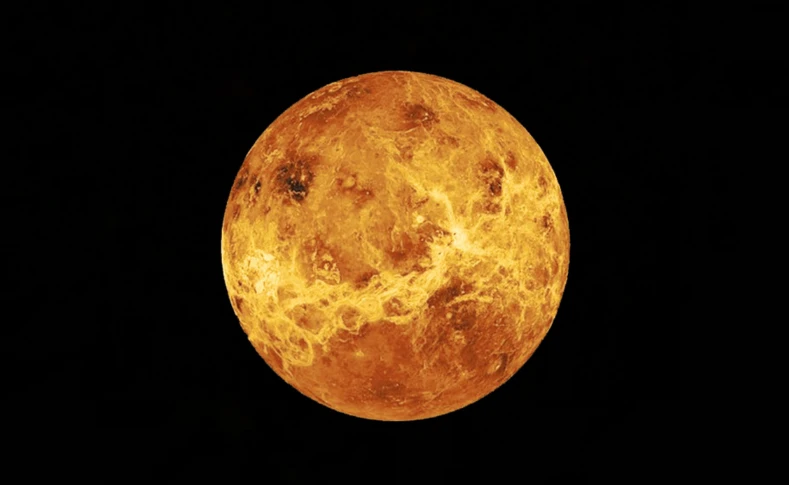
The single biggest factor is albedo, the fraction of sunlight a surface bounces back into space rather than absorbing. A perfectly black object has an albedo of zero; a perfect mirror would have an albedo of one. Venus is entirely wrapped in a permanent, unbroken layer of clouds made largely of sulfuric acid droplets, and different measurement methods put its albedo somewhere between roughly 0.65 and 0.77, depending on the wavelength and technique used. Either way, that makes Venus the most reflective planet in the solar system by a wide margin. For comparison, the Moon’s surface, an airless field of dark volcanic rock and pale highland dust, reflects only about 10 to 12 percent of the sunlight that hits it, and Mercury, similarly airless and dark, sits at roughly 11 percent. Mars, dusty but not cloud-covered, reflects around 15 to 25 percent depending on the source. Venus’s clouds turn nearly three-quarters of the sunlight striking the planet straight back out, which is also why no telescope on Earth has ever photographed the Venusian surface directly in visible light. The same clouds that make the planet dazzling from the outside make its ground permanently invisible from it.
Proximity, and the crescent paradox
The second factor is distance. Venus orbits closer to the Sun than Earth does, and its orbit brings it nearer to Earth than any other planet ever gets, close enough that its disk visibly grows and shrinks in a backyard telescope over the course of months. But proximity alone does not explain peak brightness, because Venus’s distance and its phase change in opposite directions at the same time, the same way the Moon’s phases work. When Venus is closest to Earth, it sits between Earth and the Sun, so from our side of the planet we mostly see its unlit night hemisphere: a thin crescent. When Venus is farthest from Earth, on the far side of the Sun, we see its fully lit dayside, but from nearly its maximum possible distance.
Common sense says a fuller, more illuminated disk should look brighter, the way a full Moon outshines a crescent Moon. Venus breaks that rule, because unlike the Moon, its distance from Earth changes by a factor of roughly six across one cycle, and that swing in distance overwhelms the change in phase. worldtimedata
Detailed photometric studies that tracked Venus’s brightness across 55 years of observations found that its greatest brilliancy happens, on average, when only about 22 percent of its visible disk is lit, a slim crescent, not a full or gibbous shape. At that point Venus typically reaches a magnitude of roughly -4.8, and the single brightest recorded observation, on December 19, 1989, hit magnitude -4.92, with the planet just 0.377 astronomical units from Earth. A crescent Venus that close simply presents more total reflective cloud area to an observer on Earth than a smaller, fully lit disk farther away ever could.
Ancient astronomers were already tracking this 3,600 years ago
Long before anyone understood albedo or orbital mechanics, Babylonian scribes were recording exactly when Venus rose and set. The Venus Tablet of Ammisaduqa, a cuneiform clay tablet now held in the British Museum, logs the planet’s appearances and disappearances over a 21-year span, with the original observations dated to around the mid-17th century BC under the Babylonian king Ammisaduqa. The surviving copies were made roughly a thousand years later, during the Neo-Assyrian period, and the tablet remains one of the oldest continuous astronomical records that has ever been recovered. For centuries, Venus’s dual appearance as both a morning object and an evening object led some cultures to treat it as two separate bodies before the Babylonians and later the Greeks confirmed it was a single planet tracing a repeating cycle.
That cycle has its own strange geometry. Venus and Earth’s orbits align so closely that five of Venus’s 583.9-day synodic periods equal almost exactly eight Earth years, a coincidence accurate enough that if you plot Venus’s position relative to the Sun on the same calendar date across an eight-year span, the points trace out a five-petaled, rose-like pattern in the sky, sometimes called the Venus pentagram. It is one of the more elegant side effects of two planets simply going around the Sun at slightly different speeds.
When the brightest planet gets mistaken for something else
Venus’s brilliance has produced a long, recurring history of misidentification. During the Second World War, pilots and anti-aircraft crews reportedly fired on it more than once, mistaking the steady, brilliant point of light for an enemy aircraft. In more recent decades, it has repeatedly turned up in UFO reports. The most famous case involves former US President Jimmy Carter, who filed an official UFO sighting report in 1973 describing an object he had seen in Leary, Georgia, in 1969. Astronomer and skeptic investigator Robert Sheaffer later argued that sky charts placed Venus at almost exactly the position and time Carter described, and proposed that Carter had witnessed the planet near one of its bright apparitions. Carter himself firmly rejected that explanation, pointing out that he owned a telescope and was, in his words, thoroughly familiar with how Venus looks. Other researchers have floated a competing theory involving a rocket-launched chemical tracer cloud released for upper-atmosphere research around the same period. Neither explanation has been conclusively proven, and the case remains one of the more debated entries in UFO literature, but it illustrates how convincingly a bright planet low on the horizon can read as something artificial to observers who are not expecting to see it.
What actually makes a light in the sky Venus
A few practical signs separate Venus from an aircraft or satellite. It never strays far from the Sun in the sky, appearing only in the west shortly after sunset or the east shortly before sunrise, and it moves so slowly against the background stars that over a single evening it looks essentially fixed in place, unlike a plane. It does not blink, and while its light can appear to shimmer or shift color slightly near the horizon, that effect comes from Earth’s atmosphere bending the light, not from the planet itself. Once you know to look for it, and to check that the light sits low, doesn’t move, and shows up in the same patch of sky night after night, the second-brightest object in the sky stops looking mysterious and starts looking exactly like what it is: a nearby, cloud-wrapped planet doing what it has done since long before anyone thought to write its movements down on clay.