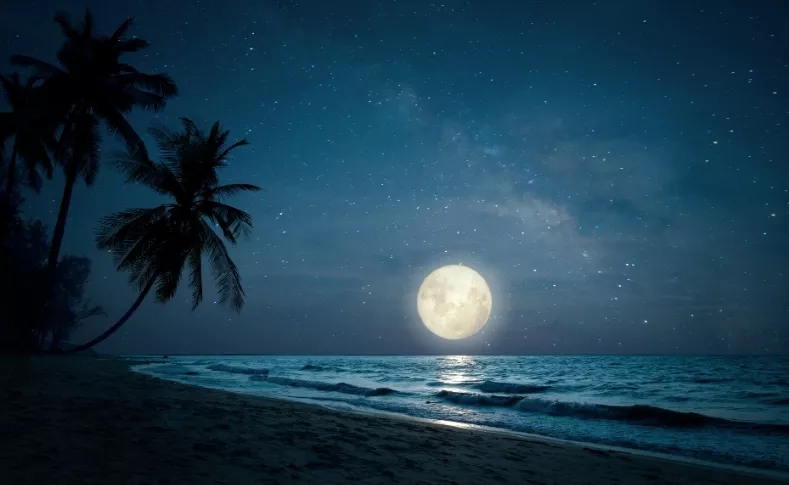
The Moon often looks much bigger when it is near the horizon than when it is high in the sky. It can seem huge as it rises behind trees, buildings, hills, or the ocean, then look smaller a few hours later when it is overhead.
But the Moon does not actually grow larger near the horizon. Its physical size does not change, and its distance from Earth does not suddenly shrink in a way that would explain the dramatic effect. What changes is how the human brain interprets the Moon when it appears close to the landscape.
This effect is known as the Moon illusion. It is one of the most familiar examples of the difference between measured reality and visual perception. Astronomy can measure the Moon’s angular size with precision, but the brain does not experience the sky like a measuring instrument.
The Short Answer: It Is Mostly a Visual Illusion
The Moon looks bigger near the horizon mostly because of a visual illusion. When the Moon is low in the sky, the brain sees it near familiar objects such as trees, buildings, mountains, or distant land. Those objects create depth and distance cues. The Moon appears to belong to that distant scene, so the brain interprets it as larger.
When the Moon is high overhead, there are fewer visual reference points. It is surrounded by open sky, with no nearby objects to compare it against. Without trees, rooftops, or horizon lines, the brain reads the Moon differently. It often seems smaller, even though its measured size in the sky is almost the same.
This is the key point: the Moon’s apparent size changes in perception, not in physical reality. The horizon gives the brain context. The empty sky removes that context.
The illusion can happen during a full moon, crescent moon, or any other phase. It is not caused by the phases of the Moon. A full moon near the horizon may look especially dramatic because it is bright and round, but the size illusion is about where the Moon appears in the sky, not what phase it is in.
The Moon Is Not Actually Much Bigger Near the Horizon
If the Moon really became much larger near the horizon, photographs and measurements would show it clearly. But when the Moon is photographed with the same camera settings and focal length at the horizon and later higher in the sky, its disk is usually almost the same size in the image.
The Moon’s angular diameter is about half a degree in the sky. That means it covers roughly the same small angle whether it is rising, setting, or high overhead. There are small real changes because the Moon’s distance from Earth varies during its orbit, but those changes do not explain the sudden “giant Moon” people notice at the horizon.
In fact, the Moon can be slightly farther from an observer when it is on the horizon than when it is directly overhead, because of the geometry between the observer, Earth, and the Moon. That makes the illusion even more interesting. The horizon Moon can look larger even when geometry does not support the idea that it should be larger.
This is why the Moon illusion is not mainly an astronomy problem. It is a perception problem. The measured Moon and the experienced Moon are not always the same thing.
What the Moon Illusion Means
The Moon illusion is the name for the way the Moon appears larger near the horizon than high in the sky, even when its actual angular size has not changed enough to explain the difference. The illusion has been discussed for centuries because it is so easy to see and so hard to ignore.
There is no single simple explanation that satisfies every detail, but the strongest explanations involve the way the brain judges distance, scale, and context. The horizon is not an empty background. It is full of visual information. Buildings, trees, hills, clouds, roads, and distant objects help the brain build a sense of depth.
When the Moon appears in that scene, the brain may treat it as part of a distant landscape. If something is interpreted as far away but still has the same angular size on the eye, the brain may read it as physically larger. This is one reason the horizon Moon can feel enormous.
High in the sky, the Moon loses that landscape context. It is no longer sitting beside objects that create depth cues. It becomes a bright disk in open space. With fewer visual clues, the Moon often feels smaller.
Why the Horizon Changes How the Brain Reads Size
Human vision does not measure the world like a ruler. The brain constantly interprets size using context. A person standing far away can cast the same image size on the eye as a smaller object nearby, but the brain uses distance clues to decide what is really large and what is really close.
The same logic affects the Moon. Near the horizon, the Moon is surrounded by distance cues. A line of buildings, a mountain ridge, or trees along the horizon gives the brain a sense of scale. The Moon appears beyond those objects, not floating on a blank background. That makes it feel larger.
This is also why the illusion can become stronger in cities or landscapes with clear foreground objects. A Moon rising behind a skyline may look huge because the buildings give the eye something to compare it with. A Moon rising over an empty ocean can also look dramatic because the horizon itself creates a strong spatial reference.
When the Moon is overhead, the sky has very little structure. There is no obvious distance ladder. The brain sees the Moon without the same sense of depth. The result is a smaller-looking Moon, even though the actual angular size has barely changed.
Why Photos Often Prove the Moon Is the Same Size
One of the simplest ways to test the Moon illusion is to photograph the Moon at different heights using the same lens, same zoom, and same camera settings. If the Moon truly became much larger near the horizon, the photo would show a larger disk. In most normal cases, it does not.
This test is useful because a camera records angular size more consistently than human perception. The camera does not care whether the Moon is above a mountain, a city, or an empty sky. If the lens and settings stay the same, the Moon’s image size stays nearly the same.
People are often surprised by this because the visual experience feels so convincing. A horizon Moon can look massive to the eye, yet ordinary in a photograph. That difference shows the power of perception. The brain is not simply recording the Moon. It is interpreting the Moon inside a scene.
There is one important exception. Photos can make the Moon look truly huge when taken with a long telephoto lens and a distant foreground, such as a person, building, or mountain. That is not the natural Moon illusion alone. It is a compression effect caused by lens choice and distance. The Moon appears large relative to the foreground because the camera setup changes the visual relationship between objects.
Why the Horizon Moon Can Look More Colorful
The Moon near the horizon may not only look bigger. It can also look yellow, orange, or red. That color change has a different cause from the size illusion.
When the Moon is low in the sky, its light passes through more of Earth’s atmosphere before reaching your eyes. Along that longer path, shorter blue wavelengths are scattered more strongly, while warmer colors can become more noticeable. Dust, smoke, pollution, humidity, and clouds can make the effect stronger.
This is similar to the process that explains why sunsets are red or orange. The low angle matters because light travels through more atmosphere near the horizon than when the object is high overhead.
So there are two different effects happening at once. The larger-looking Moon is mainly a perception effect. The warmer-looking Moon is mainly an atmospheric effect. They often appear together because both are strongest when the Moon is near the horizon, but they are not the same phenomenon.
Why the Moon’s Position in the Sky Matters
The Moon’s appearance changes with its position in the sky. It can rise near the horizon, climb higher, cross the sky, and set again. Depending on its phase and the time of month, it can also be visible at different times of day and night.
This is why understanding why the Moon is sometimes visible during the day helps separate lunar motion from visual perception. The Moon is not only a nighttime object. Its position depends on its orbit around Earth and its relationship to the Sun.
The Moon illusion is strongest when the Moon is low because the horizon gives the brain context. But the Moon’s actual path is an astronomical matter. Its rising time, setting time, phase, and position can be predicted. Its perceived size, however, depends on how the brain reads the scene.
This distinction is part of a larger idea in astronomy. The sky can be measured precisely, but human experience of the sky is not always the same as the measurement. That gap between observation, timing, and reality is closely related to the idea of astronomical time.
Why the Moon Illusion Feels So Convincing
The Moon illusion feels convincing because the brain is doing what it normally does: interpreting the world through context. Most of the time, this works well. Depth cues help people judge distance, size, movement, and position. Without that interpretation, vision would be far less useful.
The horizon Moon is unusual because the Moon is extremely far away, but the brain still reads it inside a familiar landscape. It sees the Moon near trees, buildings, hills, or the edge of the Earth. That context makes the Moon feel like part of the distant scene, and the brain adjusts its sense of size.
This is why simply knowing the explanation does not always remove the illusion. You can understand that the Moon is not actually much larger and still see it as huge near the horizon. Perception is not always corrected instantly by knowledge.
That is part of what makes the Moon illusion interesting. It is not just an astronomy fact. It is a reminder that the sky is both measured by science and experienced by the human mind.
Real Size, Angular Size, and Perceived Size
The cleanest way to understand the horizon Moon is to separate three things: real size, angular size, and perceived size.
The Moon’s real size does not change as it rises. Its angular size in the sky stays nearly the same over a single night. But its perceived size can change strongly because the brain interprets the Moon differently near the horizon than in an empty sky.
That is why the Moon can look enormous when it rises behind a city skyline and ordinary when it is high overhead. The Moon has not suddenly grown or moved dramatically closer. The visual context has changed.
The Moon illusion works because the brain does not see the sky as raw geometry. It sees scenes, distances, comparisons, and meanings. Near the horizon, the Moon has a world around it. High in the sky, it stands alone. That difference is enough to make the same Moon feel like a different size.