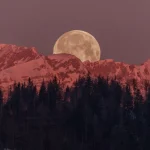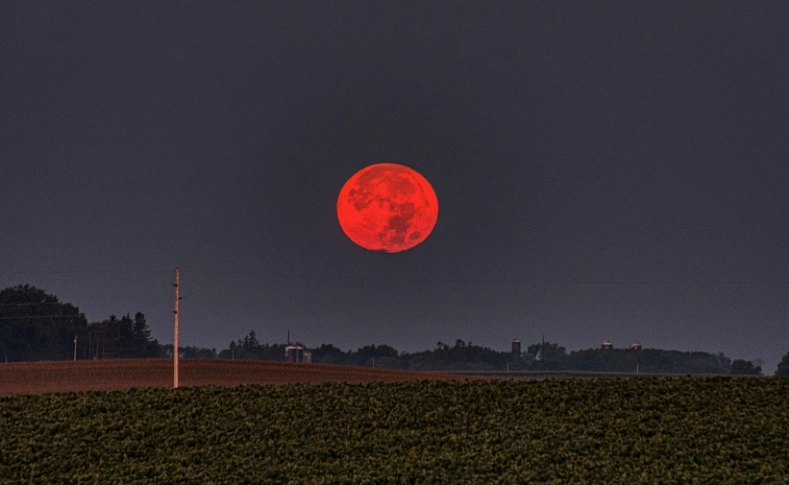
On the night of August 27, 2026, the Moon came within a hair of disappearing entirely. Earth’s shadow covered 96.2% of its surface, a partial eclipse so deep that skywatchers across the Americas, Europe, and Africa watched it turn a rusty, almost total red without technically qualifying as a full blood moon. The last genuine total lunar eclipse happened five months earlier, on March 3, 2026. The next one isn’t until New Year’s Eve, December 31, 2028, rolling into January 1, 2029. Blood moons aren’t rare in the way total solar eclipses are, but they don’t happen on any predictable annual schedule either, and the mechanism that turns the Moon red has nothing to do with blood and everything to do with physics that plays out over Earth’s own head every single evening at sunset.
A blood moon is a total lunar eclipse, full stop. The dramatic name describes a color, not a different astronomical event, and the color comes from the exact same atmospheric process that paints ordinary sunsets orange, just viewed from 384,000 kilometers away instead of from the ground.
What’s Actually Happening: Earth Gets Between the Sun and the Moon
A total lunar eclipse occurs when Earth passes directly between the Sun and a full Moon, and the Moon travels completely into Earth’s umbra, the darkest, most central part of the shadow Earth casts into space. Without any atmosphere involved, a Moon sitting inside Earth’s umbra should receive essentially no light at all and simply vanish into blackness. It doesn’t, because Earth has an atmosphere, and that atmosphere bends a portion of the Sun’s light inward, around the curve of the planet, and projects it onto the lunar surface even while the Moon sits fully in shadow.
The Same Physics That Colors Every Sunset on Earth
The light that reaches the eclipsed Moon has to pass through a long, grazing slice of Earth’s atmosphere at the edges of the planet, essentially every sunrise and sunset happening around Earth’s rim simultaneously, all bent and projected onto one target. That atmosphere scatters short blue and violet wavelengths far more efficiently than long red and orange ones, a process called Rayleigh scattering, the exact mechanism explained in the piece on the sky’s blue color. Blue light gets scattered away before it can bend far enough to reach the Moon.
Red and orange light survives the trip and paints the lunar surface in the same warm tones that color red sunsets back on the ground. If every sunrise and sunset happening on Earth at that moment were gathered up and projected onto a single screen, that screen would look like a blood moon.
Measuring the Color: The Danjon Scale
Not every blood moon looks the same shade of red, and astronomers have a formal way to rate that variation. In 1921, French astronomer André-Louis Danjon proposed a five-point scale, running from L0 to L4, for classifying how dark or bright a totally eclipsed Moon appears.
| Danjon value | Appearance |
|---|---|
| L0 | Very dark; Moon almost invisible, especially at mid-eclipse |
| L1 | Dark, grey or brownish; surface details hard to distinguish |
| L2 | Deep red or rust-colored; dark center with a brighter outer rim |
| L3 | Brick-red, with a bright or yellowish rim |
| L4 | Very bright copper-red or orange, with a bluish, vivid rim |
What pushes an eclipse toward L0 versus L4 comes down to how much dust, ash, and moisture happens to be sitting in Earth’s atmosphere at the time, and one factor dwarfs all the others.
When a Volcano on the Other Side of the World Dims the Moon
Large volcanic eruptions inject huge volumes of ash and sulfur particles into the stratosphere, and that material can linger for months or years, blocking enough sunlight to darken every lunar eclipse that occurs while it’s still suspended up there. After Krakatoa’s catastrophic 1883 eruption, the lunar eclipse the following year was so dark that observers reported the Moon nearly vanishing from view entirely during totality. The same thing happened after Mount Pinatubo erupted in the Philippines in June 1991; the total lunar eclipse of December 1992, roughly a year and a half later, was rated L0 by many observers, its dull grey disk barely visible to the naked eye.
That relationship between eruptions and eclipse darkness turns out to run in a genuinely useful direction for historians, not just astronomers, a connection covered further down.
The Term Is Recent, the Biblical Reference Isn’t
“Blood moon” sounds ancient, and the underlying phrase does trace back to scripture. The book of Joel, in the Hebrew Bible, describes the Sun turning to darkness and the Moon to blood before a coming day of judgment, language echoed later in the book of Acts and the book of Revelation. But the specific term “blood moon,” used casually the way it’s used today to mean any total lunar eclipse, is a modern coinage.
Its widespread popularity dates specifically to 2013 and 2014, when pastors John Hagee and Mark Biltz drew attention to an upcoming lunar tetrad, four consecutive total lunar eclipses with no partial eclipses in between, falling on April 15 and October 8, 2014, and April 4 and September 28, 2015. Hagee’s 2013 book, “Four Blood Moons: Something Is About to Change,” became a bestseller and argued the tetrad, which happened to fall on Jewish holy days including Passover and Sukkot, signaled major prophetic significance tied to Israel. Biblical scholars and Baptist theologians pushed back publicly at the time, noting that Joel’s original passage describes cosmic upheaval, earthquakes and darkness, alongside the Moon’s color change, conditions the 2014-2015 tetrad didn’t come close to meeting. The tetrad passed without incident. The next one isn’t projected until 2032, but the casual media shorthand “blood moon” for any total lunar eclipse stuck permanently after 2014, regardless of the prophecy attached to it.
Upcoming Blood Moons
| Date | Type | Notes |
|---|---|---|
| March 3, 2026 | Total lunar eclipse | Totality lasted roughly 58 minutes; visible from Asia, Australia, and the Americas |
| August 27-28, 2026 | Deep partial eclipse | 96.2% of the Moon covered; visible from the Americas, Europe, and Africa |
| December 31, 2028 – January 1, 2029 | Total lunar eclipse | Nicknamed the “New Year’s Blood Moon” |
| June 26, 2029 | Total lunar eclipse | Second of a run of three total eclipses within roughly six months |
| December 20-21, 2029 | Total lunar eclipse | Third eclipse in the 2028-2029 run |
Total lunar eclipses can only happen on the night of a full moon, when the Sun, Earth, and Moon line up closely enough for Earth’s shadow to fall on the lunar surface, the same underlying alignment behind a supermoon’s mechanics. Most full moons don’t produce an eclipse at all, because the Moon’s orbit is tilted slightly relative to Earth’s, and it usually passes just above or below Earth’s shadow rather than through it.
The Rare Trick of Seeing the Sun and the Eclipsed Moon at Once
Because a total lunar eclipse only happens during a full moon, the Moon should, by definition, be roughly opposite the Sun in the sky, rising as the Sun sets. Occasionally, atmospheric refraction bends both objects’ apparent positions enough that an observer near the horizon at just the right moment can glimpse the setting Sun and the rising, already-eclipsed Moon simultaneously, both appearing to sit above the horizon at once even though the geometry says only one should be visible. This effect has a name, a selenelion, and it’s only observable for a few minutes around sunrise or sunset on eclipse day, from a narrow band of locations where the timing lines up.
Using Old Blood Moons to Find Volcanoes Nobody Wrote Down
The Krakatoa and Pinatubo connection turns out to run both directions. A 2023 study published in Nature used exactly this relationship in reverse: researchers combed through historical chronicles describing the color and darkness of lunar eclipses going back centuries, converted those descriptions into Danjon-scale ratings, and cross-referenced them against tree-ring records and known climate anomalies. Because a dark, nearly invisible total lunar eclipse reliably indicates heavy volcanic aerosol loading in the stratosphere at that time, a string of unusually dark medieval eclipses, described in monastery records and court chronicles centuries before anyone understood why the Moon sometimes nearly disappeared, let the researchers pin down the approximate timing of several major volcanic eruptions that occurred without any surviving written record of the eruption itself. Nobody who watched those blood moons vanish into near-blackness knew they were logging data for a climate study that wouldn’t exist for another six or seven hundred years.