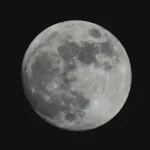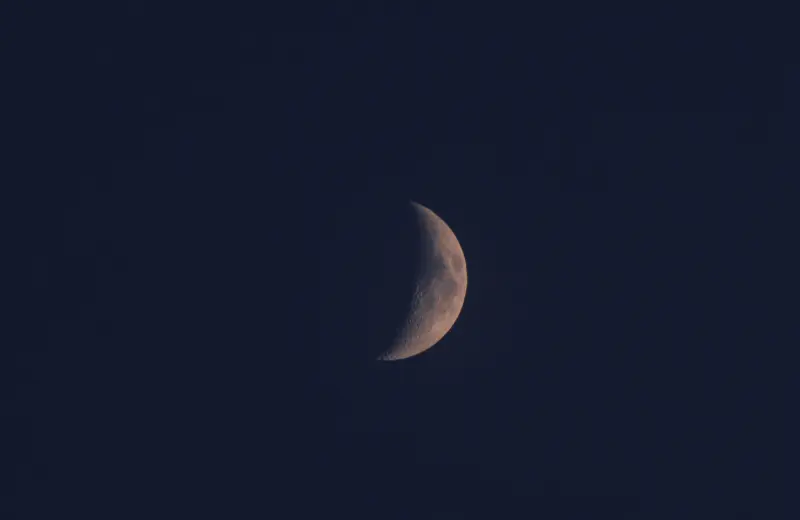
The Moon is one of the most visible objects in the sky, yet most people see it as something simple and unchanging. In reality, it is constantly shifting, and these changes follow precise physical laws.
The phases of the Moon are the result of the interaction between the Earth, the Moon, and the Sun. They show how sunlight falls on the Moon’s surface and how that illuminated part appears from Earth.
The Moon itself does not change. What changes is how its illuminated surface is viewed from Earth. The Moon remains the same object, but its visible portion changes as the geometry between these three bodies evolves over time.
This process is part of astronomical time, where time is defined by the motion of celestial bodies rather than calendar systems. Unlike calendar dates, which are fixed and artificial, lunar phases are dynamic and directly tied to physical motion in space.
Understanding lunar phases helps explain many things, from night sky illumination to natural cycles that affect life on Earth. It also provides a more intuitive way to see how time itself is connected to movement, light, and position in the universe.
What Are the Phases of the Moon
The phases of the Moon are the different visible shapes of its illuminated portion as seen from Earth. The Moon itself does not change shape and does not produce light. It only reflects sunlight.
This means that each phase reflects a specific geometric angle between the Sun, Earth, and Moon, making the entire cycle predictable and consistent over time.
Although the sequence appears simple, it reflects a precise spatial relationship that can be measured and predicted with high accuracy.
How the Lunar Cycle Works
A full lunar cycle lasts about 29.5 days. This is the time it takes for the Moon to go through all phases, from new moon to full moon and back again.
This cycle follows a precise pattern defined by the relative motion of the Earth, the Moon, and the Sun. As the Moon orbits Earth, the angle at which sunlight reaches its surface constantly changes, and this is what creates the visible phases.
It is also part of larger natural cycles that shape light patterns, day length, and environmental rhythms on Earth.
One important detail is that the Moon does not simply orbit Earth in isolation. At the same time, Earth is moving around the Sun. Because of this, the Moon needs more than one full orbit to return to the same phase as seen from Earth.
That is why the lunar cycle is about 29.5 days, not 27.3 days. The extra time accounts for the changing position of Earth in its orbit.
This constant motion is also the reason lunar phases do not align with calendar dates. Each cycle shifts slightly, making the Moon a natural timekeeper that operates independently of human-made systems.
Main Phases of the Moon
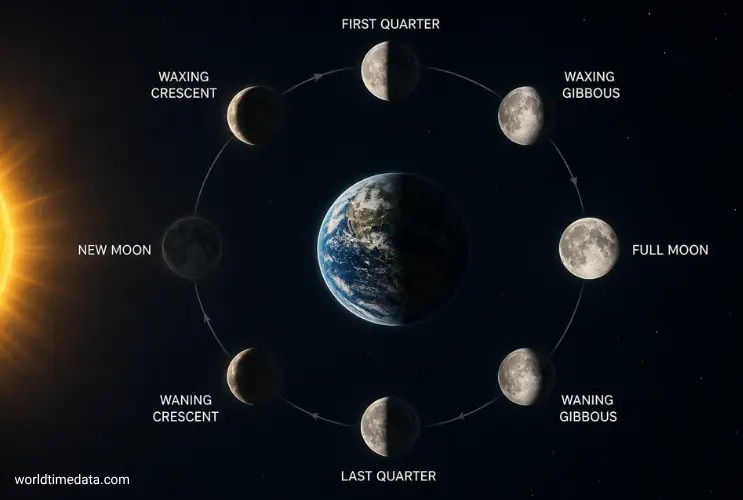
The lunar cycle consists of eight main phases that form a repeating sequence, each representing a different stage of illumination.
Each phase represents a specific geometric position between the Earth, the Moon, and the Sun.
Together, they create a continuous transition from darkness to full illumination and back again, reflecting how light interacts with the Moon’s surface over time.
| Phase | Type | Illumination | Visibility | What Happens |
|---|---|---|---|---|
| New Moon | Main | 0% | Not visible | Moon between Earth and Sun |
| Waxing Crescent | Intermediate | 0–50% | Evening | Illumination increasing |
| First Quarter | Main | 50% | Afternoon / evening | Half of the Moon is visible |
| Waxing Gibbous | Intermediate | 50–100% | Evening / night | Approaching full moon |
| Full Moon | Main | 100% | All night | Earth between Sun and Moon |
| Waning Gibbous | Intermediate | 100–50% | Night / morning | Illumination decreasing |
| Last Quarter | Main | 50% | Night / morning | Three quarters of cycle passed |
| Waning Crescent | Intermediate | 50–0% | Morning | Cycle ending |
Main phases mark key points in the cycle, where the Moon reaches clear geometric positions. Intermediate phases represent the transition between these points, showing how illumination gradually increases or decreases.
Each phase is not a separate event, but part of a continuous process. The Moon never “jumps” from one phase to another. Instead, it moves smoothly through all stages as its position in space changes.
The phases of the Moon are not a change in the object, but a change in how we see it.
worldtimedata
Why the Cycle Lasts 29.5 Days
The Moon completes one orbit around Earth in about 27.3 days. This is known as the sidereal month and describes its motion relative to distant stars.
However, this is not enough to return to the same phase. Phases depend on the alignment between the Sun, Earth, and Moon, not just the Moon’s position in space.
29.5 days = full phase cycle (synodic month)
The difference exists because Earth is constantly moving around the Sun. While the Moon completes one orbit, Earth has already shifted along its own path.
As a result, the Moon must travel a bit further to reach the same alignment with the Sun as seen from Earth. This additional motion adds about two extra days to the cycle.
This is why the visible phases repeat every 29.5 days, not 27.3. It is a direct result of motion within a dynamic system rather than a single orbit.
How Lunar Phases Affect Earth
The lunar cycle affects far more than the appearance of the night sky. It is directly linked to physical processes on Earth.
The most visible effect is tides. The Moon’s gravity pulls on Earth’s oceans, creating a rhythmic rise and fall of water levels that follows a predictable pattern.
This influence becomes stronger or weaker depending on the phase. During new moon and full moon, when the Sun and Moon are aligned, tides are more extreme. During quarter phases, they are less pronounced.
Beyond oceans, lunar phases also affect nighttime illumination. A full moon can significantly increase natural light levels, while a new moon creates much darker conditions.
These changes influence animal behavior, migration patterns, and certain biological rhythms that depend on light and timing.
In this way, the lunar cycle is not just something we observe. It is part of a larger system that shapes how we experience time, light, and environmental change on Earth.
Why Phases Keep Shifting
Lunar phases do not repeat on the same dates each month. This is not because the cycle changes, but because the calendar does not match it perfectly.
Calendar month = 30 or 31 days
This difference may seem small, but it accumulates. Each month, lunar phases shift forward by about one to two days relative to the calendar.
Over time, this creates a noticeable drift. A full moon that appears early in one month may occur closer to the end of the month later in the year.
Leap years add another layer to this effect. By inserting an extra day into the calendar, they slightly shift how weekdays and dates align with the lunar cycle.
This is why lunar phases are never fixed to specific dates. They follow astronomical motion, while the calendar follows a structured system designed for human use.
How to Read the Moon Phase in the Sky
You do not need calculations or tools to understand the Moon’s phase. In most cases, simple observation is enough.
The key is to look at which side of the Moon is illuminated. In the Northern Hemisphere, if the right side is lit, the Moon is waxing, meaning it is moving toward full moon. If the left side is lit, it is waning, moving back toward new moon.
This visual pattern reflects the direction of the cycle and the changing position of the Moon relative to the Sun and Earth.
You can also estimate the phase based on time. By tracking the date of the last new moon and counting forward through the 29.5-day cycle, it becomes possible to predict the current phase with reasonable accuracy.
Over time, this process becomes intuitive. Instead of checking a calendar, you begin to recognize the Moon’s state directly from its shape and position in the sky.
Why the Moon Cycle Matters
The phases of the Moon are more than a visual change in the night sky. They are a direct result of how Earth, the Moon, and the Sun interact within a dynamic system.
What appears as a simple shift in shape is actually the visible effect of motion, light, and alignment in space. These changes follow consistent patterns that can be observed, predicted, and understood.
The lunar cycle also connects to real processes on Earth, from tides to biological rhythms, making it part of how natural systems function over time.
It becomes a reference point for how motion shapes patterns and how those patterns define our experience of time in the physical world and beyond.