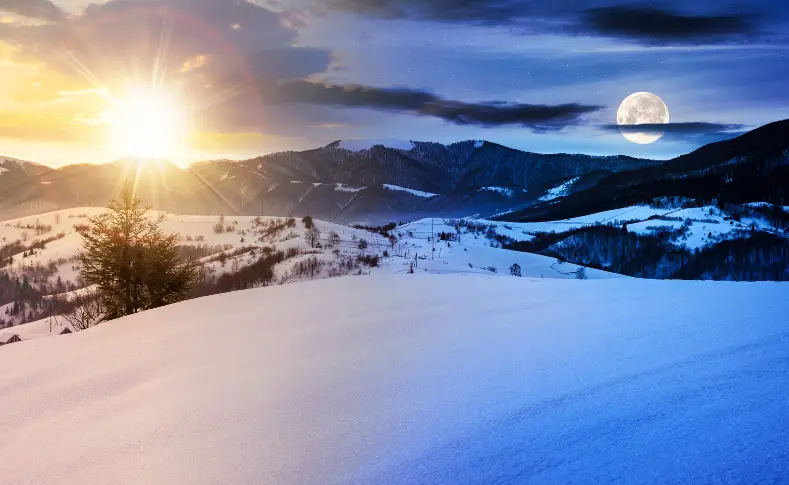
Four times a year, the sun does something specific and predictable enough that civilizations without clocks or written calendars built stone monuments to track it. Two of those moments are solstices, two are equinoxes, and together they’re the only truly fixed points in a year that otherwise drifts, wobbles, and lags behind what the sky is actually doing. Most explanations stop at “the day the sun is highest” or “the day with equal daylight.” Neither is quite right, and the gap between the popular version and the actual mechanics is where this gets interesting.
The Tilt Is the Entire Mechanism
Earth’s axis sits at roughly 23.4 degrees off the perpendicular to its orbital plane, and that single number is responsible for solstices, equinoxes, and every season in between. As Earth orbits the sun, the axis keeps pointing in the same direction in space, which means the hemisphere tilted toward the sun changes depending on where Earth happens to be in its orbit. Tilted toward the sun means longer days and higher sun angles. Tilted away means the opposite. Nothing about Earth’s distance from the sun is doing this work; the tilt alone explains why the sun’s height at solar noon changes throughout the year, and why that change reverses direction twice annually.
Solstice: The Two Days the Tilt Maxes Out
A solstice happens when Earth’s axis is tilted as far as it will get, either toward or away from the sun, for that half of the orbit. Around June 21, the Northern Hemisphere is tilted at its maximum toward the sun, producing the longest day of the year north of the equator and the shortest one south of it. Around December 21, the tilt reverses, and the Southern Hemisphere gets its longest day while the north gets its shortest. The word itself comes from the Latin for “sun stands still,” describing how the sun’s daily maximum height stops climbing or dropping and briefly holds steady before reversing course, at least as far as the eye watching the horizon each noon can tell.
The effect scales with latitude. Near the equator, the difference between a solstice and any other day is barely noticeable, sometimes just minutes of daylight. Near the poles, it’s total: a June solstice inside the Arctic Circle means the sun never sets, and a December solstice there means it never rises.
Equinox: Almost Equal, Never Quite
An equinox happens at the midpoint between the two solstices, when Earth’s axis is tilted neither toward nor away from the sun, and the sun crosses directly over the equator. This is the point most explanations get slightly wrong: an equinox is not the day of exactly equal daylight and darkness, anywhere on Earth.
Two things push against a clean 12-and-12 split. First, sunrise and sunset are measured from the moment the top edge of the sun’s disk appears or disappears, not its center, which adds a few extra minutes of daylight on both ends of the day. Second, Earth’s atmosphere bends sunlight around the curve of the horizon, so the sun is technically still below the horizon geometrically when it’s already visible, and still visible after it’s geometrically set. Combined, these two effects add roughly six to seven minutes of daylight beyond the theoretical equal split, on every equinox, everywhere. The day when daylight and darkness actually come closest to a true 12-hour split, called the equilux, lands a few days before the spring equinox and a few days after the fall one, not on the equinox itself.
The Distance Myth
It feels intuitive that summer should mean Earth is closer to the sun, and winter farther away. It’s backward. Earth reaches perihelion, its closest point to the sun all year, in the first days of January, squarely in the middle of the Northern Hemisphere’s winter. It reaches aphelion, its farthest point, in the first days of July, during the Northern Hemisphere’s summer.
The distance difference is real but small, roughly 3 percent between the two extremes, which translates to about a 7 percent difference in solar energy received. Compare that to what axial tilt does: the angle change between summer and winter alters the solar energy hitting mid-latitudes by something closer to 50 percent. Distance is a minor modifier riding on top of a much larger effect, not the cause of anything by itself.
There’s a genuine consequence buried in this, though. Because perihelion lines up with Southern Hemisphere summer, the south receives slightly more solar intensity during its summer than the north does during its own summer six months later. And because Earth moves faster in its orbit when it’s closer to the sun, the stretch of orbit covering Southern Hemisphere summer is completed slightly quicker than the stretch covering the north’s summer, making northern summers a few days longer than southern ones, and southern winters a few days shorter than northern ones.
Why the Solstice Isn’t the Hottest Day
If the June solstice delivers the most direct sunlight of the year to the Northern Hemisphere, it would seem to follow that late June should be the hottest stretch of the year. It isn’t. In most Northern Hemisphere locations, the hottest days arrive in late July or into August, four to six weeks after the solstice has already passed.
The delay is called seasonal lag, and it comes down to how slowly water heats up. Oceans cover 71 percent of Earth’s surface and have a far higher heat capacity than land or air, meaning they absorb a large amount of solar energy before their temperature actually rises. Through the weeks after the solstice, incoming solar energy is still exceeding what the oceans and landmasses are radiating back out, so the system keeps warming even as daylight hours start shrinking again. The same lag runs in reverse after the December solstice, which is why January and February are typically colder than the solstice date itself would suggest. One clean illustration of the effect: the September equinox in the Northern Hemisphere is reliably warmer than the March equinox, even though both days deliver essentially identical daylight and sun angle. The difference isn’t the sky. It’s how much heat the ocean happened to be carrying into that particular day.
The Dates Don’t Stay Still Either
None of these four moments land on a fixed calendar date, because the tropical year, the time it takes Earth to go from one March equinox to the next, runs about 365.24 days, not a clean 365. Each year, the equinoxes and solstices drift roughly six hours later than the year before, which is exactly the imbalance leap years exist to correct. Without that extra day every four years, the solstices and equinoxes would keep sliding later on the calendar, decade after decade, until June solstices were happening in what the calendar still called spring.
Even with leap years keeping the broader drift in check, the exact date and hour still shift by a day or so from year to year, and the daily creep in sunrise and sunset times that builds up between one solstice and the next is the same underlying mechanism playing out on a shorter timescale. The four-day framework is stable. The precise minute it lands on never quite is.
The sun doesn’t slow down or speed up at a solstice. Earth’s axis just stops changing its mind for a moment, and then starts again. worldtimedata
Four Fixed Points on a Moving Target
What makes solstices and equinoxes worth tracking isn’t that they’re dramatic; on the ground, most of them pass without anything visibly happening at all. It’s that they’re the only four moments in the year defined by pure geometry rather than convention, culture, or a committee’s decision about where a month should start. Every calendar humans have ever built, however it carves up the months in between, still has to answer to these same four points, because they’re the ones the sky sets on its own.