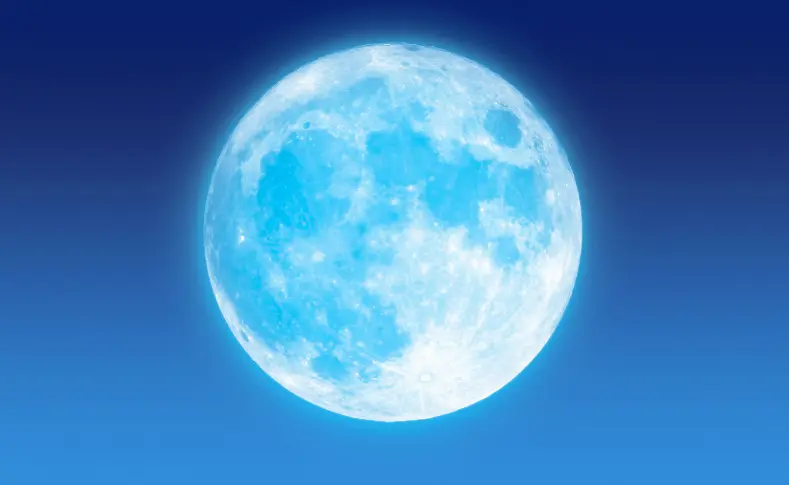
A blue moon almost never actually looks blue, and the definition most people confidently repeat, the second full moon in a calendar month, is itself the result of a 1946 magazine writer’s educated guess that turned out to be wrong. It took the very same magazine 53 years to admit the mistake, by which point the error had already become the accepted meaning of the phrase.
The Definition Everyone Knows Is a Mistake
In March 1946, amateur astronomer James Hugh Pruett published an article titled “Once in a Blue Moon” in Sky & Telescope magazine. Trying to explain the phrase’s origin, he turned to the 1937 Maine Farmers’ Almanac, edited at the time by Henry Porter Trefethen, but its actual rule for naming a blue moon was tangled up in older church-calendar conventions dense enough that Pruett apparently couldn’t fully untangle it. So he offered his own interpretation instead: a blue moon, he wrote, was simply the second full moon to occur within a single calendar month. It was a clean, easy-to-remember rule, and it spread quickly, but it wasn’t what the almanac had actually meant at all.
What the Almanac Actually Meant
The real, original rule was seasonal rather than monthly. Each of the year’s four seasons normally contains exactly three full moons, and the Maine Farmers’ Almanac had long assigned each of those three a traditional name tied to the season, an early moon, a middle moon, and a late moon carrying its own specific label, the same kind of moon-anchored calendar logic that still determines Easter’s date every year. Roughly every two to three years, a season ends up with four full moons instead of three, since the moon’s cycle doesn’t divide evenly into a calendar year. Rather than let that extra moon throw off the traditional naming sequence, the almanac’s editors labeled the third full moon of an overloaded season the blue moon, freeing up the fourth and final moon to keep the correct traditional name it would have carried anyway.
An overloaded season = 4 full moons
Naming the 3rd moon “blue” lets the 4th moon keep its correct seasonal name
Result: the calendar of moon names stays consistent, season after season
The Error That Compounded Itself
Sky & Telescope didn’t just publish Pruett’s guess once and move on. In May 1950, the magazine repeated the monthly definition in a short note, and the lunar phase data behind that note came, almost unbelievably, from Trefethen himself, the very almanac editor whose original seasonal rule Pruett had misread four years earlier. Trefethen never actually called the second full moon in a month a blue moon; the headline attaching that label appears to have been added by the magazine’s own founding editor without consulting him. From there the error only spread further: the popular radio program StarDate used the monthly definition on air in January 1980, and the 1986 edition of Trivial Pursuit printed it as a trivia answer, cementing it in pop culture years before anyone traced it back to its source.
A magazine published a guess in 1946, repeated it by accident in 1950, and spent the next 53 years watching the guess become common knowledge before finally correcting itself. worldtimedata
The correction finally came in March 1999, in the pages of the same magazine that had started the confusion. Researcher Phillip Hiscock, working with Texas astronomer Donald W. Olson, traced the entire chain of misunderstanding back to Pruett’s original 1946 article and published the findings in Sky & Telescope itself, more than half a century after the mistake was first printed. By then, the monthly definition had already won.
How Often It Actually Happens
Both definitions describe genuinely uncommon events, just on slightly different schedules. A lunar cycle, the time between one full moon and the next, averages 29.53 days, while a year runs about 365.24 days, working out to roughly 12.37 full moons per year rather than a clean 12. That extra fraction accumulates into a genuine 13th full moon in a given year about every two to three years, which is what makes either kind of blue moon possible in the first place.
| Definition | Rule | Approximate frequency |
|---|---|---|
| Modern (monthly) | Second full moon in one calendar month | Every 2.7 to 2.8 years |
| Original (seasonal) | Third full moon in a season with four | Every 2 to 3 years |
The Moon That Actually Looks Blue Is a Completely Different Thing
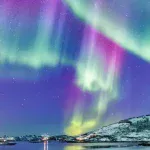
Every so often, the moon genuinely does take on a visible blue tint, and it has nothing to do with either calendar definition above. The effect requires airborne particles of a very specific size, close to the wavelength of red light, roughly 0.6 to 1 micron across, small enough to stay suspended high in the atmosphere but large enough to scatter red light out of the way while letting blue light pass through relatively undisturbed. Volcanic ash and wildfire smoke are the two most reliable sources of particles that size. The most dramatic documented case followed the 1883 eruption of Krakatoa in Indonesia, which threw ash roughly 50 miles into the atmosphere and left the moon looking distinctly blue across parts of Europe and the Americas for months afterward, an effect widely believed to be part of the same volcanic atmospheric disturbance that produced the vivid, unsettling sunset colors Edvard Munch is thought to have captured in his 1893 painting The Scream. Later eruptions, including Mount St. Helens in 1980, Mexico’s El Chichón in 1983, and Mount Pinatubo in 1991, produced the same effect on smaller scales, and large wildfires have done it too: smoke from forest fires in Alberta in September 1950 tinted the sun pink, blue, and even purple as far away as the Great Lakes and New England.
None of that has any connection to a calendar-defined blue moon, monthly or seasonal. A blue moon by either counting method almost always looks exactly like an ordinary full moon, pale white or faintly gray, precisely as unremarkable in color as the moon looks every other night of the month.
An Idiom That Used to Mean Something Stronger
The phrase “once in a blue moon” is actually older than any of this astronomy. Centuries before anyone attached it to a lunar calendar rule, English speakers used “blue moon” to describe something patently absurd or impossible, closer in meaning to “when pigs fly” than to “rarely.” The moon’s own cycle gave the phrase somewhere concrete to attach itself to once astronomers started publishing about it, and over time the meaning softened from impossible to merely rare, landing on the phrase everyone recognizes today, still describing something uncommon, just no longer describing something that never happens at all.