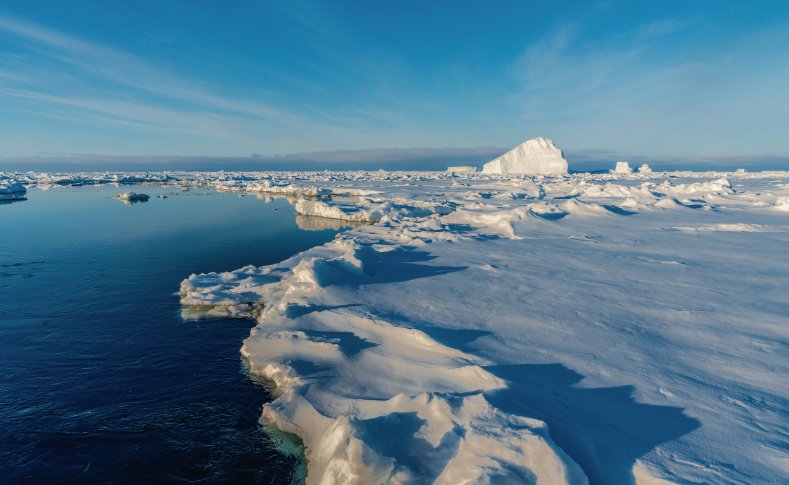
In Utqiagvik, Alaska, the sun set on November 18 and will not appear again until January 22. That’s 65 days straight with no sunrise at all. Five months later, the same town gets the opposite deal: about 84 days where the sun never dips below the horizon, even at midnight. Neither is a myth or a tourist exaggeration. Both are the direct, predictable result of how far north the town happens to sit, and the same math plays out in reverse at the bottom of the planet.
Why the Sun Refuses to Set (or Rise)
Earth’s axis is tilted about 23.4 degrees relative to its orbital plane. That tilt is the entire reason sunrise and sunset times shift anywhere on the planet, and at high latitudes the effect becomes extreme enough to eliminate sunrise or sunset altogether. For half the year, the North Pole leans toward the sun and the Arctic gets continuous daylight. For the other half, it leans away and the Arctic goes dark. The Antarctic runs on the opposite schedule, six months out of phase, which is why it is midnight sun in one hemisphere exactly when it is polar night in the other.
Where the Polar Circles Actually Sit
The Arctic Circle and Antarctic Circle mark the latitude, currently about 66°33’49” (roughly 66.5°), where the sun stays up for a full 24 hours at least once a year, on the June or December solstice. That line is not permanently fixed. It shifts slightly over centuries as Earth’s axial tilt itself oscillates, the same slow wobble that governs the exact dates of the equinoxes and solstices. Cross the line and the phenomenon appears for one day a year. Travel further toward either pole and it stretches from weeks into months.
Three Kinds of Darkness
Polar night is not a single flat state of blackness everywhere inside the circle. How dark it actually gets depends on how far below the horizon the sun sits at local noon, and that depends on latitude.
| Type | Sun’s Position at Noon | Approximate Latitude Band | What It Looks Like |
|---|---|---|---|
| Civil polar night | 0 to 6 degrees below horizon | 66.5° to 72.5° | A few hours of dim, bluish twilight around midday |
| Nautical polar night | 6 to 12 degrees below horizon | 72.5° to 78.5° | Shapes are visible outdoors, but too dark for detail |
| Astronomical polar night | 12 to 18 degrees below horizon | 78.5° to 84.5° | Stars fully visible even at midday |
| True polar night | More than 18 degrees below horizon | 84.5° to 90° | Complete darkness, no residual glow at all |
This is why residents of places like Longyearbyen still describe seeing a faint blue glow on the horizon in the middle of their “dark season.” They are far enough north for the sun to disappear, but not far enough for the sky to go fully black at noon.
How Long It Actually Lasts, Place by Place
Duration scales fast with latitude. A few extra degrees north or south can turn a one-day event into a season that eats a quarter of the calendar.
| Location | Latitude | Polar Day Length | Polar Night Length |
|---|---|---|---|
| Arctic/Antarctic Circle (exact line) | 66.5° | 1 day (June solstice) | 1 day (December solstice) |
| Tromsø, Norway | 69.6°N | About 2 months (mid-May to late July) | About 2 months (late Nov to mid-Jan) |
| Utqiagvik, Alaska | 71.2°N | About 84 days (May to Aug) | About 65 days (Nov to Jan) |
| Longyearbyen, Svalbard | 78.2°N | About 126 days (Apr 19 to Aug 23) | About 76 days (Nov 14 to Jan 29) |
| South Pole (Amundsen-Scott Station) | 90°S | About 6 months (Sept equinox to March equinox) | About 6 months (March equinox to Sept equinox) |
At the poles themselves, the sun rises and sets exactly once per year, right at the equinoxes. Staff at the South Pole station get a single sunrise in September and a single sunset in March, with nothing in between but one uninterrupted stretch of light and one of dark.
The Asymmetry Nobody Expects
Atmospheric refraction bends sunlight around the curve of the Earth, which means the sun becomes visible slightly before it has geometrically risen and stays visible slightly after it has geometrically set. That bending makes polar day measurably longer than polar night, and it pushes the effective boundary of “midnight sun” territory a little further from the pole than the boundary of “polar night” territory. The two zones are not exact mirror images of each other, even though the underlying tilt is symmetrical.
There is also a hemispheric quirk with almost no year-round population south of the polar circle to notice it. Nearly all of the land inside the Antarctic Circle is uninhabited outside of research stations, so while Arctic communities in Norway, Alaska, Canada, and Finland have built centuries of culture and infrastructure around the light cycle, its Southern Hemisphere counterpart is experienced almost exclusively by rotating scientific crews and the occasional expedition ship, since Antarctica has no standard time zone to even structure a normal working day around.
Living Through It
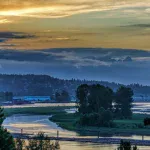
Communities inside the circle have built real traditions around the light cycle rather than just enduring it. Tromsø celebrates “Soldagen,” or Sun Day, on January 21, the day the sun clears the surrounding mountains again after the polar night. Around 40,000 sun buns get baked and eaten across the city that single day. In Svalbard, locals describe genuinely looking forward to the dark season each year as a slower, cozier stretch of the calendar rather than something to dread, helped along by the low, warm-toned light that hangs around the horizon during the transition weeks, the same kind of light photographers chase during golden hour at any other latitude, just stretched out for hours instead of minutes.
Any planet or moon with a meaningful axial tilt produces some version of polar day and polar night, the same tilt that gives Earth its seasons guarantees it wherever a world spins fast enough relative to its orbit. worldtimedata
The Place That Gets Almost Nothing In Between
Alert, a Canadian Forces and weather station on Ellesmere Island in Nunavut, sits at 82.5°N, just 817 kilometers from the North Pole, making it the northernmost continuously inhabited place on Earth. For ten months of the year, Alert is in either complete sunlight or complete darkness. Only about two months out of twelve give its handful of rotating residents anything resembling an ordinary sunrise and sunset at all, the brief transitional weeks in spring and autumn when the rest of the world’s daily rhythm of light and dark actually applies there.