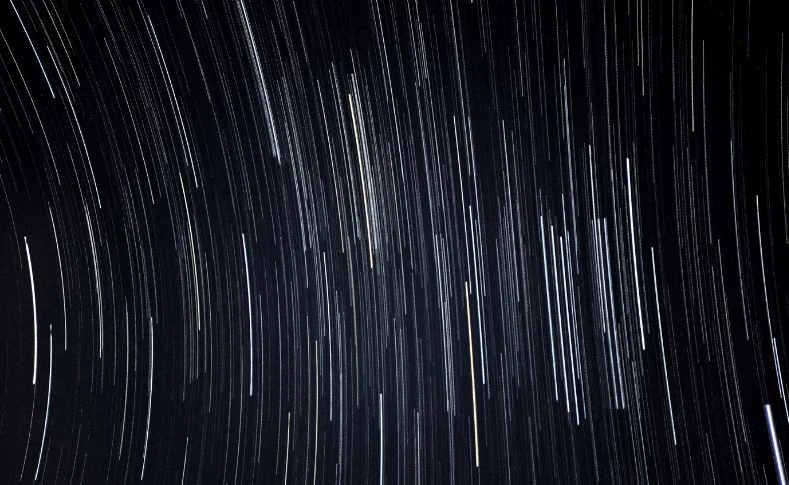
Ask how long it takes Earth to spin once on its axis and the honest answer depends on what you’re measuring the spin against. Measured against the sun, a full rotation takes 24 hours, the day everyone lives by. Measured against the distant stars, that same rotation takes 23 hours, 56 minutes, and 4 seconds. Both numbers are correct. They’re just answering two different questions, and the four-minute gap between them is the entire reason astronomers keep a separate clock that has nothing to do with sunrise or sunset.
Two Ways to Define “One Full Turn”
A solar day is the time between one solar noon and the next, the sun returning to the same position directly overhead. A sidereal day is the time it takes a specific star to return to that same overhead position instead. The two would be identical if Earth only spun in place. It doesn’t. While Earth completes one rotation, it also moves roughly one degree along its orbit around the sun, which means the sun isn’t quite back in its earlier position yet when the stars are. Earth has to keep turning for about four more minutes to catch the sun up to where it needs to be for solar noon.
That single extra sidereal rotation per year is the direct fingerprint of Earth’s orbital motion. A planet that didn’t orbit its star at all would have identical solar and sidereal days, no gap, no extra rotation, ever.
Why Astronomers Care About the “Wrong” Day
Telescopes don’t point at the sun most of the time, they point at stars, planets, and galaxies whose positions are fixed relative to the celestial sphere, not to Earth’s relationship with the sun. Astronomers assign every object a coordinate called right ascension, and a given object crosses an observer’s meridian, the imaginary line running directly overhead from north to south, exactly when the local sidereal time equals that object’s right ascension. Scheduling an observation around solar-based civil time instead would mean the target drifts out of position by roughly four minutes every single day, throwing off exactly when it’s highest in the sky and least distorted by the atmosphere.
The Same Star, Different Clock Time Every Night
That four-minute daily creep is small enough to miss night to night but adds up fast over weeks.
| Time Elapsed | How Much Earlier a Given Star Rises |
|---|---|
| 1 day | About 4 minutes |
| 1 week | About 28 minutes |
| 1 month | About 2 hours |
| 1 year | Back to the same time (a full sidereal day gained) |
This is the actual mechanism behind the sky’s seasonal rotation, the reason Orion dominates winter evenings and Scorpius takes over by summer. The stars aren’t moving through the seasons. Earth’s clock is simply sliding out of sync with them by four minutes a day, every day, all year.
A Second, Separate Kind of Mismatch: Sidereal Year vs Tropical Year
Rotation isn’t the only place sidereal and solar-based measurements disagree. Earth’s orbit produces its own version of the same problem, on a much longer timescale. A sidereal year, the time for Earth to complete one orbit relative to the fixed stars, runs about 365.256 days. A tropical year, the time from one spring equinox to the next, runs about 365.242 days, roughly 20 minutes shorter. The difference comes from axial precession, the slow wobble of Earth’s rotational axis, the same wobble behind Polaris losing its role as the North Star over the coming millennia.
| Measurement | Length | Defined Relative To |
|---|---|---|
| Solar day | 24 hours | The sun’s position in the sky |
| Sidereal day | 23h 56m 4.1s | Distant, fixed stars |
| Tropical year | ~365.242 days | Equinox to equinox (used for our calendar) |
| Sidereal year | ~365.256 days | Earth’s position relative to fixed stars |
Twenty minutes a year sounds negligible, but it compounds into a full 360-degree cycle over roughly 25,772 years, the same slow drift behind the zodiac’s shifting dates against the constellations they were originally named for. The equinox itself is quietly sliding backward against the stars, a few dozen arcseconds at a time, every single year.
Earth’s spin creates a four-minute mismatch every day, and Earth’s wobble creates a twenty-minute mismatch every year, two completely different effects that both come down to the same problem: measuring time against a sky that never holds perfectly still. worldtimedata
The Greek Astronomer Who Noticed First
The gap between the sidereal and tropical year isn’t a modern discovery. Hipparchus, working in the 2nd century BCE, compared his own star position measurements against records made roughly 150 years earlier and noticed the equinox point had shifted against the background stars, a difference small enough that it took a century and a half of accumulated drift to become detectable at all with naked-eye instruments. That comparison made him the first person on record to identify precession, centuries before anyone understood it as a wobble in Earth’s axis rather than a wobble in the heavens themselves.