An eclipse happens when the Sun, the Moon, and Earth line up in space so precisely that one body blocks light from another. A solar eclipse happens when the Moon gets between Earth and the Sun. A lunar eclipse happens when Earth gets between the Sun and the Moon.
That sounds simple, but eclipses are not everyday events. The Moon orbits Earth every month, and the Moon goes through its regular phases of the Moon every month, but most months pass without any eclipse at all. The reason is geometry: the alignment has to be close enough, not just roughly in the same part of the sky.
This is what makes eclipses so interesting. They are predictable, but not tied to ordinary calendar dates. They happen when orbital motion puts light, shadow, and the observer in the right geometry.
What Actually Creates an Eclipse
The Sun is the light source. Earth and the Moon are the objects that can block that light. When one of them moves into the right position, a shadow is created.
In a solar eclipse, the Moon casts its shadow onto Earth. From places inside that shadow, the Sun appears partly or fully covered. In a lunar eclipse, Earth casts its shadow onto the Moon. From the night side of Earth, people can watch the Moon darken, turn coppery red, or pass through only part of Earth’s shadow.
The important point is that an eclipse is not caused by darkness spreading across the sky by itself. It is a shadow event. The positions of the Sun, Earth, and Moon decide what kind of eclipse is possible, how long it lasts, and where it can be seen.
A solar eclipse can happen only near a new moon, because the Moon must be between Earth and the Sun. A lunar eclipse can happen only near a full moon, because Earth must be between the Sun and the Moon. But new moons and full moons happen every month, while eclipses do not. That is where the real explanation begins.
Why There Is Not an Eclipse Every Month
If the Moon orbited Earth in exactly the same flat plane that Earth orbits the Sun, eclipses would happen much more often. Every new moon could create a solar eclipse, and every full moon could create a lunar eclipse.
But the Moon’s orbit is tilted. Most of the time, the new moon passes slightly above or below the Sun from our point of view, so its shadow misses Earth. Most of the time, the full moon passes slightly above or below Earth’s shadow, so it does not become a lunar eclipse.
An eclipse happens only when the Moon is close enough to one of the points where its tilted orbit crosses Earth’s orbital plane. Those crossing points are called nodes. When the Sun, Moon, and Earth line up near a node, the geometry becomes tight enough for an eclipse.
This is why the phrase “the Sun, Moon, and Earth line up” is true, but not complete. They have to line up in three-dimensional space, not just appear to be in the right phase. The Moon must be at the right phase and close enough to the right orbital crossing point.
An eclipse is not just a phase of the Moon. It is a precise alignment of light, shadow, and orbital geometry. worldtimedata
Solar Eclipses and Lunar Eclipses Are Different Events
A solar eclipse happens during the day, when the Moon moves between Earth and the Sun. The Moon blocks part or all of the Sun’s disk for observers in the right place. This is possible because the Moon can be in the daytime sky, even if people often associate it with night. That same idea helps explain why the Moon is sometimes visible during the day.
Solar eclipses are local events. Only people inside the path of the Moon’s shadow see the strongest effect. A total solar eclipse is visible only from a narrow path on Earth. People outside that path may see a partial eclipse, or nothing at all.
A lunar eclipse works differently. It happens at night, when the Moon passes into Earth’s shadow. Because the night side of Earth faces the Moon, a lunar eclipse can be visible from a much larger part of the world. If the Moon is above your horizon during the eclipse, you may be able to see it.
| Type of eclipse | Alignment | Moon phase | Visibility |
|---|---|---|---|
| Solar eclipse | Moon between Earth and Sun | New moon | Visible from a limited path on Earth |
| Lunar eclipse | Earth between Sun and Moon | Full moon | Visible from the night side of Earth where the Moon is above the horizon |
This difference is why solar eclipses often feel rarer than lunar eclipses. Solar eclipses are not necessarily much rarer in space, but the best view of one is limited to a much smaller area on Earth. A lunar eclipse is easier for more people to see because Earth’s shadow is larger and the event is visible across a wider region.
There are also different kinds of each eclipse. A solar eclipse can be total, partial, annular, or hybrid. A lunar eclipse can be total, partial, or penumbral. These labels describe how deeply the Sun, Moon, and Earth overlap from the observer’s point of view.
Why Eclipse Dates Change
Eclipse dates can look irregular in the Gregorian calendar because eclipses are not built around fixed civil dates. They follow orbital motion first, and only then do we label the event with a calendar date.
This is different from why some holidays change date every year. A holiday may move because of a calendar rule, a religious calculation, or a weekday pattern. An eclipse happens because the Sun, Moon, and Earth physically line up in space.
That is why eclipses can be predicted years, decades, and even centuries in advance. Their timing comes from orbital cycles. The Moon’s path, Earth’s rotation, the distance between the bodies, and the observer’s location all matter.
Prediction also explains why eclipse maps are so detailed. For a solar eclipse, the path of totality is not a general region. It is a calculated track across Earth’s surface. A city can be inside the path, just outside it, or only see a partial eclipse. A small change in location can change the experience completely.
This is where astronomical time becomes important. Eclipse timing is not approximate in the casual sense. Astronomers calculate contact times, maximum eclipse, duration, and visibility for specific locations because the event depends on real motion in space.
What People Actually See During an Eclipse
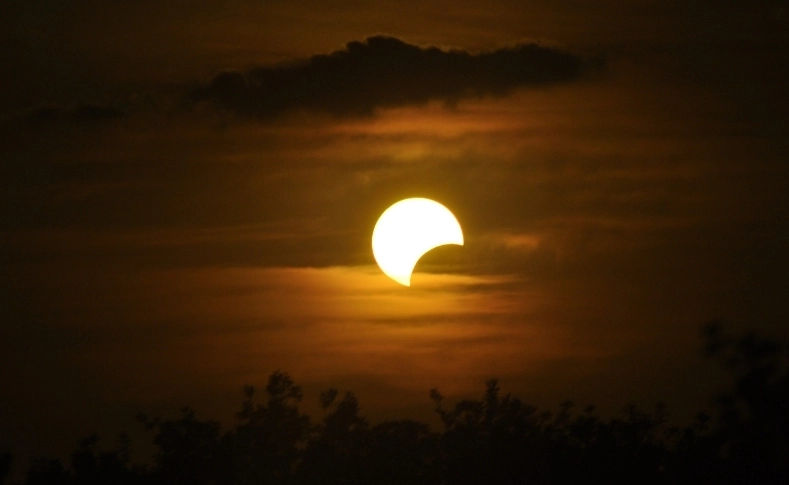
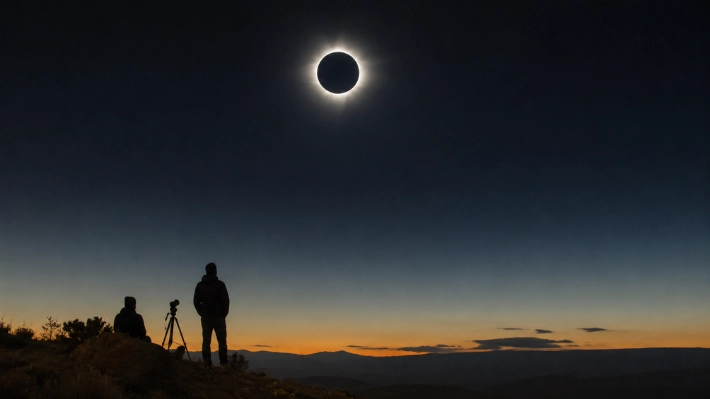
During a solar eclipse, the Moon appears to cover the Sun. In a partial solar eclipse, the Sun looks as if a bite has been taken out of it. In a total solar eclipse, the Moon fully covers the bright disk of the Sun for observers in the path of totality, and the Sun’s outer atmosphere, the corona, can become visible.
An annular solar eclipse happens when the Moon is too far from Earth to cover the Sun completely. The Moon appears slightly smaller in the sky, so a bright ring of sunlight remains around it. This is sometimes called a “ring of fire,” although it is still sunlight, not fire.
A lunar eclipse looks different. The Moon does not disappear instantly. It moves through Earth’s shadow gradually. During a total lunar eclipse, the Moon can turn red or copper-colored because some sunlight passes through Earth’s atmosphere and is bent toward the Moon. Blue light is scattered more strongly in the atmosphere, while redder light can continue through and reach the lunar surface.
This red color is the reason people sometimes call a total lunar eclipse a “blood moon.” The name is dramatic, but the explanation is physical: Earth’s atmosphere filters and bends sunlight into the shadow.
Why Location and Timing Matter So Much
An eclipse is global in cause but local in experience. The same alignment can look very different depending on where you are.
For a solar eclipse, location is everything. People inside the narrow path of totality may see the Sun fully covered. People a short distance away may see only a partial eclipse. People on the other side of Earth see nothing because it is nighttime or the shadow does not reach them.
For a lunar eclipse, the viewing area is broader, but timing still matters. The Moon must be above your horizon while the eclipse is happening. If the eclipse occurs before moonrise or after moonset in your location, you may miss part or all of it.
This is why eclipse guides often include exact local times. A general date is not enough. Viewers need to know when the eclipse begins, when it reaches maximum, and whether the Sun or Moon is visible from their location at that time.
The Simple Way to Understand Eclipses
The easiest way to understand eclipses is to separate three ideas: phase, alignment, and shadow.
The phase tells you whether an eclipse is even possible. A solar eclipse needs a new moon. A lunar eclipse needs a full moon. Alignment tells you whether the Sun, Moon, and Earth are close enough to a straight line. Shadow tells you what people actually see.
That is why every eclipse is both predictable and special. Predictable, because the bodies follow regular orbital motion. Special, because the alignment has to be precise and the viewing location has to be right.
A solar eclipse is the Moon’s shadow reaching Earth. A lunar eclipse is Earth’s shadow falling on the Moon. The calendar gives the event a date, but the eclipse itself is created by motion, alignment, and shadow in space.