Major Airports in Zimbabwe
- Joshua Mqabuko Nkomo International Airport (BUQ) - 01:43:44
- Robert Gabriel Mugabe International Airport (HRE) - 01:43:44
- Victoria Falls International Airport (VFA) - 01:43:44
Daylight saving time in Zimbabwe
Zimbabwe has 1 listed IANA time zones. None of them observe daylight saving time in 2026. The UTC offset remains stable throughout the year.
Best Time to Call Zimbabwe
Business hours in Zimbabwe (9 AM–5 PM local time) fall at these local times elsewhere:
- Beijing: 3:00 PM – 11:00 PM ( Partial overlap)
- Paris: 9:00 AM – 5:00 PM ( Convenient)
- Toronto: 3:00 AM – 11:00 AM ( Outside normal hours)
- Seoul: 4:00 PM – 12:00 AM (next day) ( Partial overlap)
- Mexico City: 1:00 AM – 9:00 AM ( Outside normal hours)
- Cairo: 10:00 AM – 6:00 PM ( Convenient)
- Bangkok: 2:00 PM – 10:00 PM ( Partial overlap)
Times shown reflect current UTC offsets and may shift by up to an hour around daylight saving transitions.
Time Difference from Zimbabwe
Compare time in Zimbabwe with other countries.
Countries in the Same Time Zone as Zimbabwe
Most Popular Cities in Zimbabwe
Holidays in Zimbabwe
Official national public holidays. Regional and religious observances may vary by area.
About Time in Zimbabwe
When a Time-Zone Database and the Archive Disagree
Zimbabwe now keeps Central Africa Time, two hours ahead of UTC, throughout the year. For modern timestamps the arrangement is unusually simple: there is one national civil offset and no seasonal clock change. The difficult part begins when the record is pushed back into the nineteenth and early twentieth centuries.
The current IANA time-zone database places Harare in its historical backzone data with a modeled local mean time offset of 2 hours, 4 minutes and 12 seconds east of Greenwich until March 1903, followed by Central Africa Time at two hours east. IANA itself warns that its pre-1970 material is incomplete, that backzone is less reliable than the post-1970 database, and that local mean time values should not automatically be treated as authoritative descriptions of what every clock actually showed.
That warning is especially relevant here. A 2021 submission to the IANA time-zone discussion list cited the Bulawayo Chronicle and Government Notice No. 160 of 1899 in the British South Africa Company Government Gazette as evidence that standard time two hours ahead of Greenwich was adopted on 1 August 1899, with Salisbury previously using a time two and a half hours ahead of Greenwich. The evidence does not match the simplified Harare backzone sequence. For historical conversions around this period, the responsible approach is therefore to distinguish the computer database model from the surviving legal and newspaper record rather than silently treating either one as complete.
A second discrepancy appears in 1920. A Zimbabwean historical reconstruction based on contemporary Government Gazette and Rhodesia Herald reports documents a daylight-saving experiment that began at midnight on 4 January, advancing clocks by one hour, and was abandoned on 1 February. A Bulawayo historical chronology independently records the same one-hour experiment and the February reversal. This episode is not represented in the current IANA Harare backzone entry, another reminder that early civil time can be more complicated than a modern zone file suggests.
Salisbury's Longitude Was Measured Through Telegraphic Time
Timekeeping was also part of the machinery used to put the country onto an accurate geodetic map. Alexander Simms completed an early geodetic series in Southern Rhodesia in 1901. The network used Salisbury, now Harare, as its original reference point, so establishing the city's astronomical position accurately was fundamental to the coordinates assigned to the rest of the survey.
The longitude of Salisbury was not obtained simply by reading a map. Survey records describe an interchange of telegraphic signals with the Royal Observatory at the Cape, combined with astronomical determinations of time. Sir David Gill's history of the Cape Observatory likewise records that Salisbury's original position depended on a telegraphic determination of its astronomical longitude difference from the Cape Observatory, while latitude and the initial azimuth came from direct astronomical observations.
The method relied on a basic relationship between astronomy and time: Earth turns through 360 degrees in roughly 24 hours, so one hour of astronomical time corresponds to 15 degrees of longitude. Observers could determine local sidereal or astronomical time from stars, exchange timed signals over the telegraph, and turn the measured time difference between two stations into a longitude difference. The telegraph therefore functioned as a precision surveying instrument as much as a communications network.
The survey was later tied into the wider southern African triangulation system. A 1938 review noted that Simms's original chain had been completed in 1901, while the published survey report appeared in 1905. The episode is a useful example of a period when accurate time transfer, astronomy and mapmaking were inseparable sciences.
Goetz Observatory Moved from Variable Stars to GPS-Timed Seismology
Bulawayo developed a different scientific tradition around precise observation. Jesuits established an observatory there in 1903 under Edmund Goetz, who had previously worked at the Stonyhurst and Georgetown observatories. Its program combined astronomy, geomagnetism and meteorology rather than treating the sky, weather and Earth's magnetic field as unrelated subjects.
In 1913 Goetz installed a 16-centimeter Cooke equatorial telescope. Scholarly histories record that he used it for observations of variable stars in collaboration with astronomer Johann Georg Hagen. The observatory's major contributions also included regional climate work and magnetic surveys. In 1926 it passed to the colonial administration and later continued as a state scientific institution under the Goetz Observatory name.
The site's modern role shows how the instruments changed while the demand for accurate timing remained. Zimbabwe's Meteorological Services Department still lists Bulawayo (Goetz Observatory) as an operating fixed station. The International Federation of Digital Seismograph Networks identifies Goetz Observatory as the operator of the Zimbabwe Seismic Network, whose first seismic station in Bulawayo dates from 1959.
A technical description of the national seismic system lists a network time server with a GPS antenna among the equipment at Goetz Observatory. Seismology depends on comparing the arrival times of waves at separated stations, so clock accuracy is built directly into the measurement. The same site that once timed astronomical observations of stars now participates in a digital network in which satellite timing helps timestamp motion inside the Earth.
Mwedzi Connects the Moon, the Month and the Seasonal Year
Not all Zimbabwean systems of time began with mechanical clocks or imported standard meridians. In Shona usage, mwedzi can refer to the moon or the month, a linguistic connection that reflects a much older way of organizing recurring time. Academic work on Shona religious culture describes a traditional calendar based on lunar movement and identifies a 13-month cycle in that tradition.
The relationship is not a simple one-to-one translation of the modern Gregorian calendar. Research on the month name Mbudzi explains that it is the name of the eleventh moon in the Shona lunar calendar and is now generally used for November, even though the Gregorian month and the older lunar period are not perfectly congruent. Unicode's current Shona locale data likewise gives Mbudzi as the Shona name used for Gregorian November.
Mbudzi also carries a seasonal and cultural meaning. Research from southern Zimbabwe links the name with goats and with the breeding season, and documents a traditional moratorium on ceremonies that require goat sacrifice during this period. Another academic study describes Mwedzi weMbudzi as a sacred interval in which certain ancestral and ritual activities are suspended. These accounts should be read as descriptions of documented Shona traditions, not as a claim that every Zimbabwean follows the same observance today.
This is a different kind of chronology from a UTC offset. The unit of time is tied at once to the lunar cycle, rainfall, animal reproduction, agriculture and ritual practice. Modern Shona month names now sit inside the Gregorian calendar, but their vocabulary preserves evidence of a calendar in which the sky and seasonal ecology supplied the structure of the year.
Three Minutes of Totality Crossed the North-East in 2001
On 21 June 2001, the first total solar eclipse of the twenty-first century crossed southern Africa. NASA's path calculations show the Moon's umbral shadow moving through Zambia, Zimbabwe and Mozambique before crossing the Mozambique Channel toward Madagascar. In Zimbabwe the path of totality clipped the north-eastern part of the country, while the rest of the territory experienced a partial eclipse.
NASA's regional description gives totality in this part of southern Africa at about three minutes, with the late-afternoon Sun roughly 23 degrees above the horizon as the shadow moved eastward. A detailed NASA map for Zimbabwe and Mozambique shows the total-eclipse corridor crossing the Zambezi escarpment and the north-east, with Harare lying outside the totality band. The global maximum of 4 minutes 56.5 seconds occurred much farther west and must not be confused with the shorter local duration in Zimbabwe.
The date added another astronomical layer: 21 June is near the southern winter solstice, when the Sun reaches its most northerly declination and daylight is close to its annual minimum in Zimbabwe. The eclipse therefore brought two different celestial cycles together on the same day, the annual solar cycle that defines the solstice and the lunar orbital geometry required for a total eclipse.
For a country whose time history includes telegraphic longitude work, lunar calendars and a long-running observatory, the 2001 eclipse is not merely a spectacle. It is a precisely predictable event whose local circumstances depend on the same fundamental quantities that recur throughout the history of timekeeping: position on Earth, the motion of the Sun and Moon, and the conversion between a global time scale and local observation.
Frequently Asked Questions
How many time zones does Zimbabwe have?
One. The whole of Zimbabwe follows Africa/Harare, so every city shows the same local time as the capital, Harare.
Is Zimbabwe ahead of or behind GMT?
Zimbabwe is currently 2 hours ahead of GMT (UTC+2).
Does Zimbabwe use summer time?
No. Zimbabwe does not observe daylight saving time, so its clocks stay at UTC+2 all year. Its time difference with countries that do change their clocks still shifts by an hour in spring and autumn.
How many public holidays does Zimbabwe have in 2026?
Zimbabwe has 13 national public holidays in 2026, when banks and government offices are usually closed. Some regions may also have their own local holidays.
How do I dial a phone number in Zimbabwe from abroad?
From a mobile phone, type +263 and then the local number without the leading 0 used for domestic calls, if it has one. From a landline, replace the plus sign with your exit code: 011 from the US and Canada, or 00 from most of Europe, for example 00 263 followed by the number.
What language is spoken in Zimbabwe?
The main languages of Zimbabwe are English, Shona and South Ndebele.
Beyond the Clock

Working Hours by Country: How Long Is the Workday and the Work Year Around the World
The average worker in Mexico puts in about 2,200 hours a year. The average worker in Germany puts in about 1,340. The gap of roughly 860 hours equals more than 21 standard 40-hour weeks, close to five extra months of full-time work. Most "who works

What the Research Actually Says About the “23 Minutes to Refocus” Claim
"It takes 23 minutes and 15 seconds to refocus after an interruption" shows up in productivity apps, management slide decks, and posts about deep work. The figure is real, and it comes from a serious researcher. It does not mean what it is usually taken

How Americans Spend Their 24 Hours: What the Time Use Survey Shows
The average American age 15 and over logs about 9 hours of sleep a day, spends just over 5 hours on leisure and works 3 hours. That last number looks wrong until you see how it is built, and nearly every headline figure from the

Pomodoro Technique: Why 25 Minutes and When a Different Interval Works Better
The most famous number in time management started as a workaround. In the late 1980s Francesco Cirillo, a university student who could not make himself study, used a tomato-shaped kitchen timer to test a small question: could he work for two minutes without interruption? Twenty-five

Why the Moon’s Phases Don’t Actually Change Its Size
A thin crescent looks small enough to disappear. A full moon looks like it's swelling on the horizon. Neither impression is true. The Moon's diameter is 3,474 kilometers on every night of the month, whether it's a sliver or a full disc, and nothing in

Why Saturn’s Rings Are Disappearing From View in 2025 and 2026
Saturn's rings turned edge-on to Earth on March 23, 2025, at 12:04 p.m. EDT, and for weeks the planet looked like a plain yellow ball through backyard telescopes. This is not decay or destruction. It is a geometric alignment called a ring plane crossing, and

What Is a Harvest Moon and Why It Rises at Almost the Same Time Several Nights Running
On most nights of the year, the Moon rises roughly 50 minutes later than it did the night before. Around the Harvest Moon, that gap collapses to as little as 10 minutes in parts of the UK and Canada, and rarely more than 30 minutes
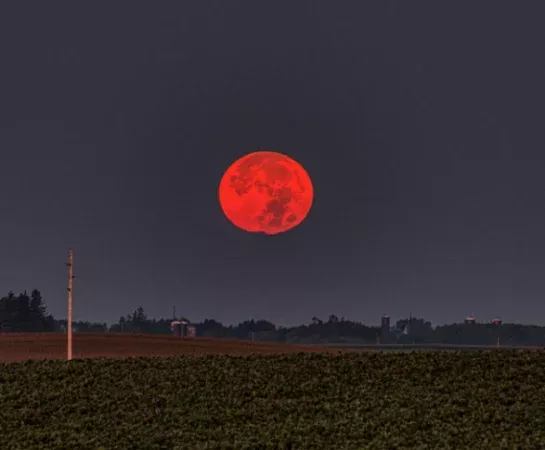
What Is a Blood Moon and Why Does the Moon Turn Red
On the night of August 27, 2026, the Moon came within a hair of disappearing entirely. Earth's shadow covered 96.2% of its surface, a partial eclipse so deep that skywatchers across the Americas, Europe, and Africa watched it turn a rusty, almost total red without
Time Tools
Quick access to timers, stopwatch, world clock and time zone tools.
Time Guides
Read useful guides about time zones, calendars, finance and astronomy.


