Major Airports in Libya
- Al Abraq International Airport (LAQ) - 00:30:41
- Benina International Airport (BEN) - 00:30:41
- Mitiga International Airport (MJI) - 00:30:41
Daylight saving time in Libya
Libya has 1 listed IANA time zones. None of them observe daylight saving time in 2026. The UTC offset remains stable throughout the year.
Best Time to Call Libya
Business hours in Libya (9 AM–5 PM local time) fall at these local times elsewhere:
- Beijing: 3:00 PM – 11:00 PM ( Partial overlap)
- Paris: 9:00 AM – 5:00 PM ( Convenient)
- Toronto: 3:00 AM – 11:00 AM ( Outside normal hours)
- Seoul: 4:00 PM – 12:00 AM (next day) ( Partial overlap)
- Mexico City: 1:00 AM – 9:00 AM ( Outside normal hours)
- Cairo: 10:00 AM – 6:00 PM ( Convenient)
- Bangkok: 2:00 PM – 10:00 PM ( Partial overlap)
Times shown reflect current UTC offsets and may shift by up to an hour around daylight saving transitions.
Time Difference from Libya
Compare time in Libya with other countries.
Countries in the Same Time Zone as Libya
Most Popular Cities in Libya
Holidays in Libya
Official national public holidays. Regional and religious observances may vary by area.
About Time in Libya
Libya Pumps Water to the Coast That Fell as Rain Thousands of Years Ago
One of Libya's most unusual relationships with time is hidden underground. Much of the groundwater beneath the southeastern desert is fossil water: rainfall entered the aquifers during wetter climatic periods that no longer exist under the modern Saharan climate.
Isotope studies of the Kufra and Sirte basins separate several generations of groundwater. Radiocarbon work identified older waters broadly between about 13,000 and 34,000 years before present, alongside younger Holocene recharge episodes around 5,000 to 7,800 years ago. Other work in northern Kufra has produced ages exceeding roughly 20,000 years.
The distinction matters because this is not an ordinary reservoir replenished on a human timescale. Modern rainfall over the Kufra region is extremely small, and hydrogeological studies conclude that much of the deep water being extracted today was recharged under cooler and wetter climatic conditions.
The Great Man-Made River converts that geological storage into a modern delivery schedule. Law No. 11 of 1983 created the project authority, construction began with the foundation ceremony at Sarir on 28 August 1984, and the first major reservoirs began receiving water before the end of that decade.
Ajdabiya reservoir received project water on 11 September 1989. Omar Mukhtar reservoir at Suluq followed on 28 August 1991, Gardabiya reservoir near Sirte on 4 September 1991, and water reached the Sidi Assaiah reservoir serving Tripoli on 28 August 1996.
The system was designed around enormous daily flows. Official project documentation describes first-stage pipelines up to four metres in diameter and an eventual integrated transfer capacity measured in millions of cubic metres per day.
This creates an extreme contrast in timescales. Rain may have entered sandstone twenty thousand years ago, remained underground throughout almost all recorded human history, then travelled through a modern pipeline toward the coast in days. Libya's water infrastructure is therefore drawing down a climatic archive much older than the cities it now supplies.
When Fezzan's Springs Failed, Agriculture Moved Underground
The ancient agricultural history of Fezzan contains a chronological transition that can be reconstructed from groundwater, archaeology and plant remains. Research in Wadi al-Ajal suggests that by about 3,100 ± 125 years before present, natural surface water along parts of the escarpment had become extremely scarce or had disappeared.
Agriculture did not disappear with the springs. Archaeobotanical evidence shows irrigated cultivation developing during the early first millennium BC, initially probably through wells reaching a water table that was still relatively close to the surface.
The larger technological shift came later. Hundreds of underground galleries known as foggaras were constructed to intercept groundwater and carry it by gravity toward fields and settlements. Modern archaeological dating demonstrates that these systems were operating from roughly 400 BC through about AD 700.
The network was extensive. Surveys have identified hundreds of foggaras across Fezzan, particularly in Wadi al-Ajal. Their lines of vertical access shafts still mark the desert surface even where the underground channels no longer carry water.
The irrigation system changed the agricultural year as well as the landscape. Plant remains from Garamantian settlements show both winter and summer cultivation. Wheat and barley could occupy one part of the year, while dates, grapes, figs and other crops formed part of a more diversified oasis economy.
This matters because the Sahara no longer supplied a dependable natural growing season through rainfall. Agriculture required water accumulated underground during much earlier climatic conditions, delivered continuously enough for farmers to create their own cultivation calendar.
The same process eventually contained a long-term limit. Continued groundwater decline made some foggaras harder to maintain and reduced their effectiveness. A system that had allowed agriculture to escape the immediate rainfall calendar remained dependent on a water table that was slowly falling over centuries.
On 29 March 2006, More Than Four Minutes of Totality Crossed the Libyan Desert
On 29 March 2006, the path of a total solar eclipse crossed Libya, turning part of the desert into one of the world's most important astronomical observing sites for a few minutes.
NASA calculations give a maximum total phase of approximately 4 minutes 7 seconds along the eclipse path. That is long for a total solar eclipse: many totalities at a fixed location last only one or two minutes.
The geometry was predictable with extraordinary precision. Astronomers knew years in advance where the Moon's shadow would travel, when totality would begin and how long it would last at different points along the path.
That predictability allowed international and Libyan scientific teams to place instruments in the desert before the event. Researchers used the short interval of totality to observe the solar corona, which normally disappears in the overwhelming brightness of the photosphere.
The most valuable observing period lasted only minutes, but preparation took months or years. Telescopes had to be transported into remote areas, equipment aligned and experiments tested before the shadow arrived. Once totality began, a failed instrument could not simply be restarted the following hour.
The event demonstrates an unusual form of scientific time pressure. The eclipse itself followed celestial mechanics that could be calculated long in advance, yet the actual experimental window was shorter than an ordinary coffee break.
For observers in Libya, the desert became the intersection of two radically different scales: orbital cycles extending across centuries and a usable scientific interval measured in seconds.
Libyan Law Can Turn the Same Working Day into Eight Hours, Six Continuous Hours and Three Hours of Overtime
Libyan labour legislation divides the working day into several different legal intervals rather than treating all elapsed hours alike.
Under the current labour framework, ordinary active work is limited to eight hours per day. Where the workday exceeds six hours, it must include prayer, food or rest periods arranged so that an employee does not normally work more than six consecutive hours without interruption.
Overtime has another limit. The legislation allows additional work when required but caps ordinary additional hours at three hours per day under the 2010 labour-relations rules. Overtime must also carry additional compensation above the normal hourly rate.
Working on the weekly rest day creates a different kind of time entitlement. The law provides either a substitute rest day within the following three days or enhanced pay for the hours worked.
Ramadan introduces a separate annual public-sector clock. Rather than leaving the daily schedule unchanged, official decisions can shorten government working hours for the entire lunar month.
The exact schedule can change from year to year. In 2024, official public-sector hours were set from 10:00 to 15:00. In 2025, Decision No. 91 moved them to 09:00-14:00. In 2026, Decision No. 56 returned the schedule to 10:00-15:00, while essential services requiring continuous operation were treated separately.
The result is a legal calendar layered on top of ordinary civil time. Eight hours defines the normal workday, six hours defines a continuous-work threshold, three hours defines a daily overtime ceiling, and during Ramadan an annual government decision can temporarily redefine when the public administrative day begins and ends.
On 25 October 2013, Daylight Saving Ended but the Clocks Did Not Move
Libya's most unusual modern time-zone transition happened because two changes cancelled each other out.
At the beginning of 2013, the country's standard offset was UTC+1. On 29 March, daylight saving began. At 01:00, clocks advanced directly to 02:00, putting civil time at UTC+2.
Under the planned rule, daylight saving was supposed to end on the final Friday of October. Ordinarily, that would have moved clocks backward by one hour.
Instead, the scheduled October transition was cancelled at the last moment. On 25 October 2013, the daylight-saving designation ended, but the underlying standard time was simultaneously changed from UTC+1 to UTC+2.
The arithmetic is unusual but simple. Before the change, the clock was UTC+1 plus one daylight-saving hour, which equalled UTC+2. Afterward, daylight saving became zero, but standard time itself became UTC+2. The displayed clock therefore remained exactly where it was.
IANA had to update the Time Zone Database immediately because software had been expecting the backward transition. Release 2013h, issued on 25 October, recorded Libya as switching to permanent UTC+2 without seasonal daylight saving.
This is a useful reminder that a time-zone transition does not necessarily require a visible clock change. The legal meaning of the displayed time changed even though 01:59 was followed normally by 02:00 and no hour was skipped or repeated.
In the Oasis Belt, One Date Harvest Runs from July to August and Another Begins in December
The palm oases around Jalu, Awjila and Jakhira do not produce one uniform date harvest. Different stages of the fruit create separate commercial seasons within the same year.
Local agricultural reporting records the first fresh dates, or rutab, beginning to ripen around the start of July. Successive varieties then mature through July and August.
The main marketing period for fresh ripe fruit begins around the start of September. Growers in the oasis region cultivate more than one hundred locally recognized varieties, so maturity is spread rather than concentrated on one harvest day.
The calendar changes again later in the year. Fully dried dates and other later-maturing fruit enter their main season from around December.
This creates a multi-stage biological timetable on the same palm. Fruit moves from early ripening to fresh-market harvest and eventually into drier forms suitable for longer storage. The useful stage depends on variety, temperature and what the grower intends to sell.
Olives operate on another autumn clock in northern agricultural regions. Libyan agricultural guidance places their normal ripening broadly through October, November and December, with harvest determined not simply by date but by colour change and oil accumulation.
For oil olives, waiting too long can become counterproductive. Agricultural authorities advise selecting harvest according to maturity and processing capacity because fruit quality begins changing once olives are detached and waiting for the press.
Libya therefore contains agricultural calendars that overlap rather than align: fresh oasis dates can begin in midsummer, dried dates continue toward winter, and the olive harvest occupies much of the intervening autumn. The annual food calendar is staggered by crop and stage rather than divided into one national harvest season.
Frequently Asked Questions
How many time zones does Libya have?
One. The whole of Libya follows Africa/Tripoli, so every city shows the same local time as the capital, Tripoli.
Is Libya ahead of or behind GMT?
Libya is currently 2 hours ahead of GMT (UTC+2).
Does Libya use summer time?
No. Libya does not observe daylight saving time, so its clocks stay at UTC+2 all year. Its time difference with countries that do change their clocks still shifts by an hour in spring and autumn.
How many public holidays does Libya have in 2026?
Libya has 15 national public holidays in 2026, when banks and government offices are usually closed. Some regions may also have their own local holidays.
How do I dial a phone number in Libya from abroad?
From a mobile phone, type +218 and then the local number without the leading 0 used for domestic calls, if it has one. From a landline, replace the plus sign with your exit code: 011 from the US and Canada, or 00 from most of Europe, for example 00 218 followed by the number.
What language is spoken in Libya?
The main languages of Libya are Arabic, Italian and English.
Beyond the Clock

The Planning Fallacy: Why Tasks Take Longer Than You Expect and How to Correct It
In a 1994 study, 37 psychology students estimated how long it would take them to finish their honors theses. Their average answer was 33.9 days. They also gave a best-case estimate, 27.4 days on average, and a worst-case estimate, "if everything went as poorly as

What the Research Actually Says About the “23 Minutes to Refocus” Claim
"It takes 23 minutes and 15 seconds to refocus after an interruption" shows up in productivity apps, management slide decks, and posts about deep work. The figure is real, and it comes from a serious researcher. It does not mean what it is usually taken

Why the 40-Hour Work Week Exists: From 10-Hour Days to Ford’s 1926 Experiment
The 40-hour week looks like a natural unit of work, but the number was never derived from a measurement of how much work is best. It is the product of two separate fights: one over the length of the day, which ended at eight hours,

Pomodoro Technique: Why 25 Minutes and When a Different Interval Works Better
The most famous number in time management started as a workaround. In the late 1980s Francesco Cirillo, a university student who could not make himself study, used a tomato-shaped kitchen timer to test a small question: could he work for two minutes without interruption? Twenty-five

Total Solar Eclipse on August 2, 2027: Where, When, and Why It Lasts So Long
On Monday, August 2, 2027, the Moon's shadow will cross southern Spain, North Africa and the Arabian Peninsula, producing the second-longest total solar eclipse of the 21st century. At its maximum, in southern Egypt near Luxor, the Sun will be completely covered for about 6

When Does Winter Start: Meteorological vs Astronomical Seasons
Winter 2026 starts twice in the Northern Hemisphere. Meteorological winter begins on Tuesday, December 1, 2026. Astronomical winter begins at the December solstice, on Monday, December 21, 2026 at 20:50 UTC, which is 3:50 p.m. Eastern and 12:50 p.m. Pacific. Both answers are correct. They

What Is a Supermoon and When Is the Next One
Every time a supermoon rises, the same statistic gets repeated: 14% bigger, 30% brighter. It's in almost every news segment and nearly every listicle, and it's also a comparison almost nobody in the audience will ever actually witness, because it measures the single closest possible
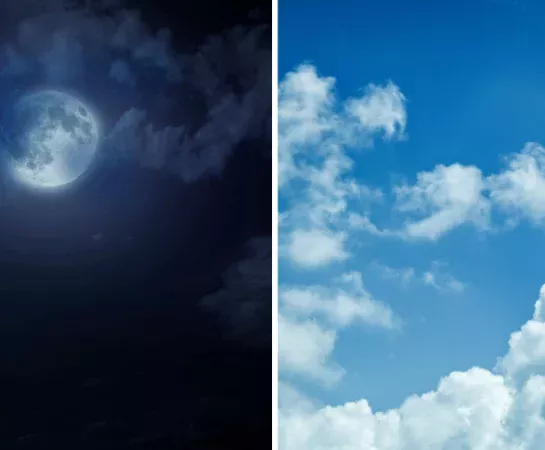
Why the Sky Is Blue During the Day and Black at Night
Sunlight is white. Air is, as far as anyone can tell by looking through a window, colorless. And yet every clear afternoon the same 400,000-kilometer column of gas above your head reads as a specific, saturated blue, then goes black within an hour of sunset.
Time Tools
Quick access to timers, stopwatch, world clock and time zone tools.
Time Guides
Read useful guides about time zones, calendars, finance and astronomy.


