Major Airports in Rwanda
- Kigali International Airport (KGL) - 01:47:21
Daylight saving time in Rwanda
Rwanda has 1 listed IANA time zones. None of them observe daylight saving time in 2026. The UTC offset remains stable throughout the year.
Best Time to Call Rwanda
Business hours in Rwanda (9 AM–5 PM local time) fall at these local times elsewhere:
- Beijing: 3:00 PM – 11:00 PM ( Partial overlap)
- Paris: 9:00 AM – 5:00 PM ( Convenient)
- Toronto: 3:00 AM – 11:00 AM ( Outside normal hours)
- Seoul: 4:00 PM – 12:00 AM (next day) ( Partial overlap)
- Mexico City: 1:00 AM – 9:00 AM ( Outside normal hours)
- Cairo: 10:00 AM – 6:00 PM ( Convenient)
- Bangkok: 2:00 PM – 10:00 PM ( Partial overlap)
Times shown reflect current UTC offsets and may shift by up to an hour around daylight saving transitions.
Time Difference from Rwanda
Compare time in Rwanda with other countries.
Countries in the Same Time Zone as Rwanda
Most Popular Cities in Rwanda
Holidays in Rwanda
Official national public holidays. Regional and religious observances may vary by area.
About Time in Rwanda
On the Last Saturday of Every Month, Rwanda Reserves Three Morning Hours for Umuganda
Rwanda has a recurring national time block that is neither a public holiday nor an ordinary workday. On the last Saturday of each month, communities hold Umuganda, a period of collective work organized around local projects such as cleaning public spaces, repairing drainage channels, maintaining roads or working on community infrastructure.
Government material describes the activity as generally running from 08:00 to 11:00. Banks and other services adjust their Saturday schedules around it, and official information for visitors specifically warns that the last Saturday of the month operates differently from an ordinary weekend morning.
The timing is important because Umuganda is designed as a synchronized event. It does not depend on each neighborhood choosing a convenient day independently. The same monthly position, the final Saturday, creates a recurring national rhythm in which thousands of local projects happen during roughly the same three-hour window.
The tradition predates the modern state, when forms of collective labor were used for tasks such as constructing homes and maintaining agricultural and water infrastructure. Contemporary institutions adapted that older practice into organized community work linked to local development.
In practical terms, this means that the calendar changes behavior before the clock does. A Saturday at the beginning of the month may function normally for shopping or banking. The same clock hours on the final Saturday can instead belong to community work, with local services opening later or altering their schedule.
Few national calendars contain such a frequent civic rhythm. Public holidays usually occur once a year. Umuganda creates a recurring three-hour interval twelve times a year, making the last Saturday itself a recognizable unit of Rwandan public time.
Lake Kivu Stores Gas on a Clock Measured in Centuries, but Rwanda Extracts It Every Second
Lake Kivu contains one of the world's most unusual long-term natural clocks. Below its upper oxygenated layer, the lake is strongly stratified and contains enormous quantities of dissolved carbon dioxide and methane. Rwanda Energy Group places the most gas-rich water broadly between about 270 and 500 metres depth.
The lake does not overturn seasonally like many temperate lakes. Salinity and temperature differences keep the deep layers remarkably stable, allowing gas to accumulate for very long periods rather than escaping to the atmosphere each year.
Modeling published in 2022 suggests that the present stratified structure could have developed over roughly 2,000 years after a major mixing event. Another reconstruction proposes that a much older limnic eruption may have occurred around 4,000 years ago during a period of major lake-level reduction. These are scientific reconstructions rather than directly observed historical events, but they show that Lake Kivu's deepest clock runs on millennial scales.
Modern Rwanda has inserted a completely different timescale into the same system. Methane was extracted experimentally from the lake as early as 1963 to supply a brewery, with a pilot plant delivering about 5,000 cubic metres of methane per day. That operation continued for more than forty years.
Commercial electricity generation accelerated the process. KivuWatt entered commercial operation on 31 December 2015 with a nominal gross capacity of 26 MW. Gas-rich water is brought upward from hundreds of metres below the surface, methane is separated, and the remaining water is returned to a depth chosen to preserve the lake's density structure.
The engineering challenge is therefore temporal as well as chemical. Extraction must remove methane continuously without mixing layers that have remained separated for centuries. A poorly designed system could disturb the very stratification that keeps the dissolved gases contained.
Lake Kivu is thus one of the rare places where electricity production interacts directly with a geological clock. Gas accumulates over decades and centuries, while turbines convert part of that stored chemical energy into power second by second.
One Hour Is the Legal Wildlife Clock for a Gorilla Encounter
Mountain-gorilla tourism in Rwanda is organized around an unusually strict unit of time. Visitors entering Volcanoes National Park for gorilla tracking must report to the registration centre at 07:00, but the trek itself can take anywhere from about thirty minutes to more than four hours depending on where the assigned gorilla family is located.
The uncertainty ends when contact is made. Rwanda Development Board rules limit viewing time with a habituated gorilla family to exactly one hour. Groups are also limited to a maximum of eight visitors.
That sixty-minute limit creates a sharp contrast with the rest of the day. A visitor may spend hours climbing through steep forest, then the most important part of the experience begins only when trackers locate the animals and ends one hour later regardless of how long the approach took.
The time restriction is not simply a tourism scheduling device. Human presence can alter gorilla behavior and increases disease-transmission risk because mountain gorillas are genetically close to humans and susceptible to respiratory infections. Limiting the duration and size of each encounter reduces the cumulative exposure of individual families to visitors.
The daily schedule therefore converts conservation into a clock. Trackers may spend much of the morning following fresh nests, footprints, feeding remains and vocalizations, but the moment direct viewing begins a fixed countdown replaces the uncertainty of tracking.
This also creates an unusual definition of success. RDB rules distinguish between visitors who spend the day tracking without ever locating a group and those who actually reach the animals. The length of the search can vary dramatically, but once the encounter begins, everyone receives the same basic sixty-minute window.
Rwanda's Coffee Year Starts When the September Rains Wake the Flowers
Rwanda's coffee calendar begins not with harvest but with the end of the long dry season. The National Agricultural Export Development Board describes June through August as the principal dry period for coffee-growing areas. The first rains in September trigger flowering.
That trigger can be visually dramatic. Coffee trees that appeared almost dormant can flower heavily after rain, covering branches with white blossoms over a relatively short period. The event marks the beginning of fruit development that will occupy many months.
Harvest does not arrive everywhere at once. Around the shores of Lake Kivu in Western Province, picking can begin in late February. In much of the rest of the country it starts around early March, while some high or cooler areas in Northern Province may continue harvesting into August.
The result is a crop calendar that almost closes into a full annual loop. The first rains of September initiate flowering, cherries develop through the following months, harvesting starts around February or March, and in some areas the final picking continues until just before another September flowering cycle.
Altitude stretches that clock. Rwanda grows coffee across a wide range of elevations, and cooler conditions at higher sites slow fruit development. Two farms can therefore experience the same national month but be at different biological stages.
The commercial calendar continues after the last cherry is picked. For the 2026 Best of Rwanda competition, samples were submitted in July, national and international judging took place through August, results were announced on 27 August and the auction of winning coffees was scheduled for 21 October.
A single crop can therefore cross several very different clocks: rain initiates flowering, temperature controls maturation, harvest moves geographically through the country, processing continues afterward and the highest-value lots may not reach auction until more than a year after the previous dry season began.
Nyungwe Chimpanzees May Build Tonight's Bed for Weather That Has Not Arrived Yet
In Nyungwe National Park, eastern chimpanzees build a new sleeping nest before spending the night in the forest. A 2026 study found that the structure and position of those nests were more closely associated with the weather that followed overnight than with conditions measured only at the moment of construction.
Researchers measured temperature, humidity, wind and rainfall while nests were being built and again during the night. They also recorded nest height, canopy cover, tree characteristics, slope position and how well different nests insulated their occupants.
On cooler or wetter nights, chimpanzees tended to choose taller trees, build higher and select denser canopy cover. The choices were consistent with better thermal protection in Nyungwe's cool montane environment.
The striking part is the timing. Those decisions were made before the chimpanzees experienced most of the night's weather. The statistical relationships were stronger with subsequent overnight conditions than with immediate conditions at nest-building time.
The researchers stop short of claiming proof that chimpanzees consciously forecast weather. Temperature, humidity and pressure at dusk can already contain information about the coming night, and the study was observational rather than an experiment designed to prove prediction.
Even with that caution, the behavior creates an unusual biological clock. A chimpanzee chooses where and how to sleep during the evening, but the value of that decision may not become clear until several hours later when temperature drops, rain begins or wind changes.
Nyungwe therefore offers a form of timekeeping with no clock face at all. The relevant interval is the gap between an environmental decision at dusk and the conditions that arrive during the night.
Kigali's Old Solar Clock Was Only Sixteen Seconds Away from Modern UTC+2
Rwanda's current civil time is unusually simple: UTC+2 throughout the year, with no daylight-saving clock changes.
The historical reconstruction is interesting precisely because the difference from modern time was so small. IANA's older data reconstruct Kigali local mean time as UTC+2:00:16 before standardization in 1935.
That means the astronomical time implied by Kigali's longitude was only sixteen seconds ahead of the round UTC+2 offset eventually adopted. In many countries, replacing local mean time required clocks to move by several minutes or even tens of minutes. Kigali was already almost exactly aligned with a modern two-hour zone.
The reconstructed transition took place in June 1935, when the remaining sixteen-second difference disappeared and the offset became exactly UTC+2.
This makes Rwanda's time-zone history a rare case where standardization barely changed what a well-adjusted local solar clock would have shown. The important change was not the size of the correction but the reference behind it: local longitude gave way to a standardized regional civil time.
The historical figure still deserves caution. IANA later moved much African pre-1970 detail into historical backzone data because documentary evidence for old civil-time practice is often incomplete. The sixteen-second value is therefore a reconstruction from longitude-based historical data, not proof that every clock in Kigali was synchronized to that precision.
Modern Rwanda has no such ambiguity. Kigali and the rest of the country use one fixed UTC+2 clock all year, while the Sun, coffee flowering, monthly community work and wildlife schedules supply far more interesting variations in how time is actually experienced.
Frequently Asked Questions
How many time zones does Rwanda have?
One. The whole of Rwanda follows Africa/Kigali, so every city shows the same local time as the capital, Kigali.
Is Rwanda ahead of or behind GMT?
Rwanda is currently 2 hours ahead of GMT (UTC+2).
Does Rwanda use summer time?
No. Rwanda does not observe daylight saving time, so its clocks stay at UTC+2 all year. Its time difference with countries that do change their clocks still shifts by an hour in spring and autumn.
How many public holidays does Rwanda have in 2026?
Rwanda has 19 national public holidays in 2026, when banks and government offices are usually closed. Some regions may also have their own local holidays.
How do I dial a phone number in Rwanda from abroad?
From a mobile phone, type +250 and then the local number without the leading 0 used for domestic calls, if it has one. From a landline, replace the plus sign with your exit code: 011 from the US and Canada, or 00 from most of Europe, for example 00 250 followed by the number.
What language is spoken in Rwanda?
The main languages of Rwanda are Kinyarwanda, English and French.
Beyond the Clock

India vs US Time Difference: Why the Gap Changes Twice a Year
For most of the year, India is 9 hours 30 minutes ahead of New York. From November 1, 2026 to March 14, 2027, it is 10 hours 30 minutes ahead. India's clocks do not change in either case. The whole difference comes from the United
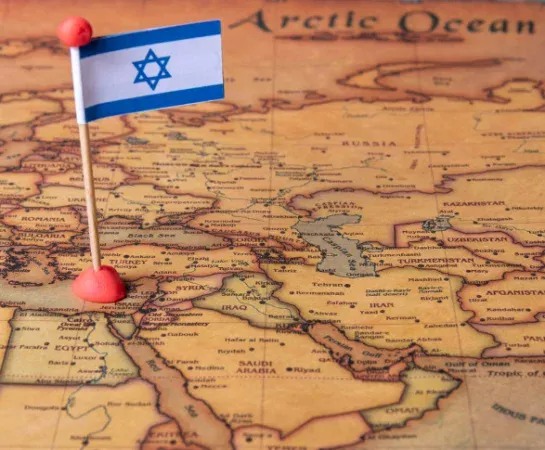
Why Israel Changes Its Clocks on a Different Schedule Than Europe
Israel's clocks now fall back on the same day the European Union's do, the last Sunday of October, a deliberate alignment written into a 2013 law. But the two systems still don't match. Israel springs forward on the Friday before the EU's last Sunday of
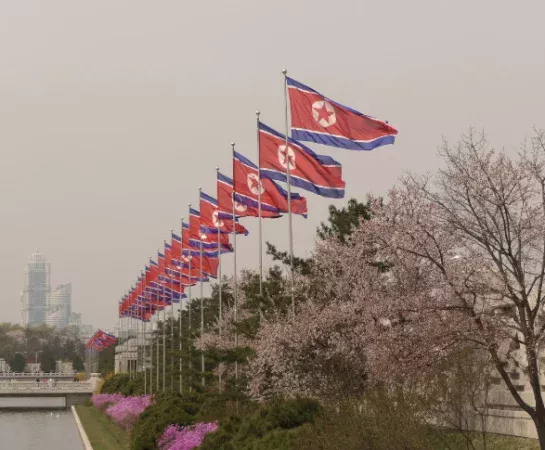
Why North Korea Changed Its Time Zone Twice in One Decade
North Korea turned its clocks back 30 minutes on August 15, 2015, breaking from South Korea and Japan to create its own "Pyongyang Time," then reversed the entire move less than three years later, on May 5, 2018, realigning with Seoul again. Both changes were

Why India’s Time Zone Is Exactly 5:30 Off UTC
India runs on a single clock from the Arabian Sea to the Myanmar border, a stretch of roughly 3,000 kilometers, and that clock sits at a UTC offset almost nobody outside the region can round off in their head. UTC+5:30 isn't a rough approximation or

Why the Moon’s Phases Don’t Actually Change Its Size
A thin crescent looks small enough to disappear. A full moon looks like it's swelling on the horizon. Neither impression is true. The Moon's diameter is 3,474 kilometers on every night of the month, whether it's a sliver or a full disc, and nothing in

Why Saturn’s Rings Are Disappearing From View in 2025 and 2026
Saturn's rings turned edge-on to Earth on March 23, 2025, at 12:04 p.m. EDT, and for weeks the planet looked like a plain yellow ball through backyard telescopes. This is not decay or destruction. It is a geometric alignment called a ring plane crossing, and
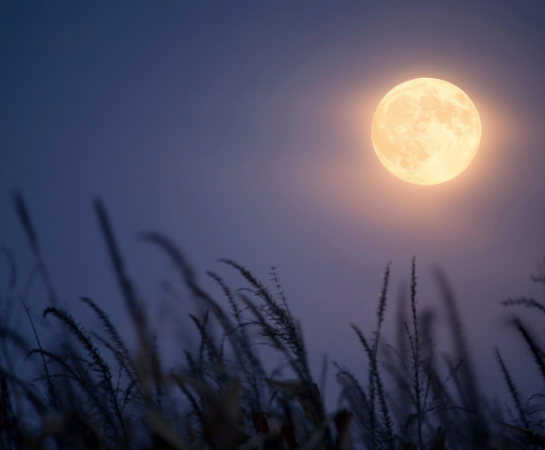
What Is a Harvest Moon and Why It Rises at Almost the Same Time Several Nights Running
On most nights of the year, the Moon rises roughly 50 minutes later than it did the night before. Around the Harvest Moon, that gap collapses to as little as 10 minutes in parts of the UK and Canada, and rarely more than 30 minutes
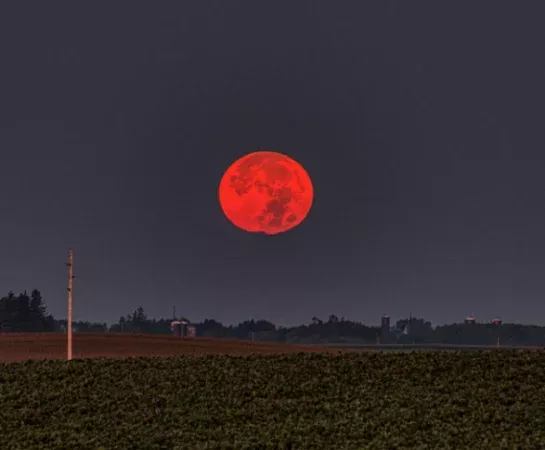
What Is a Blood Moon and Why Does the Moon Turn Red
On the night of August 27, 2026, the Moon came within a hair of disappearing entirely. Earth's shadow covered 96.2% of its surface, a partial eclipse so deep that skywatchers across the Americas, Europe, and Africa watched it turn a rusty, almost total red without
Time Tools
Quick access to timers, stopwatch, world clock and time zone tools.
Time Guides
Read useful guides about time zones, calendars, finance and astronomy.


