Major Airports in Romania
- Avram Iancu Cluj International Airport (CLJ) - 02:21:36
- Bacău George Enescu International Airport (BCM) - 02:21:36
- Brașov-Ghimbav International Airport (GHV) - 02:21:36
- Bucharest Băneasa Aurel Vlaicu International Airport (BBU) - 02:21:36
- Bucharest Henri Coandă International Airport (OTP) - 02:21:36
- Craiova International Airport (CRA) - 02:21:36
- Iaşi International Airport (IAS) - 02:21:36
- Mihail Kogălniceanu International Airport (CND) - 02:21:36
- Oradea International Airport (OMR) - 02:21:36
- Sibiu International Airport (SBZ) - 02:21:36
- Suceava Ștefan cel Mare International Airport (SCV) - 02:21:36
- Timișoara Traian Vuia International Airport (TSR) - 02:21:36
Daylight saving time changes in Romania
Romania has 1 listed IANA time zones. 1 of them observe daylight saving time changes in 2026.
Next change: October 25, 2026
Clock moves back from 04:00 to 03:00 local time.
Best Time to Call Romania
Business hours in Romania (9 AM–5 PM local time) fall at these local times elsewhere:
- Beijing: 2:00 PM – 10:00 PM ( Partial overlap)
- Paris: 8:00 AM – 4:00 PM ( Convenient)
- Toronto: 2:00 AM – 10:00 AM ( Outside normal hours)
- Seoul: 3:00 PM – 11:00 PM ( Partial overlap)
- Mexico City: 12:00 AM – 8:00 AM ( Outside normal hours)
- Cairo: 9:00 AM – 5:00 PM ( Convenient)
- Bangkok: 1:00 PM – 9:00 PM ( Partial overlap)
Times shown reflect current UTC offsets and may shift by up to an hour around daylight saving transitions.
Time Difference from Romania
Compare time in Romania with other countries.
Countries in the Same Time Zone as Romania
Most Popular Cities in Romania
Holidays in Romania
Official national public holidays. Regional and religious observances may vary by area.
About Time in Romania
In 1895, Romania Tried to Synchronize Bucharest with a Cannon
The arrival of railways created a problem that village clocks and local solar time had never needed to solve. A railway network could not safely operate if every station interpreted noon independently. By the 1890s, Romania therefore needed not merely accurate clocks but a mechanism capable of distributing the same time across the country.
Ștefan Hepites, director of the Romanian Meteorological Institute, became one of the central figures in that transition. A special meridian room equipped with a telescope had been established in 1892 so that astronomical observations could be used to determine precise time. Hepites was also sent to Germany to study methods of time standardization already being developed elsewhere in Europe.
One of Romania's first attempts at public synchronization was surprisingly physical. In 1895, the exact time at noon was announced in Bucharest with a cannon shot. The idea was simple: one signal, heard simultaneously, could allow many clocks to be corrected at once.
The experiment exposed the weakness of acoustic time distribution almost immediately. The cannon could not be heard reliably throughout the expanding city. Distance, buildings and local conditions turned a supposedly simultaneous signal into an imperfect system.
In September 1895, the solution moved from sound to electricity. A direct telegraph connection linked the Meteorological Institute with Filaret railway station. At noon, the Institute transmitted the exact time to the railway, and the signal could then be distributed through the railway telegraph network to stations elsewhere in the country.
The change was more important than replacing one technology with another. A cannon could synchronize people within hearing range. Telegraphy separated the time signal from physical distance. A station hundreds of kilometers away could receive the same reference without waiting for a train, messenger or audible signal to reach it.
Railway clocks gradually became public reference clocks, while key employees carried watches whose agreement mattered operationally. Historical accounts describe the process spreading beyond the railway to postal services and other institutions. By around 1900, Bucharest time had become a national reference, giving rise to the phrase that railway time was becoming the country's time.
For 2 Minutes 23 Seconds in 1999, the Center of a Continental Eclipse Was in Romania
On 11 August 1999, the Moon's shadow crossed Europe, the Middle East and South Asia. The eclipse was visible as total from several countries, but its geometrical maximum occurred in south-central Romania.
NASA calculations place greatest eclipse at 11:03:04 UTC. At that instant the axis of the lunar shadow passed closest to the center of Earth near Râmnicu Vâlcea. Maximum totality lasted approximately 2 minutes 23 seconds, with the Sun about 59 degrees above the horizon and the path of totality roughly 112 kilometers wide.
Only a few minutes later, at about 11:07 UTC, the shadow reached Bucharest. The capital lay close to the center line and experienced about 2 minutes 22 seconds of totality, only about one second less than the maximum duration farther west.
The event turned Romania into a temporary center for eclipse science. The Romanian Space Agency coordinated the national ECLIPSA 99 program, which included scientific experiments and public communication. The agency also worked with the European Space Agency on a live internet transmission, an unusually ambitious effort for the web infrastructure of the late 1990s.
Researchers used the darkness for measurements that are difficult or impossible under ordinary daylight. At the Bucharest Observatory, astronomers photographed solar prominences using a Danjon astrolabe adapted with a CCD camera and a narrow-band filter. Meteorological teams also examined atmospheric responses as incoming solar radiation collapsed and then recovered over only a few minutes.
The eclipse even entered everyday monetary circulation. The National Bank of Romania issued a special 500 lei coin on the day of the eclipse, with four million ordinary circulation pieces and a smaller collector issue. An astronomical interval lasting barely more than two minutes was therefore fixed into objects that could remain in circulation long after the shadow had crossed the Black Sea.
At 21:21, a Deep Vrancea Earthquake Reached Bucharest with Devastating Force
On the evening of 4 March 1977, daily life in Romania was interrupted by one of the most destructive earthquakes in the country's modern history. U.S. Geological Survey field investigators recorded the main shock at approximately 21:21 local time, with the source in the Vrancea seismic region northeast of Bucharest.
The earthquake had a magnitude around 7.2 and originated at a depth of roughly 100 to 110 kilometers. That depth is one of the defining features of Vrancea seismicity. Instead of releasing its energy at a shallow crustal fault directly below one city, the earthquake originated deep beneath the Carpathian bend and transmitted strong long-period shaking over a very large region.
Bucharest was especially vulnerable. USGS reconnaissance documented the collapse of 33 multistory buildings in the capital, alongside extensive damage to many other structures. More than 1,500 people died across Romania, and thousands were injured.
The timestamp itself became scientifically important because the event was recorded by seismic stations far beyond the country. Arrival times allowed seismologists to refine the hypocenter and compare how waves propagated through different parts of southeastern Europe. The earthquake was felt across an enormous area extending from Italy toward the Soviet Union and from Turkey toward northern Europe.
Its destructive phase lasted only a short time, but reconstruction operated on a completely different scale. Damaged buildings had to be inspected, unstable structures demolished and building standards reconsidered. The contrast is characteristic of major earthquakes: seconds of ground motion can create years of engineering and urban consequences.
Vrancea also changes the meaning of recurrence. Romania does not experience destructive earthquakes according to a simple calendar interval. The region has produced several major intermediate-depth earthquakes, including the powerful event of 10 November 1940, but their spacing is irregular. Historical dates help define the seismic record; they do not form a reliable countdown to the next large event.
A Sturgeon May Enter the Danube in Autumn and Wait Until Spring to Spawn
The lower Danube carries another Romanian timetable, one governed by fish that may spend more than a decade in the Black Sea before returning to fresh water. Beluga, Russian and stellate sturgeons historically migrated upstream through the Romanian Danube to reproduce, but not every adult followed the same seasonal schedule.
Research on tagged sturgeons in the Romanian lower Danube during 1998-2000 identified strong spring movement and a distinct autumn migration. Stellate sturgeon moving in autumn had largely stopped migrating by early October, when river temperature was around 16 degrees Celsius. Some fish then occupied wintering habitat rather than continuing immediately toward spawning areas.
This creates two reproductive strategies measured across different seasons. Some adults enter the river in spring and proceed toward spawning in the same broad period. Others enter during late summer or autumn, spend winter inside the river system while their gonads continue developing, and resume the reproductive sequence the following spring.
The timing is biologically expensive. Sturgeons mature slowly, and some species may require ten or twenty years before reproducing. Adults also do not necessarily spawn every year. A migration interrupted by capture, barriers or unsuitable river conditions can therefore affect a reproductive opportunity separated from the next by years.
Telemetry changed what researchers could see. Traditional fishing records revealed when fish were caught, but acoustic tags allowed scientists to reconstruct individual movement, pauses, reversals and wintering behavior. In the 1998-2000 research, more than half of some tagged groups dropped back downstream after capture and handling, illustrating how easily the observed migration could be altered by human interference.
Even the expected seasonal pattern can produce surprises. In July 2023, authorities intercepted poachers near the Chilia branch with a mature female beluga weighing about 110 kilograms and carrying approximately 14 kilograms of eggs. Researchers highlighted the timing because mature beluga normally enter the Danube mainly in autumn or early spring. A reproductively advanced female appearing in July did not fit the standard migration calendar.
The case is useful precisely because it does not invalidate the seasonal pattern. Biological calendars describe probabilities and recurring windows, not appointments. Temperature, river discharge, individual condition and long life histories can produce movements outside the dates researchers usually expect.
23 April and 26 October Divided the Traditional Pastoral Year
In Romanian pastoral tradition, the year could be divided by two named days rather than by 1 January. Saint George's Day, Sângeorz, on 23 April marked the opening of the pastoral summer, while Saint Demetrius' Day, Sâmedru, on 26 October marked its end and the beginning of the winter pastoral season.
This division corresponded broadly to the annual movement of livestock and the biological cycle of grazing. Spring brought the formation of mountain sheepfolds, selection of shepherds, organization of flocks and movement toward summer pasture. Autumn reversed the sequence as animals left high grazing areas and returned toward villages, foothills or lowland wintering grounds.
Transhumance extended that calendar across long distances. Some shepherding communities moved sheep between Carpathian mountain pastures and plains far to the south or east. The exact departure date could vary with altitude, grass development, weather and local custom, but the Saint George to Saint Demetrius interval provided a recognizable cultural framework for the productive season.
The calendar was practical as well as ceremonial. Agreements between livestock owners and shepherds were traditionally made around the beginning of the summer season. Flocks were counted and milk production could be measured to determine how dairy products would later be divided. A religious feast day thus served as a recurring point for economic contracts and labor organization.
Saint Demetrius marked the opposite threshold. Romania's National Heritage Institute describes 26 October as the closing of the pastoral year opened on Saint George's Day. It was also associated with the settlement of agreements and seasonal fairs, while popular customs treated the date as the opening of pastoral winter.
The system should not be interpreted as evidence that every shepherd moved on precisely the same two dates. Weather in the Carpathians varies substantially with elevation and region. The dates functioned more like cultural boundaries around ecological transitions than railway departure times.
That distinction reveals how several systems of time could coexist. By the late nineteenth century, railway employees were synchronizing watches through telegraph signals precise enough to coordinate trains. In mountain pastoralism, the useful unit could still be the interval between spring grass and autumn descent. Both were systems of timing, but each was optimized for a completely different problem.
Frequently Asked Questions
How many time zones does Romania have?
One. The whole of Romania follows Europe/Bucharest, so every city shows the same local time as the capital, Bucharest.
Is Romania ahead of or behind GMT?
Romania is currently 3 hours ahead of GMT (UTC+3).
Does Romania use summer time?
Yes. Bucharest uses UTC+2 (EET) in standard time and UTC+3 (EEST) during daylight saving time, and is currently on summer time.
How many public holidays does Romania have in 2026?
Romania has 16 national public holidays in 2026, when banks and government offices are usually closed. Some regions may also have their own local holidays.
How do I dial a phone number in Romania from abroad?
From a mobile phone, type +40 and then the local number without the leading 0 used for domestic calls, if it has one. From a landline, replace the plus sign with your exit code: 011 from the US and Canada, or 00 from most of Europe, for example 00 40 followed by the number.
What language is spoken in Romania?
The main languages of Romania are Romanian, Hungarian and Romany.
Beyond the Clock

Friday the 13th: How Often It Happens and Why It Falls on a Friday Most Often
November 13, 2026 is the third Friday the 13th of the year, after February 13 and March 13. That won't happen again until 2037. The next one after November comes on August 13, 2027, and then the calendar produces the longest possible drought: 14 months

When Is Eid al-Fitr and How Its Date Depends on Ramadan’s Final Moon Sighting
Eid al-Fitr never sits on a fixed date, and it isn't confirmed until the night before it happens. Unlike Christmas or New Year's Day, locked to the Gregorian calendar months in advance, the first day of Shawwal depends on whether a sliver of crescent moon

What Is Nowruz and Why It Always Falls on the Spring Equinox
Nowruz is the Persian New Year, celebrated by more than 300 million people across Iran, Afghanistan, Central Asia, the Caucasus, and Kurdish communities, and it begins at the exact astronomical instant of the March equinox rather than on a fixed date on any calendar grid.

Why Hanukkah’s Date Moves Every Year on the Solar Calendar
In 2013, the first candle of Hanukkah was lit on the night before Thanksgiving, a coincidence rare enough that it won't happen again until 2070. Eleven years later, in 2024, the first candle fell on the evening of December 25 itself, the same alignment that

Why the Moon’s Phases Don’t Actually Change Its Size
A thin crescent looks small enough to disappear. A full moon looks like it's swelling on the horizon. Neither impression is true. The Moon's diameter is 3,474 kilometers on every night of the month, whether it's a sliver or a full disc, and nothing in

Why Saturn’s Rings Are Disappearing From View in 2025 and 2026
Saturn's rings turned edge-on to Earth on March 23, 2025, at 12:04 p.m. EDT, and for weeks the planet looked like a plain yellow ball through backyard telescopes. This is not decay or destruction. It is a geometric alignment called a ring plane crossing, and
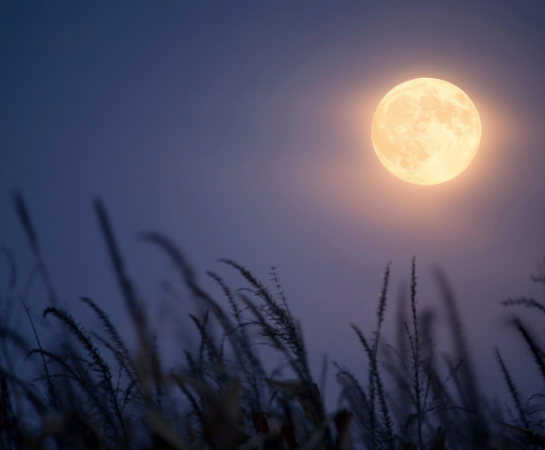
What Is a Harvest Moon and Why It Rises at Almost the Same Time Several Nights Running
On most nights of the year, the Moon rises roughly 50 minutes later than it did the night before. Around the Harvest Moon, that gap collapses to as little as 10 minutes in parts of the UK and Canada, and rarely more than 30 minutes
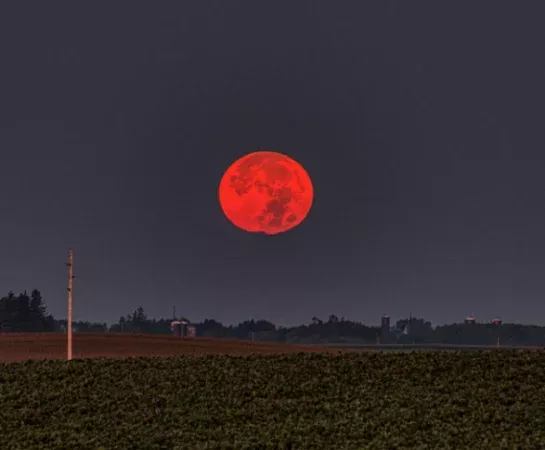
What Is a Blood Moon and Why Does the Moon Turn Red
On the night of August 27, 2026, the Moon came within a hair of disappearing entirely. Earth's shadow covered 96.2% of its surface, a partial eclipse so deep that skywatchers across the Americas, Europe, and Africa watched it turn a rusty, almost total red without
Time Tools
Quick access to timers, stopwatch, world clock and time zone tools.
Time Guides
Read useful guides about time zones, calendars, finance and astronomy.


