Every August, without fail, the night sky puts on the most reliable fireworks show in astronomy, and almost nobody has to plan around a rocket launch schedule or ticket sales to see it. The Perseids show up on the same few nights every single year, driven by a piece of celestial mechanics so precise that Chinese astronomers were already recording it in the year 36 AD. Understanding why it happens on schedule, and why the hours right before dawn matter so much more than the hours after sunset, turns a casual glance at the sky into something considerably more interesting.
Why the Same Week, Every Year
The Perseids aren’t debris randomly drifting through space. They’re the leftover trail of comet 109P/Swift-Tuttle, a 16-mile-wide ball of ice and rock that swings through the inner solar system once every 133 years. Every time it passes near the Sun, it sheds dust and gravel along its orbital path, and that debris stream has been accumulating for centuries. Earth’s own orbit crosses through that stream at almost exactly the same point every year, which is why the shower peaks around the same dates annually, typically August 11 through 13, regardless of where the comet itself happens to be at the time. Swift-Tuttle last passed through in 1992 and won’t return again until 2125, but the trail it left behind on that pass, and on dozens of passes before it, is still there waiting for Earth to plow through it every summer.
Entry speed: about 59 km/s (37 miles per second)
Burnup altitude: roughly 60 to 80 km above the ground
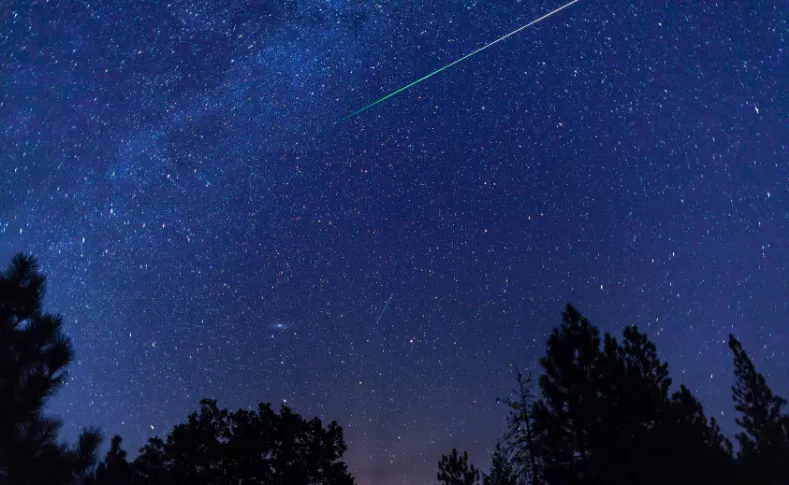
Nothing solid actually reaches the ground during a Perseid shower. What you’re watching is friction, not falling rock. At nearly 60 kilometers per second, among the fastest of any annual meteor shower, these tiny fragments compress and superheat the air directly in front of them so violently that both the particle and a column of surrounding air glow brightly enough to see from the ground, then vanish completely tens of kilometers up.
The Physics Behind “Watch After Midnight”
Nearly every guide says the same thing: don’t bother going outside right after sunset, wait until after midnight, and the best show comes just before dawn. The usual explanation is that the shower’s radiant point, the spot in the constellation Perseus the meteors appear to stream from, sits low on the horizon in the evening and climbs higher as the night goes on. That’s true, but it’s only half the story, and the more interesting half almost never gets explained.
Earth is moving through space at roughly 30 kilometers per second, orbiting the Sun, and that motion has a direction. Before local midnight, your location on the planet’s surface is facing away from the direction Earth is traveling, on what amounts to the trailing side. After midnight, Earth’s rotation carries you around to the leading side, the hemisphere actually plowing forward into the debris stream. It works the same way bugs hit a moving car’s windshield far more than its rear window. Before midnight, you’re standing on the rear window. After midnight, you’ve rotated onto the windshield, and you start intercepting meteoroid debris head-on instead of only catching the occasional particle that happens to catch up with Earth from behind.
You’re not just waiting for a better view of the radiant after midnight. You’re waiting for your exact spot on Earth to rotate into the side of the planet actually plowing through the debris. worldtimedata
A Shower With a 2,000-Year Paper Trail
The Perseids have one of the longest continuous observational histories of any astronomical event, with the earliest surviving record appearing in Chinese court astronomical annals in 36 AD, more than 1,800 years before anyone understood what caused it. For centuries in Catholic Europe, the shower was known as the Tears of Saint Lawrence, since its peak consistently falls within a few days of the saint’s August 10 feast day, and medieval observers had no explanation beyond a religious one for the streaks appearing on cue every summer.
The actual mechanism wasn’t identified until 1866, when the Italian astronomer Giovanni Schiaparelli calculated the orbit of the newly discovered comet Swift-Tuttle and realized it matched the path of the Perseid debris stream almost exactly. It was among the first solid evidence connecting meteor showers to comets at all, a discovery that reframed a religious mystery as an orbital mechanics problem with a comet’s name attached to it. The fixed date works for a simple reason: Earth returns to the same point in its orbit on roughly the same calendar day every year, so it crosses the debris stream at the same time each summer, the same basic principle behind why the calendar’s equinoxes and solstices land on predictable dates too, even though the two phenomena are driven by entirely different mechanics.
How to Actually Watch It
The Perseids reward almost no preparation. Binoculars and telescopes actively hurt your chances, since they narrow your field of view down to a tiny patch of sky when meteors can streak across almost any part of it. What actually matters is finding a wide, unobstructed view away from artificial light, giving your eyes at least twenty minutes to adjust to the darkness, and being patient enough to stay out past midnight rather than giving up after a quiet first half hour right after sunset.
Knowing roughly when true darkness sets in matters here too, since how early or late dawn actually arrives shifts throughout the year, which changes how much genuinely dark viewing window you get before the sky starts brightening again in mid-August. You don’t need to stare directly at the radiant in Perseus either. Meteors trailing back toward that point can appear anywhere in the sky, and looking roughly 45 degrees away from the radiant tends to show longer, more dramatic streaks than staring straight at the source. If you’re trying to orient yourself and find Perseus in the first place, it sits not far from Polaris and the northern circumpolar constellations that stay roughly fixed in the same part of the sky all night, which makes for a reliable landmark once you’ve found it once.
Two Clocks Running at Once
Swift-Tuttle’s 133-year orbit determines how much fresh debris sits in the stream at any given point in history. Earth’s own single-year orbit determines exactly which August nights carry you through the densest part of it. Neither cycle depends on the other, and neither one was designed with the other in mind, yet they intersect precisely enough that the same few nights in mid-August have delivered a reliable show since long before anyone had a name for what was causing it. The court astronomer who logged it in 36 AD had no way to know a comet was involved at all. The only thing that’s actually changed in the nearly two thousand years since is that we finally know why it works.