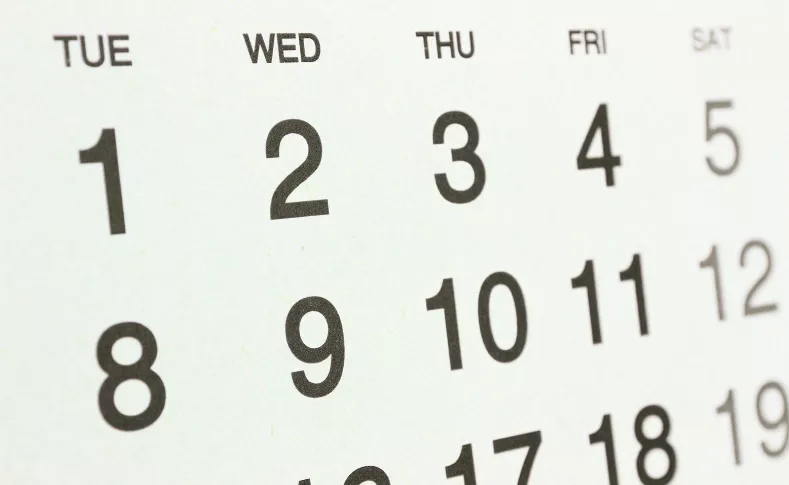
The word predates the Battle of Hastings, survives in British payroll software, and gets typed into search engines every day by teenagers convinced it is a misspelling of a video game. A fortnight is fourteen days, exactly two weeks, no more and no less. What makes the word interesting is not the definition but the fact that it has outlived almost every other unit its own age, while its supposed modern replacement turns out to be genuinely broken.
The short answer
A fortnight always means 14 days. It is common, ordinary, unremarkable vocabulary in the United Kingdom, Ireland, Australia, and New Zealand, where people casually say things like “see you in a fortnight” or receive their wages fortnightly without a second thought. In American English, the word is rare enough to sound faintly archaic, and “two weeks” or “biweekly” takes its place. That regional split is not an accident of taste. It is the surviving edge of a word that used to be universal in English and slowly retreated to one side of the Atlantic.
Where the word actually comes from
Fortnight is a contraction of the Old English fēowertīene niht, literally “fourteen nights.” The choice of nights rather than days was not poetic license. The Anglo-Saxons, like other Germanic peoples, reckoned time by nights instead of days, a custom the Roman historian Tacitus specifically noted as unusual when he described Germanic tribes in his first-century work Germania. Traces of that habit still sit inside modern English without most speakers noticing: a “fortnight” counts nights, and older constructions like “sennight,” meaning seven nights, once did the same job for a single week.
The earliest surviving written trace of the phrase appears far earlier than most dictionary entries let on. It shows up in the law code of Ine, a king of Wessex, compiled around 694 AD and preserved in later manuscript copies. One clause fixes the value of a ewe with her lamb at one shilling “oð þæt feowertyne niht ofer eastron,” until fourteen nights after Easter, a strikingly mundane use of the phrase to settle a livestock dispute more than 1,300 years ago. By around 1300, the poem Layamon’s Brut shows the phrase already contracting toward a single word, written as “fourteniht.” The spelling settled into something close to its modern form by the 17th century.
English is unusual simply for having a single dedicated word at all. Several other languages either count fifteen days rather than fourteen, treating the span inclusively, or have no fixed word for it whatsoever and default to a phrase meaning “two weeks.”
| Language | Term | Literal meaning |
|---|---|---|
| English | fortnight | Fourteen nights |
| Welsh | pythefnos | Fifteen nights |
| French | quinzaine | A group of fifteen |
| Greek | dekapenthímero | Fifteen days |
| American English | biweekly | Ambiguous between “every two weeks” and “twice a week” |
The sibling word that did not survive
Fortnight was never alone. Sennight, a matching contraction of “seven nights,” meant one week and appeared just as naturally in medieval and early modern English. It lost that battle entirely. The word “week,” borrowed from a different root, pushed sennight out of common use by the 19th century, and today it survives only in deliberately old-fashioned or literary writing. Fortnight’s survival, by contrast, has more to do with region than with grammar. A related look at how a year actually breaks down into weeks shows why a clean two-week unit like a fortnight was useful enough to keep around in payroll and scheduling long after “sennight” had already disappeared.
Why American English let it go, and what replaced it is actually worse
Fortnight simply never took root as firmly in American usage, and by the 20th century “two weeks” had become the default phrase, with “biweekly” adopted for schedules and pay periods. That substitution looks tidy until you check what biweekly actually means, because dictionaries themselves cannot agree. Merriam-Webster, Dictionary.com, and Cambridge Dictionary all define biweekly as both “occurring every two weeks” and “occurring twice a week,” two contradictory meanings sitting inside the same entry. The confusion is not a recent internet complaint either. In 1844, a reader wrote to the Southern Literary Messenger to complain that a magazine calling itself “bi-monthly” arrived only once every two months instead of twice a month, and the publisher admitted its own editors could not settle on which meaning was correct.
A word that has meant exactly one thing for 1,300 years is, by any practical measure, more precise than the modern word that replaced it. worldtimedata
The Associated Press Stylebook eventually picked a side, instructing writers to use “biweekly” only for “every other week” and “semiweekly” for “twice a week.” Most dictionaries still list both meanings anyway, because both are genuinely in active use and neither has driven the other out. Fortnight has no such problem. It has meant fourteen days since before England was a unified kingdom, and it still does.
Beyond payroll: a fortnight is also a real astronomical interval
The word is not only a cultural holdover. In astronomy, a lunar fortnight refers to half of the Moon’s synodic month, the average interval between a full moon and the following new moon, which works out to roughly 14.77 days. That interval also governs a genuine physical phenomenon: the fortnightly tidal cycle that produces alternating spring tides and neap tides as the gravitational pull of the Sun and Moon shift in and out of alignment roughly twice a month. A fortnight, in other words, is close enough to a real half-lunar-cycle that its usefulness was never purely cultural. Anyone curious how other named spans of time, from a decade to a millennium, get their exact boundaries can see a similar pattern of convention meeting astronomy in how those longer units are actually defined.
A 1,300-year-old word gets a second life through a video game
The most unexpected chapter in the word’s history has nothing to do with medieval law codes. In 2017, Epic Games released a survival shooter called Fortnite, a name that plays on both “fort” and “night,” referencing the original game mode’s premise of building forts to survive nightly monster attacks, while also echoing the older English word for a two-week span, since that early version of the game was built around roughly fourteen-day survival stretches. Epic Games has never officially confirmed the exact reasoning behind the name, but the wordplay is widely accepted among players and linguists alike. What is verifiable is the effect: an entire generation, many of them American, encountered the sound and spelling of “fortnight” for the first time through a game controller rather than a British novel, frequently assuming the older word was simply a typo of the newer one. Taylor Swift and Post Malone added a second, unrelated pop-culture echo in 2024 with a song titled “Fortnight,” on the correct historical spelling, giving the original word a small resurgence in searches from listeners trying to figure out what it actually meant. For a related sense of how unusual time-related terms persist in specific communities long after most people stop using them, the same dynamic shows up in why Zulu time still gets used in aviation and the military decades after most civilians switched to naming time zones differently.
A word that never needed fixing
Most surviving fragments of Old English are frozen in idioms nobody examines closely, like the “fore” in “foretell” or the silent history buried in “goodbye.” Fortnight is unusual because it never fully fossilized. It still functions as an everyday working word for roughly a hundred million English speakers, still shows up on payslips and cricket schedules and NHS press releases, and still describes something real enough that astronomers use a version of it without irony. The word did not survive because English speakers felt sentimental about the Anglo-Saxons. It survived because nobody ever invented a better one, and the closest attempt, a prefix borrowed from Latin and bolted onto “weekly,” turned out to mean two different things at once.