
The time of sunrise changes every day, and this change is not random. It is a direct result of the geometry of Earth’s motion relative to the Sun.
This is not caused by a single factor. It is the combined effect of Earth’s axial tilt, its orbital motion, and the observer’s location on the planet. Together, they create a continuous but non-uniform shift in sunrise time.
Earth’s axial tilt defines the structure of daylight
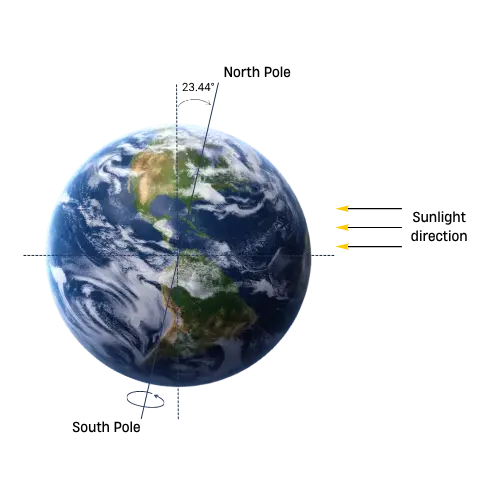
Earth’s rotational axis is tilted at 23.44° relative to the plane of its orbit. This is the key parameter that drives seasonal changes and the apparent motion of the Sun in the sky.
When a hemisphere is tilted toward the Sun, the Sun’s daily path becomes longer and higher above the horizon. As a result, sunrise occurs earlier and sunset later.
When the hemisphere is tilted away, the Sun’s path shortens and remains lower in the sky, shifting sunrise to a later time.
Earth’s orbit affects how fast the change happens
Earth does not move around the Sun at a constant speed. Its orbit is slightly elliptical, with an eccentricity of about 0.0167. This deviation from a perfect circle is small, but it has measurable effects on how solar time behaves.
According to Kepler’s second law, Earth sweeps out equal areas in equal times. This means its orbital velocity increases as it approaches perihelion and decreases near aphelion. In practical terms, the apparent motion of the Sun along the sky is not uniform when measured against clock time.
This variation changes how quickly the Sun’s position shifts from one day to the next. During periods of faster orbital motion, the Sun appears to move more quickly relative to the fixed 24-hour clock. During slower periods, that shift becomes more gradual.
Because of this, the true solar day – defined by successive solar noons – is not constant. It fluctuates slightly around 24 hours rather than matching it exactly. These small variations accumulate and directly influence the timing of sunrise.
As a result, the daily shift in sunrise time is not driven only by axial tilt. It is also shaped by how Earth moves along its orbit at that specific time of year.
The difference between solar time and clock time
Clock time is based on the mean solar day, which is defined as exactly 24 hours. This is a constructed average that smooths out the irregularities in Earth’s motion.
In reality, the Sun does not cross the sky at a perfectly uniform rate. Its apparent motion is influenced both by axial tilt and by the changing orbital speed. This creates a measurable difference between true solar time and the standardized time used in clocks.
This difference is described by the equation of time, which quantifies how far true solar time deviates from mean solar time at any given moment.
The value of this deviation changes continuously throughout the year and can reach approximately ±16 minutes. It does not follow a simple linear pattern, but instead forms a smooth curve with multiple peaks and minima.
This is why sunrise time does not shift at a constant rate. Even if the geometric position of the Sun changes gradually, the translation of that motion into clock time introduces additional variation.
In practice, this means that two consecutive days can have slightly different shifts in sunrise time, even under similar seasonal conditions. The observed change is always the result of both geometry and timekeeping interacting together.
Latitude determines the scale of change
The magnitude of sunrise variation depends on geographic latitude.
- near the equator, changes are minimal throughout the year
- in mid-latitudes, the shift is noticeable day by day
- at high latitudes, changes become extreme and can lead to polar day or polar night
The further from the equator, the stronger the variation in solar angle and the more pronounced the shift in sunrise time.
The change is not uniform
Sunrise does not shift by a fixed number of minutes each day.
There are periods when the change accelerates and periods when it almost stabilizes. The slowest changes occur near the solstices.
This non-uniform behavior comes from the combined effect of axial tilt and orbital motion.
How sunrise is calculated
Sunrise is determined geometrically using a set of physical parameters:
- geographic latitude
- solar declination
- solar elevation angle relative to the horizon
In simplified form, the moment of sunrise is defined by:
where φ is latitude, δ is solar declination, and H is the hour angle.
This equation determines the moment when the Sun crosses the horizon for a given location.
What this means in practice
Sunrise time is not a fixed value tied to a specific clock reading. It is the output of a calculation that depends on both physical geometry and timekeeping systems.
To determine the exact moment of sunrise, systems combine geographic coordinates with the current date and the local time zone. Latitude defines the Sun’s path relative to the horizon, while the date determines solar declination. The time zone then converts the calculated solar moment into local time.
This process is fully deterministic. For any location and date, sunrise can be calculated with high precision. There is no randomness involved, only the application of consistent astronomical models.
However, the output is not evenly spaced from day to day. The change in sunrise time reflects the interaction between axial tilt, orbital motion, and the conversion from solar time to clock time. As these components evolve continuously, the resulting shift also varies in magnitude.
In practical terms, this is why sunrise tables, weather services, and navigation systems must compute values dynamically rather than rely on fixed intervals. Even small differences matter, especially at higher latitudes where the rate of change increases significantly.
Each new day produces a slightly different result, but the pattern over the year remains predictable and repeatable. Sunrise is not just observed. It is calculated from a stable physical system.