If a newspaper horoscope calls you an Aries, the sun was not actually sitting in front of the constellation Aries on the day you were born. It hasn’t been for roughly two thousand years. This isn’t a conspiracy, a recent discovery, or a sign that astrology got its math wrong. It’s the direct, measurable, predictable result of a slow wobble in Earth’s own rotation, one astronomers have tracked for over two thousand years and can calculate centuries into the future with total confidence. The gap between where the zodiac says the sun is and where the sun actually appears against the stars keeps growing, by design, because of how both systems were built in the first place.
A Twenty-Six-Thousand-Year Wobble
Earth doesn’t spin on a perfectly fixed axis. Like a slowing top tracing a slow circle instead of standing perfectly upright, Earth’s axis sweeps out its own circle in space, pulled by the combined gravity of the sun and moon acting on the slight equatorial bulge created by the planet’s rotation. This motion, called axial precession, is extraordinarily slow: one full circuit takes approximately 25,772 years. But it’s also completely regular, slowly moving the vernal equinox point backward through the background stars at a steady rate of about one degree every 72 years. Over centuries, that steady creep adds up to something large enough to matter.
How Anyone Noticed a 26,000-Year Cycle
Detecting a wobble that takes 25,772 years to complete a single circuit sounds like it should be impossible with only a human lifetime of data to work from, and for most of history it was. The breakthrough belongs to the Greek astronomer Hipparchus, working in the second century BCE. Around 129 BCE, Hipparchus completed a detailed star catalog and compared his own measurements against records left by Timocharis of Alexandria roughly 150 years earlier, along with older Babylonian observations. He focused on the bright star Spica relative to the autumn equinox point: Timocharis had recorded it sitting about 8 degrees west of the equinox; Hipparchus measured it at roughly 6 degrees west. The 2-degree difference was too large and too consistent across multiple stars to be measurement error.
Hipparchus reasoned correctly that the stars themselves weren’t drifting. Earth’s own axis had shifted slightly over the century and a half between the two sets of observations. From that single, carefully isolated discrepancy, he calculated a precession rate of about 45 to 46 arcseconds per year, remarkably close to the modern accepted figure of roughly 50 arcseconds per year, using nothing more than patient comparison of two star catalogs separated by five generations. It remains one of the earliest examples in history of a slow, imperceptible planetary motion being deduced entirely from careful record-keeping rather than direct observation.
Twelve Equal Slices of an Uneven Sky
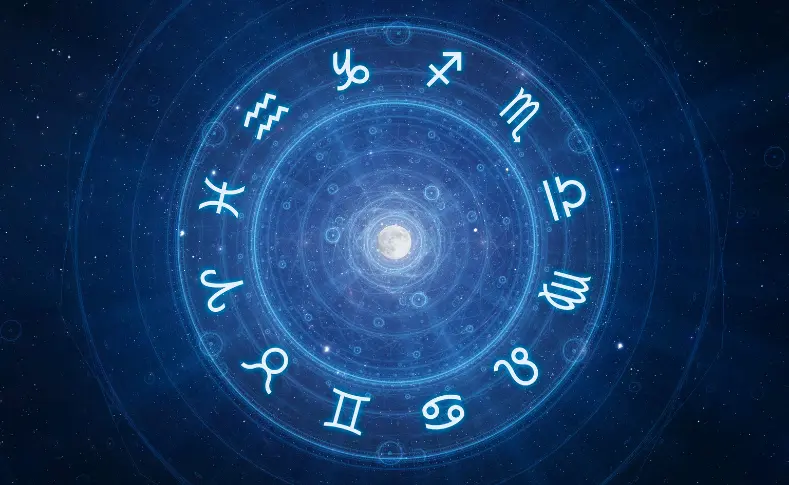
The zodiac’s twelve signs didn’t begin as a precise mapping of twelve constellations in the first place. When Babylonian astronomers systematized the zodiac roughly 2,500 to 3,000 years ago, they were working from a sky that the sun’s path, the ecliptic, actually carries through thirteen constellations, not twelve. Rather than deal with an unequal, thirteen-part system, they divided the ecliptic into twelve equal 30-degree segments and named each one after the constellation that roughly occupied that stretch of sky, discarding the thirteenth entirely for the sake of a clean, calendar-friendly number.
The constellations themselves were never evenly sized to begin with. Virgo sprawls across roughly 44 degrees of the ecliptic, while Scorpius occupies barely 7. A system built on twelve equal 30-degree slices was always an approximation laid over a genuinely irregular sky, centuries before precession had shifted anything at all. The tropical zodiac, the version most Western horoscopes still use today, was cemented in this form by the astronomer Claudius Ptolemy in his second-century work Tetrabiblos, around 150 CE, which is also the closest thing the system has to a fixed starting point for measuring how far it has since drifted from the stars.
The Twenty-Four Degrees That Built Up Since
Since Ptolemy’s era, roughly 1,875 years of steady precession, at about one degree every 72 years, has added up to somewhere around 24 degrees of drift between where the tropical zodiac places the sun and where the sun actually appears against the constellations. Twenty-four degrees is close to a full sign’s width, which is why the mismatch isn’t scattered randomly across the year; it lines up almost perfectly with a one-sign shift. A star called Mesarthim, once recorded as marking the exact start of Aries near 392 BCE, is measured today at roughly 3 degrees into the constellation Taurus, a small, specific illustration of a drift that has been building the entire time.
The practical result is that anyone born under a given tropical sign is very likely born while the sun was actually positioned in front of the constellation just before it.
| Tropical sign | Traditional dates | Sun’s actual constellation backdrop today |
|---|---|---|
| Aries | Mar 21 – Apr 19 | Pisces |
| Taurus | Apr 20 – May 20 | Aries |
| Gemini | May 21 – Jun 20 | Taurus |
| Cancer | Jun 21 – Jul 22 | Gemini |
| Leo | Jul 23 – Aug 22 | Cancer |
| Virgo | Aug 23 – Sep 22 | Leo |
| Libra | Sep 23 – Oct 22 | Virgo |
| Scorpio | Oct 23 – Nov 21 | Libra |
| Sagittarius | Nov 22 – Dec 21 | Scorpius / Ophiuchus |
| Capricorn | Dec 22 – Jan 19 | Sagittarius |
| Aquarius | Jan 20 – Feb 18 | Capricorn |
| Pisces | Feb 19 – Mar 20 | Aquarius |
Because the constellations vary so much in width, this one-sign shift is a useful approximation rather than an exact rule for every date. But the direction and the rough scale are consistent: the sky has moved by almost exactly one sign’s worth since the system was fixed in place.
The Constellation Nobody Officially Counted
That thirteenth constellation the Babylonians dropped, Ophiuchus, the Serpent Bearer, sits between Scorpius and Sagittarius, and the sun spends roughly 18 days passing in front of it every year, from about November 29 to December 17. It’s a real, catalogued constellation, not a recent addition or a hoax; it has simply never had a corresponding sign in the traditional twelve-part system.
The Babylonians didn’t miss Ophiuchus. They cut it, on purpose, because thirteen slices made worse arithmetic than twelve. worldtimedata
That deliberate omission is also the root of a piece of viral misinformation that resurfaces every few years: the claim that NASA “added” Ophiuchus as a new 13th sign and secretly changed everyone’s zodiac. The rumor traces back to a 2016 NASA Space Place post written for children, explaining constellations and precession in simple terms. NASA never proposed changing anything; it was describing astronomy that had been documented for millennia. The claim has gone viral repeatedly since, resurfacing on social media in 2016, 2020, and again in a wave that specifically swept through Ukrainian social media in September 2023, with NASA publicly clarifying each time that it doesn’t practice astrology and never touched anyone’s sign.
Two Honest Systems, Not One Mistake
It’s worth being fair to the tropical zodiac here, because the “mismatch” framing can make it sound like a broken system rather than a system built on a different premise entirely. Tropical astrology, the version behind most Western newspaper horoscopes, has never claimed to track the literal constellations. It’s anchored to the seasons: 0 degrees Aries is defined as the moment of the spring equinox, full stop, regardless of which constellation happens to sit behind the sun at that instant. On its own terms, precession changes nothing, because the system was never measuring the stars in the first place.
Sidereal astrology takes the opposite position and actually does track the constellations. Practiced for centuries in Vedic, or Jyotish, astrology in India, and revived in the West during the twentieth century largely through the work of Irish astrologer Cyril Fagan, sidereal systems apply a running correction, called an ayanamsa, that shifts the zodiac’s zero point to keep pace with precession. It’s the same underlying instinct behind leap year corrections: a system that has to reconcile a clean, evenly divided framework with an astronomical reality that doesn’t move in clean, even units.
A Sky That Keeps Moving, On Schedule
None of this drift is random or accelerating. It’s the same steady one degree every 72 years it has always been, predictable centuries out in either direction, currently carrying the spring equinox point through the constellation Pisces and toward Aquarius, the astronomical basis for the popular idea of a coming “Age of Aquarius.” The zodiac’s twelve signs were an approximation from the moment the Babylonians drew them, built on constellations that were never equal in size to begin with. Precession didn’t break an otherwise perfect system. It just kept adding to a gap that was already there, one slow degree at a time, and will keep doing so with or without anyone noticing.