Four Fridays a year, without fail, trading volume on US exchanges spikes hard enough that even investors who’ve never heard the term can usually tell something unusual is happening. The cause isn’t a crisis, a scandal, or breaking news. It’s paperwork, specifically three entirely different categories of derivative contract all reaching their deadline on the exact same afternoon, forcing an enormous, mechanically predictable wave of buying and selling that has nothing to do with what anyone actually thinks a stock is worth.
Three Derivatives, One Deadline
Triple witching refers to the simultaneous expiration of three separate contract types: stock options, stock index futures, and stock index options. Each one has a fixed lifespan, unlike a share of stock itself, and each forces the people holding it to make a decision once that lifespan runs out: exercise it, let it expire worthless, or roll the position into a new contract further out. Stock options had already been trading on organized exchanges since the Chicago Board Options Exchange opened in 1973, expiring monthly on their own schedule. Stock index futures and stock index options arrived nearly a decade later, in the early 1980s, running on a quarterly cycle instead. Later in that same decade, regulators aligned the monthly stock options cycle to land on the identical Friday used for the quarterly index contracts, and triple witching, as a single concentrated event, was born. It now falls on the third Friday of March, June, September, and December, every year, without exception.
Why “Witching”
The name borrows directly from older folklore about the witching hour, traditionally understood as the dead of night, somewhere around 3 to 4 a.m., when supernatural activity was said to peak. Medieval church authorities reportedly discouraged people from being out during that stretch specifically because of the association. Wall Street flipped the clock on the idea: in US markets, the closing hour, 3 to 4 p.m. Eastern, is where trading activity peaks on expiration days, as institutions rush to close out or roll forward positions before the deadline hits. Some accounts also connect the “witching” language to the three witches who open Shakespeare’s Macbeth, a fitting pun given that three separate contract types are doing the converging, though the folklore explanation is the one with the clearer documented lineage.
Where the Volume Actually Comes From
Expiration alone doesn’t explain the scale of what happens on a witching Friday; the real driver is what index funds and exchange-traded funds are contractually required to do. Funds built to track a benchmark like the S&P 500 don’t just hold stocks passively forever. On days when that benchmark rebalances, or when the fund needs to true up its holdings to match an official closing value, it has to trade an enormous, precisely calculated basket of stocks at the closing price itself, not sometime near it. That obligation is what produces the market-on-close imbalances that make witching-day closes so distinctive: enormous, one-directional order flow that exchanges know is coming in advance because funds are required to publish imbalance estimates before the close, and that still moves prices meaningfully once it actually executes.
That timing isn’t a coincidence, either. S&P Dow Jones Indices deliberately schedules its quarterly reconstitution of the S&P 500, adding and removing companies to keep the index current, to take effect right after the close on the same third Friday used for triple witching, specifically so passive funds can execute both sets of trades in the same closing auction rather than two separate ones. The scale that produces is genuinely enormous: on the December 2025 witching Friday, an estimated 7.1 trillion dollars in equity options expired simultaneously, a session Piper Sandler projected would rank as the fourth-largest trading volume day on record, the same session in which Carvana was added to the S&P 500 itself. It’s a pattern that repeats: index additions and removals routinely land on witching Fridays specifically so the rebalancing trades and the mechanical expiration flow can be absorbed together in the same closing auction.
A second, subtler effect shows up in the days leading into expiration rather than on the day itself. Options market makers who’ve sold contracts often hedge their own exposure by trading the underlying stock, and as expiration approaches, that hedging activity can pull a stock’s price toward whichever strike price has the most open options contracts attached to it, a pattern traders call pin risk. It isn’t guaranteed to happen, but it’s common enough that some traders watch open interest by strike specifically to anticipate where a stock might drift right before its options expire.
The Fourth Witch That Came and Went
For nearly two decades, “triple” wasn’t even always the right number. The Commodity Futures Modernization Act of 2000 lifted a long-standing ban on single-stock futures in the United States, and starting in November 2002, the OneChicago exchange began listing them, expiring on the same quarterly schedule as everything else. With a fourth contract type now converging on the same Friday, the event briefly picked up the nickname quadruple witching. Single-stock futures never became a major US product, and trading in them stopped entirely around September 2020, leaving the market back where it started: three contract types, one Friday, and the older name once again the accurate one.
The Friday Before Black Monday
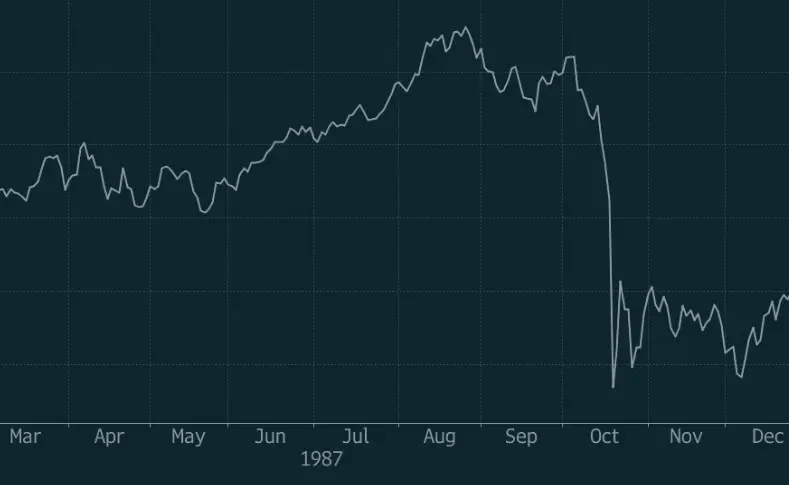
The clearest illustration of how disruptive a witching day can get isn’t a recent one. According to the Federal Reserve’s own official history of the period, October 16, 1987, a Friday, was a triple witching day, and the rolling sell-off already underway that week coincided directly with it. By the close, the Dow Jones Industrial Average had fallen 108.35 points, a 4.6 percent drop that was, at the time, the largest single-day point decline in the index’s history.
Triple witching didn’t cause what came next. It just made sure Wall Street walked into the weekend already off balance. worldtimedata
What came next was worse. Over that weekend, Treasury Secretary James Baker publicly threatened to devalue the US dollar to narrow a widening trade deficit, and by the time Asian markets opened before US trading resumed, stocks were already sliding hard overseas. When American markets opened on Monday, October 19, automated portfolio-insurance strategies, designed to sell stock index futures as prices fell, kicked in simultaneously across much of Wall Street, feeding the exact kind of selling pressure they were supposed to guard against. The Dow lost 22.6 percent that day, still the largest single-day percentage decline in its history. Regulators never concluded that triple witching caused Black Monday; portfolio insurance and the dollar-devaluation shock did far more damage. But the Friday’s already-elevated, witching-driven volatility is consistently cited as part of the unstable footing the market was standing on when the real blow landed.
The regulatory response reshaped how expiration itself works today. Exchanges shifted key parts of the witching settlement process to the afternoon specifically to reduce the kind of pre-market selling pressure that had built up heading into that particular Monday, and separately introduced the circuit breaker system that still halts trading during severe single-day drops, thresholds that have been revised more than once since but trace their existence directly back to that same October. Under the current version, a 7 or 13 percent intraday decline before 3:25 p.m. triggers a 15-minute pause, and a 20 percent drop at any point shuts the market down for the rest of the session.
What It Actually Looks Like on an Ordinary Quarter
Most witching Fridays never come close to 1987. What they reliably produce is volume, concentrated into the final hour before the closing bell, at levels that can run well above a typical day’s average, alongside short bursts of volatility that don’t necessarily track any actual news. That combination catches casual investors off guard more often than professionals, who plan around it, precisely because the price movement on a witching day can look like it means something about a company’s prospects when it’s really just funds and market makers unwinding positions that were always scheduled to unwind on that exact date. The market’s other predictable pocket of volatility sits at the opposite end of the trading day, and between the two, a surprising share of a quarter’s most chaotic-looking price action turns out to be entirely scheduled in advance, just rarely advertised outside of financial media that already knows to expect it.