Major Airports in Norway
- Ålesund Airport (AES) - 00:27:39
- Bergen Airport, Flesland (BGO) - 00:27:39
- Bodø Airport (BOO) - 00:27:39
- Harstad/Narvik Airport (EVE) - 00:27:39
- Kristiansand Airport (KRS) - 00:27:39
- Oslo-Gardermoen International Airport (OSL) - 00:27:39
- Sandefjord Airport, Torp (TRF) - 00:27:39
- Stavanger Airport, Sola (SVG) - 00:27:39
- Tromsø Airport (TOS) - 01:27:39
- Trondheim Airport, Værnes (TRD) - 00:27:39
Daylight saving time changes in Norway
Norway has 1 listed IANA time zones. 1 of them observe daylight saving time changes in 2026.
Next change: October 25, 2026
Clock moves back from 03:00 to 02:00 local time.
Best Time to Call Norway
Business hours in Norway (9 AM–5 PM local time) fall at these local times elsewhere:
- Beijing: 3:00 PM – 11:00 PM ( Partial overlap)
- Paris: 9:00 AM – 5:00 PM ( Convenient)
- Toronto: 3:00 AM – 11:00 AM ( Outside normal hours)
- Seoul: 4:00 PM – 12:00 AM (next day) ( Partial overlap)
- Mexico City: 1:00 AM – 9:00 AM ( Outside normal hours)
- Cairo: 10:00 AM – 6:00 PM ( Convenient)
- Bangkok: 2:00 PM – 10:00 PM ( Partial overlap)
Times shown reflect current UTC offsets and may shift by up to an hour around daylight saving transitions.
Time Difference from Norway
Compare time in Norway with other countries.
Most Popular Cities in Norway
Holidays in Norway
Official national public holidays. Regional and religious observances may vary by area.
About Time in Norway
A Stick That Told the Farming Year
Long before printed calendars reached rural Norway, farmers kept time with a flat wooden stick called a primstav, its name blending the Latin prima with the Norwegian word for stick. Notched along both edges to mark every day of the year, it carried carved symbols at the dates that mattered: a key for Saint Peter's Day in February, a warning that lake ice might no longer hold; other marks for planting, shearing, brewing and the days on which farmhands' contracts began or ended. The oldest surviving example dates to 1457, and the tradition likely reaches back further still into pre-Christian practice, later absorbing dozens of Catholic saints' days even after the Reformation had formally done away with their veneration.
The stick's most consistent feature was its two faces. One side, beginning 14 April, covered the light half of the year; the other, beginning 14 October, covered the dark half, and on each of those two dates Norwegian households would physically turn the primstav over, a small domestic ritual that doubled as the traditional day for hiring or dismissing farm labour. Because the symbols were carved by hand and passed down regionally rather than printed centrally, meanings drifted: a mark near the coast might flag the start of a fishing season that meant nothing to a farmer in the interior. The primstav lost its practical function only gradually after Norway adopted the Gregorian calendar, remaining in everyday use in some rural districts well into the twentieth century.
A Country That Ran on Two Clocks at Once
Norway came to standard time later than most of Europe, largely because it had little need of one before the railways arrived. When the electric telegraph first linked Kristiania, now Oslo, to Drammen in 1855, operators simply used Copenhagen time to coordinate messages, switching in 1866 to Kristiania's own local time, seven minutes later than the Danish capital's. Railways then compounded the confusion rather than resolving it: trains running from the city's eastern terminus kept Kristiania time, while those departing from the western terminus a short walk away ran on Drammen local time, a genuine discrepancy of several minutes between two stations in the same city.
The country did not fix this until 1 January 1895, when it adopted Central European Time, aligning the whole nation, at midnight, clocks in the capital moved forward by seventeen minutes to match the new 15-degree-east reference meridian rather than the city's own longitude. Even then the change came ahead of full railway unification, since the line connecting the eastern and western networks was not completed until 1909. Daylight saving proved a far less settled matter over the following century, tried and abandoned repeatedly through the First World War, the German occupation, and again in the 1960s amid public controversy, before Norway finally adopted the seasonal changeover it still uses today in 1980.
A Month That Decided Two Fates
At roughly three in the afternoon on 14 December 1911, Roald Amundsen and four companions planted the Norwegian flag at the geographic South Pole, having kept their true destination secret from rivals until their ship was already at sea. Amundsen had originally aimed for the North Pole, but on learning in 1909 that Frederick Cook and Robert Peary both claimed to have already reached it, he quietly redirected his entire expedition south, choosing dogs, skis and a base camp sixty miles closer to the pole than his British competitor Robert Falcon Scott.
Scott's own party reached the same spot on 18 January 1912, more than a month behind, having relied on motorised sledges and Siberian ponies rather than dogs. It was a fatal delay in every sense: weakened by exhaustion and cold on the return march, Scott and his remaining companions died in their tent, pinned down by a blizzard just eleven miles short of a supply depot that would very likely have saved them. Amundsen's party, by contrast, made it back to base camp on 25 January 1912, having covered roughly 1,400 nautical miles in 99 days, a margin of preparation and pacing that turned a matter of weeks into the difference between a triumphant return and a tragedy still recounted in polar history a century later.
Seven Hours That Became a Genre
On 27 November 2009, the Norwegian public broadcaster NRK aired something no channel had seriously attempted before: an unedited, seven-hour-and-sixteen-minute broadcast of the entire train journey between Bergen and Oslo, filmed from the driver's cab with nothing but ambient sound, timed to mark the Bergen Line's hundredth anniversary. Rather than cut away during the route's 182 tunnels, producers filled the darkness with archival photographs and interviews with railway historians, letting the programme run at exactly the pace of the real journey rather than any edited version of it.
Around 1.2 million viewers, close to a quarter of Norway's population, tuned in, and the format, which came to be known as sakte-TV, or slow television, only grew bolder from there. In 2011, NRK broadcast the full 134-hour voyage of the coastal ferry Hurtigruten from Bergen to Kirkenes, drawing an audience share that peaked above a third of the country and prompting crowds to gather on shorelines hoping to be seen live on camera as the ship passed. The genre has since been exported to broadcasters from Britain to Sweden, built entirely around the idea that an event told at its own real duration, with nothing sped up, cut or dramatised, could hold a television audience just as well as one compressed for convenience.
Frequently Asked Questions
How many time zones does Norway have?
One. The whole of Norway follows Europe/Oslo, so every city shows the same local time as the capital, Oslo.
Is Norway ahead of or behind GMT?
Norway is currently 2 hours ahead of GMT (UTC+2).
Does Norway use summer time?
Yes. Oslo uses UTC+1 (CET) in standard time and UTC+2 (CEST) during daylight saving time, and is currently on summer time.
How many public holidays does Norway have in 2026?
Norway has 12 national public holidays in 2026, when banks and government offices are usually closed. Some regions may also have their own local holidays.
How do I dial a phone number in Norway from abroad?
From a mobile phone, type +47 and then the full local number exactly as it is written, because numbers in Norway have no domestic prefix to drop. From a landline, replace the plus sign with your exit code: 011 from the US and Canada, or 00 from most of Europe, for example 00 47 followed by the number.
What language is spoken in Norway?
The main languages of Norway are Norwegian, Norwegian Bokmål and Norwegian Nynorsk.
Beyond the Clock

When Does the Fed Announce Interest Rates: Exact Time and Why It Moves Markets
The Federal Reserve announces its interest rate decision at 2:00 p.m. Eastern Time on the final day of each scheduled Federal Open Market Committee (FOMC) meeting, and the Chair's press conference follows at 2:30 p.m. Those times have been fixed since March 2013. The rest

What Is the Closing Auction and Why the Last 10 Minutes Move the Market
The 4:00 p.m. bell on the New York Stock Exchange does not simply end the trading day. It triggers the closing auction, a one-time match of buyers and sellers at a single price that becomes each stock's official close, and which NYSE describes as the

Jobs Report Day: Why the First Friday of the Month Moves Every Market at Once
Once a month, at 8:30 a.m. Eastern, currency pairs jump, bond yields snap, and equity futures swing before most traders have settled at their desks. Everyone calls it "the first Friday of the month." Almost everyone is wrong about why it lands there. The date

Earnings Season Calendar: Why Companies Report Before or After the Bell
JPMorgan Chase kicked off the 2026 earnings season on Tuesday, January 13, reporting its fourth-quarter results before the market opened, the same slot the bank has used every January for years. Two days later, Netflix, Microsoft, and Nvidia would report in the opposite window, after

Why the Moon’s Phases Don’t Actually Change Its Size
A thin crescent looks small enough to disappear. A full moon looks like it's swelling on the horizon. Neither impression is true. The Moon's diameter is 3,474 kilometers on every night of the month, whether it's a sliver or a full disc, and nothing in

Why Saturn’s Rings Are Disappearing From View in 2025 and 2026
Saturn's rings turned edge-on to Earth on March 23, 2025, at 12:04 p.m. EDT, and for weeks the planet looked like a plain yellow ball through backyard telescopes. This is not decay or destruction. It is a geometric alignment called a ring plane crossing, and
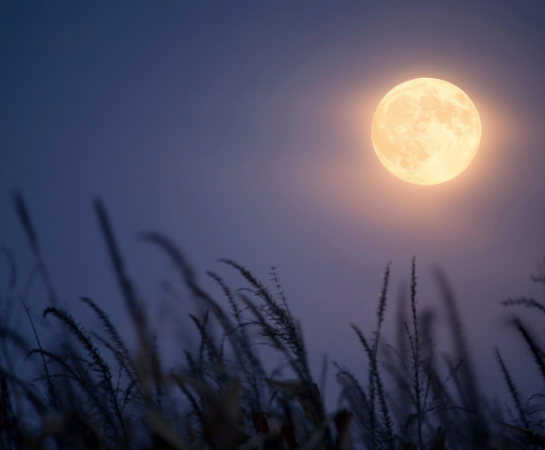
What Is a Harvest Moon and Why It Rises at Almost the Same Time Several Nights Running
On most nights of the year, the Moon rises roughly 50 minutes later than it did the night before. Around the Harvest Moon, that gap collapses to as little as 10 minutes in parts of the UK and Canada, and rarely more than 30 minutes
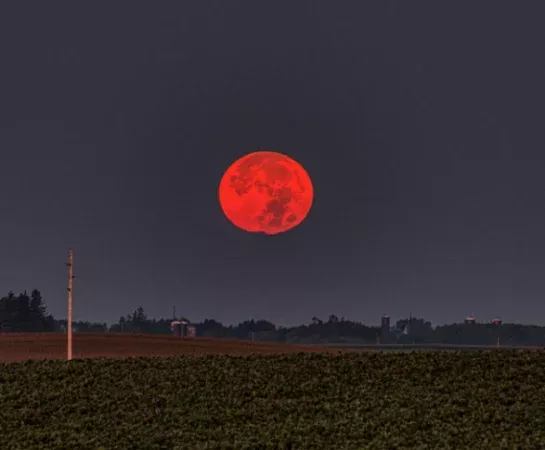
What Is a Blood Moon and Why Does the Moon Turn Red
On the night of August 27, 2026, the Moon came within a hair of disappearing entirely. Earth's shadow covered 96.2% of its surface, a partial eclipse so deep that skywatchers across the Americas, Europe, and Africa watched it turn a rusty, almost total red without
Time Tools
Quick access to timers, stopwatch, world clock and time zone tools.
Time Guides
Read useful guides about time zones, calendars, finance and astronomy.


