Major Airports in Hungary
- Budapest Liszt Ferenc International Airport (BUD) - 01:05:29
- Debrecen International Airport (DEB) - 01:05:29
- Pécs-Pogány International Airport (PEV) - 01:05:29
Daylight saving time changes in Hungary
Hungary has 1 listed IANA time zones. 1 of them observe daylight saving time changes in 2026.
Next change: October 25, 2026
Clock moves back from 03:00 to 02:00 local time.
Best Time to Call Hungary
Business hours in Hungary (9 AM–5 PM local time) fall at these local times elsewhere:
- Beijing: 3:00 PM – 11:00 PM ( Partial overlap)
- Paris: 9:00 AM – 5:00 PM ( Convenient)
- Toronto: 3:00 AM – 11:00 AM ( Outside normal hours)
- Seoul: 4:00 PM – 12:00 AM (next day) ( Partial overlap)
- Mexico City: 1:00 AM – 9:00 AM ( Outside normal hours)
- Cairo: 10:00 AM – 6:00 PM ( Convenient)
- Bangkok: 2:00 PM – 10:00 PM ( Partial overlap)
Times shown reflect current UTC offsets and may shift by up to an hour around daylight saving transitions.
Time Difference from Hungary
Compare time in Hungary with other countries.
Most Popular Cities in Hungary
Holidays in Hungary
Official national public holidays. Regional and religious observances may vary by area.
About Time in Hungary
The Calendar Reform Became a Dispute About Authority
The Gregorian calendar did not arrive as a simple nationwide switch of dates. Pope Gregory XIII introduced the reform in 1582 to correct the accumulated drift of the Julian calendar, but in the Kingdom of Hungary the technical question of calendar accuracy quickly became entangled with religion, political authority and local autonomy. King Rudolf II ordered the new calendar to be used in his lands, and Catholic institutions began adopting it during the 1580s. Protestant communities were much more resistant, in part because they regarded a reform issued from Rome as a matter of confessional authority rather than neutral chronology.
The transition was consequently uneven. Historical records from Szepes County show communities negotiating or resisting the reform rather than changing dates simultaneously. Some administrative offices adopted the new reckoning before a general legal settlement had been reached. The Hungarian Diet eventually accepted legislation enforcing the Gregorian system in 1588, several years after the original papal reform. Even that did not end the controversy. A further law in 1599 imposed penalties connected with opposition to the new calendar, and historical sources record continued adherence to the older system in some Protestant communities afterward.
This makes late sixteenth-century dates unusually sensitive to context. A document's calendar cannot always be inferred simply from the territory in which it was written. Confession, institution and local practice could determine whether an apparently identical date was being expressed under Julian or Gregorian reckoning. In the 1580s the two calendars differed by ten days, enough to shift legal deadlines, feast days and the chronology of correspondence unless the dating system is identified correctly.
The First Hungarian-Language Calendar Was a Practical Guide to the Year
One of the earliest printed works to make calendrical and astronomical information available in Hungarian was István Székely's calendar, produced in Kraków around 1538. Bibliographic research treats it as the earliest known printed Hungarian-language calendar, although surviving copies and later reprints make the precise publication history more complicated than a single securely dated first edition.
Its purpose went well beyond listing saints' days. Contemporary descriptions of the work show that it explained the structure of the year, movable feast calculations, the new Moon, the beginning of the seasons and the movement of the Sun through the zodiac. It also gave information about when the Sun rose. Székely presented the book as something Hungarian-reading children could use to understand the recurring structure of the year rather than relying entirely on Latin calendrical material.
The format reflects what a calendar meant in the sixteenth century. It was simultaneously a chronological tool, a compact introduction to practical astronomy and a guide to religious observance. Later Hungarian calendars expanded this model with weather expectations, agricultural advice, historical notes and other information. Long before clocks became nationally synchronized, printed calendars were already standardizing another dimension of time by giving readers a shared framework for locating days, seasons and recurring events within the year.
Budapest Joined Central European Time Before Vienna
The nineteenth-century railway network created a different synchronization problem. Local astronomical time was poorly suited to a system in which trains, postal services and telegraph messages had to be coordinated between distant cities. Budapest's local mean time was approximately UTC+1:16:20, reflecting its longitude rather than a whole-hour international zone. A clock based on the local meridian therefore ran more than sixteen minutes ahead of the Central European standard later adopted for transport and public use.
Central European Time entered the Austro-Hungarian railway system in 1891. Contemporary scientific reporting states that the railways were using the common standard from 1 October of that year and that more than fifty towns in the monarchy had aligned their clocks soon afterward. Budapest and Prague were among the early adopters, while Vienna initially retained local time for ordinary city use and did not fully align until later. The contrast shows that standardization did not necessarily spread outward from imperial capitals. Railway operations and communications could force practical synchronization before municipal convention caught up.
The modern result is familiar: standard time is CET, UTC+1, with CEST at UTC+2 during the seasonal summer period. Geographically, however, Budapest lies east of the 15th meridian on which CET is centered. Its old local mean time preserves that fact numerically. The roughly sixteen-minute difference between the historic Budapest meridian and CET is the astronomical remainder hidden by the standardized clock.
Exact Time Became a Service Distributed Through the City
Once clocks had been standardized, the next problem was keeping them synchronized. An observatory built into the university complex on Múzeum körút became part of Budapest's precision-time infrastructure. University and Budapest archival sources record that accurate time signals from the observatory were supplied to the railway, the postal system and the Telefonhírmondó. A public clock outside the building was electrically linked to the astronomical department's reference clock, allowing passers-by to compare and adjust their own watches against a trusted urban standard.
This connection between astronomy and communications became especially distinctive through the Telefonhírmondó, the wired "telephone newspaper" that began regular service in Budapest in 1893. It transmitted spoken news, financial information, theatre and music over a dedicated network years before conventional radio broadcasting. Archival accounts show that exact time became part of the service, and surviving program schedules included announcements of exact astronomical time.
For subscribers, synchronization therefore arrived through the same network that carried breaking news and market prices. This was a transitional technology between observatory time signals and mass electronic broadcasting. The reference was still rooted in astronomical measurement and precision clocks, but electrical distribution allowed the same time to reach transport operators, institutions and private listeners almost instantly. When Hungarian radio broadcasting formally began in 1925, it inherited part of this communications infrastructure from the Telefonhírmondó system.
The Repeated Hour Once Required an A and a B in Official Records
Daylight saving first altered civil time during the First World War. A government decree ordered clocks forward at 11 p.m. on 30 April 1916 so that the next civil hour became midnight on 1 May. The stated rationale was wartime economy, particularly reducing the amount of fuel and energy needed for artificial lighting. Seasonal time was used again in subsequent war years, but its history was far less continuous than the modern twice-yearly routine suggests.
The most revealing consequence appears in official record keeping. When clocks were turned backward, one interval of local time occurred twice. Hungarian authorities recognized that this could make birth and death registrations ambiguous. Archival material from 1918 records instructions requiring the first occurrence of the repeated 2 o'clock hour to be marked "2 A" and the second occurrence "2 B." The notation distinguished two real moments that otherwise had exactly the same local date and clock reading.
Political events created another complication in 1919. The government initially ordered a return from summer time in September, but the Romanian military command occupying parts of the country did not permit the change to be implemented as planned. A subsequent decree therefore kept summer time in effect, and the final return to Central European Time did not occur until 24 November. This is an unusually clear example of a clock rule being altered not by astronomy or engineering but by immediate political control on the ground.
Seasonal time returned in several later periods, including the 1940s and the mid-1950s, before another long interruption. The current continuous era began in 1980. Since then the clock has moved between CET and CEST each year, with the modern transition dates coordinated under the wider European system. For historical timestamps, however, today's rules cannot safely be projected backward. The interruptions, wartime measures and exceptional 1919 sequence are all part of the Europe/Budapest time-zone record.
Frequently Asked Questions
How many time zones does Hungary have?
One. The whole of Hungary follows Europe/Budapest, so every city shows the same local time as the capital, Budapest.
Is Hungary ahead of or behind GMT?
Hungary is currently 2 hours ahead of GMT (UTC+2).
Does Hungary use summer time?
Yes. Budapest uses UTC+1 (CET) in standard time and UTC+2 (CEST) during daylight saving time, and is currently on summer time.
How many public holidays does Hungary have in 2026?
Hungary has 16 national public holidays in 2026, when banks and government offices are usually closed. Some regions may also have their own local holidays.
How do I dial a phone number in Hungary from abroad?
From a mobile phone, type +36 and then the local number without the leading 0 used for domestic calls, if it has one. From a landline, replace the plus sign with your exit code: 011 from the US and Canada, or 00 from most of Europe, for example 00 36 followed by the number.
What language is spoken in Hungary?
The main language of Hungary is Hungarian.
Beyond the Clock

Why the Moon’s Phases Don’t Actually Change Its Size
A thin crescent looks small enough to disappear. A full moon looks like it's swelling on the horizon. Neither impression is true. The Moon's diameter is 3,474 kilometers on every night of the month, whether it's a sliver or a full disc, and nothing in

Why Saturn’s Rings Are Disappearing From View in 2025 and 2026
Saturn's rings turned edge-on to Earth on March 23, 2025, at 12:04 p.m. EDT, and for weeks the planet looked like a plain yellow ball through backyard telescopes. This is not decay or destruction. It is a geometric alignment called a ring plane crossing, and

What Is a Harvest Moon and Why It Rises at Almost the Same Time Several Nights Running
On most nights of the year, the Moon rises roughly 50 minutes later than it did the night before. Around the Harvest Moon, that gap collapses to as little as 10 minutes in parts of the UK and Canada, and rarely more than 30 minutes
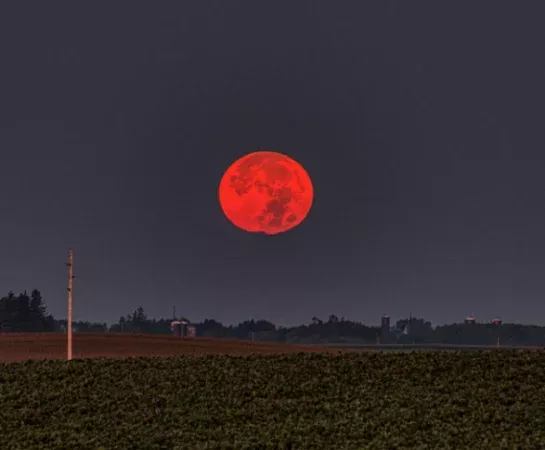
What Is a Blood Moon and Why Does the Moon Turn Red
On the night of August 27, 2026, the Moon came within a hair of disappearing entirely. Earth's shadow covered 96.2% of its surface, a partial eclipse so deep that skywatchers across the Americas, Europe, and Africa watched it turn a rusty, almost total red without

The Hour That Happens Twice: What Actually Occurs at 1:30 AM When Clocks Fall Back
At 1:59:59 a.m. on Sunday, November 1, 2026, clocks in New York will not tick over to 2:00. They will jump back to 1:00:00 a.m., and the next 60 minutes will replay. Every time from 1:00 to 1:59 happens twice that night, once on Eastern

Why the International Space Station Runs on UTC Instead of Local Time
Astronauts aboard the International Space Station see the sun rise and set 16 times in a 24-hour period, once every 90 to 93 minutes, as the station circles Earth at roughly 28,000 kilometers per hour. No conventional time zone survives contact with that kind of

Standard Time vs Daylight Time: What’s the Actual Difference
Most people assume "Standard Time" is the normal, default setting and "Daylight Time" is some separate seasonal overlay that temporarily replaces it. That mental model is backwards in a way that federal law makes explicit, and once you see the actual legal language, the whole

Why the Hour Was Originally a Different Length in Summer and Winter
For most of recorded history, an hour was not a fixed amount of time. It was a fraction, one twelfth of however long daylight happened to last that day. In June that fraction stretched past 80 modern minutes. In December it shrank to barely 40.
Time Tools
Quick access to timers, stopwatch, world clock and time zone tools.
Time Guides
Read useful guides about time zones, calendars, finance and astronomy.


