Major Airports in Czechia
- České Budějovice South Bohemian Airport (JCL) - 01:42:35
- Karlovy Vary Airport (KLV) - 01:42:35
- Leoš Janáček Airport Ostrava (OSR) - 01:42:35
- Pardubice Airport (PED) - 01:42:35
- Václav Havel Airport Prague (PRG) - 01:42:35
Daylight saving time changes in Czechia
Czechia has 1 listed IANA time zones. 1 of them observe daylight saving time changes in 2026.
Next change: October 25, 2026
Clock moves back from 03:00 to 02:00 local time.
Best Time to Call Czechia
Business hours in Czechia (9 AM–5 PM local time) fall at these local times elsewhere:
- Beijing: 3:00 PM – 11:00 PM ( Partial overlap)
- Paris: 9:00 AM – 5:00 PM ( Convenient)
- Toronto: 3:00 AM – 11:00 AM ( Outside normal hours)
- Seoul: 4:00 PM – 12:00 AM (next day) ( Partial overlap)
- Mexico City: 1:00 AM – 9:00 AM ( Outside normal hours)
- Cairo: 10:00 AM – 6:00 PM ( Convenient)
- Bangkok: 2:00 PM – 10:00 PM ( Partial overlap)
Times shown reflect current UTC offsets and may shift by up to an hour around daylight saving transitions.
Time Difference from Czechia
Compare time in Czechia with other countries.
Most Popular Cities in Czechia
Holidays in Czechia
Official national public holidays. Regional and religious observances may vary by area.
About Time in Czechia
Ten Dates Disappeared From Bohemia in January 1584
The Gregorian calendar did not arrive in the Czech lands as one clean nationwide change. Emperor Rudolf II issued a mandate in December 1583 ordering the new calendar to be introduced in the Kingdom of Bohemia at the beginning of the following year. The instruction was explicit: after 6 January 1584, the next written date was to be 17 January. The dates from 7 through 16 January simply did not exist in the official sequence.
The mandate also shows why a calendar reform was an administrative problem rather than a purely astronomical correction. Rudolf ordered printers of calendars and prognostications to use the revised dating and postponed sessions of important courts because the missing dates could create confusion for people required to appear before them. Contracts, hearings, feast days and deadlines all depended on a calendar whose numbering was about to jump forward by ten days.
The transition was not simultaneous across the lands that form modern Czechia. Moravia resisted the first implementation and continued with the older calendar for much of 1584. There, 3 October was followed by 14 October. For several months, Bohemia and Moravia could therefore assign different calendar dates to the same phase of the year. Even Easter fell on different dates because the two regions were temporarily using different calendar systems.
The surviving parliamentary edition of Rudolf's mandate makes the episode unusually well documented. Czech calendar history contains a literal gap: in Bohemia, there was no official 7 January 1584, 8 January 1584 or any of the next eight dates.
The Prague Orloj Can Show Hours That Change Their Length
The astronomical clock on Prague's Old Town Hall was built in 1410 by clockmaker Mikuláš of Kadaň. The familiar story that Master Hanuš created the clock and was then blinded by the city councillors belongs to later legend. Hanuš worked on the mechanism near the end of the fifteenth century, but the original astronomical clock predates his involvement.
The machine is remarkable not because it tells one time especially accurately, but because its dial preserves several historically different ideas of what an hour and a day can mean. Old Bohemian time counted twenty-four equal hours from sunset. Because sunset moves through the year, the outer ring carrying the Gothic numerals has to change its position so that the twenty-fourth hour continues to coincide with the end of the day.
The clock also displays unequal, traditionally called Babylonian, hours. Daylight from sunrise to sunset is divided into twelve parts. Those parts are therefore not sixty-minute hours: Prague City Tourism notes that their length ranges from roughly forty minutes in winter to about eighty minutes in summer. Twelve daylight hours are always shown, but the duration represented by each one changes with the season.
A further indication gives sidereal time, the astronomical scale based on Earth's rotation relative to the stars rather than the civil day. The modern dial also shows Central European civil time. According to the official history of the clock, this civil-time display was introduced in its present form during the reconstruction completed after the Second World War in 1948. A single medieval machine thus places several incompatible definitions of time on one face.
Rudolfine Prague Produced a Surviving Clock With a Seconds Display
Around 1600 Prague became an exceptional meeting place for astronomy, mathematics, instrument making and precision clockwork. At the court of Rudolf II, Tycho Brahe and Johannes Kepler worked in the same scientific environment as instrument maker Erasmus Habermel and clockmaker Jost Bürgi. The surviving instruments from this circle show how closely astronomical measurement depended on mechanical precision.
The Kunsthistorisches Museum in Vienna attributes the so-called Vienna Crystal Clock to Bürgi and identifies it with Prague culture around 1605. The museum describes it as the oldest surviving clock with a seconds display. At a time when ordinary public clocks were concerned principally with hours and portions of hours, seconds were becoming useful to observers attempting much finer astronomical measurements.
Bürgi was not simply producing decorative court clocks. His work on escapements and highly precise mechanisms grew out of the need to measure astronomical observations more accurately. The Prague court encouraged direct cooperation between astronomers, mathematicians and mechanics, and the resulting instruments combined calculation, celestial models and time measurement in the same machines.
The National Technical Museum preserves another part of this scientific network. Its collections include major sextants by Bürgi and Habermel. The museum dates Bürgi's large sextant to Prague around 1600 and records its use by Kepler for observations in 1602 to 1604 and again in 1628. Precision timekeeping and precise angular measurement were developing side by side.
Prague Sent Noon From a Beam of Light to a Flag, a Cannon and Radio
The Clementinum developed one of the clearest historical chains from astronomical time determination to public time distribution. Inside its Meridian Hall, local noon could be identified when a narrow beam of sunlight entering through a slit reached a line marked by a stretched string. The observatory could determine the event scientifically, but a second problem remained: how could that information be delivered quickly to the city?
Beginning in 1842, the answer was a flag. At the determined moment of noon, a signal was given from the gallery of the Astronomical Tower. From 1891, the visual signal was accompanied by a cannon shot from the Hradčany fortifications. Anyone who could see the tower or hear the gun could use the event to check a clock or watch.
This system survived into the twentieth century. The cannon signal continued until the 1920s, while radio gradually made the tower signal obsolete. The Clementinum began supplying an exact time signal for radio broadcasting in the 1920s. On 31 January 1928 the public noon signal from the tower was discontinued after more than eighty years.
The same observatory also created one of Prague's most important long time series in a different scientific field. Antonín Strnad began the uninterrupted series of daily meteorological observations at the Clementinum on 1 January 1775. Earlier measurements existed, but the continuous daily sequence starts with that date. The institution that once determined noon for the city also became a place where exact repetition at known times produced a climatic record extending across centuries.
In the Winter of 1946, 3 a.m. Became 2 a.m. Without Returning to Standard Time
Czechoslovakia carried out an exceptionally unusual clock experiment after the Second World War. A law adopted in November 1946 authorized the government to introduce what it explicitly called winter time, meaning an offset one hour behind Central European standard time rather than the ordinary return from summer time to standard time.
The implementing regulation specified the transition precisely. On 1 December 1946, at 03:00 Central European Time, clocks were moved backward to 02:00. This was not the normal autumn reversal of daylight saving time. Standard time itself had been displaced by another hour.
The experiment ended on 23 February 1947. At 02:00 winter time, clocks were advanced to 03:00 and Central European Time was restored. The special winter offset was not repeated in subsequent Czech history.
The distinction becomes clearer when compared with the surrounding clock changes. Separate legislation already existed for summer time. The 1946 winter-time law created a second mechanism that allowed clocks to be moved in the opposite direction from standard time. Czech legal history therefore contains both positive summer displacement and, for one winter, a negative displacement below the normal standard.
OMA 50 Put the National Time Scale on a Longwave Carrier
By the middle of the twentieth century, distributing exact time no longer required a person watching a light beam in the Clementinum. Czechoslovak engineers began experimental radio transmission of standard frequency and time signals in 1955. In April 1958 this development produced OMA 50, transmitting on 50 kHz from Liblice near Český Brod.
The carrier itself was part of the service. Receivers could use the stable transmitted frequency as a reference while the signal also carried second and minute markers. By the 1960s Czechoslovak technical publications listed OMA 50 alongside major international standard-frequency stations and described its time marks and reference-frequency function in detail.
A major change came with atomic timekeeping. From January 1969, the Prague coordinated time scale UTC(TP) was transmitted through OMA 50 in microsecond agreement with international Coordinated Universal Time, using a reference derived from cesium atomic clocks. In 1974 the service added coded calendar and clock information using phase modulation, allowing suitable equipment to recover more than a simple sequence of second pulses.
Engineers also built clocks capable of using the broadcast automatically. Technical literature from the period describes experimental receivers that could synchronize within better than ten milliseconds across Czechoslovakia. The idea anticipated the radio-controlled consumer clocks that later became common in Europe, but OMA 50 never developed a comparable mass market. Czech metrology publications identify the lack of inexpensive compact receivers, maintenance interruptions and operating costs among the factors that limited wider use.
The transmitter was shut down in 1995. The national time scale itself did not disappear. Today UTC(TP) is maintained by the Laboratory of the National Time and Frequency Standard at the Institute of Photonics and Electronics of the Czech Academy of Sciences. Its cesium standards contribute measurements used in international UTC calculations. The route from a seventeenth-century astronomical clock to radio-distributed cesium time is therefore not a single story of increasing precision. It is also a history of repeatedly changing how a common time reference reaches the people and machines that need it.
Frequently Asked Questions
How many time zones does Czechia have?
One. The whole of Czechia follows Europe/Prague, so every city shows the same local time as the capital, Prague.
Is Czechia ahead of or behind GMT?
Czechia is currently 2 hours ahead of GMT (UTC+2).
Does Czechia use summer time?
Yes. Prague uses UTC+1 (CET) in standard time and UTC+2 (CEST) during daylight saving time, and is currently on summer time.
How many public holidays does Czechia have in 2026?
Czechia has 13 national public holidays in 2026, when banks and government offices are usually closed. Some regions may also have their own local holidays.
How do I dial a phone number in Czechia from abroad?
From a mobile phone, type +420 and then the local number without the leading 0 used for domestic calls, if it has one. From a landline, replace the plus sign with your exit code: 011 from the US and Canada, or 00 from most of Europe, for example 00 420 followed by the number.
What language is spoken in Czechia?
The main languages of Czechia are Czech and Slovak.
Beyond the Clock

When Does the Fed Announce Interest Rates: Exact Time and Why It Moves Markets
The Federal Reserve announces its interest rate decision at 2:00 p.m. Eastern Time on the final day of each scheduled Federal Open Market Committee (FOMC) meeting, and the Chair's press conference follows at 2:30 p.m. Those times have been fixed since March 2013. The rest

What Is the Closing Auction and Why the Last 10 Minutes Move the Market
The 4:00 p.m. bell on the New York Stock Exchange does not simply end the trading day. It triggers the closing auction, a one-time match of buyers and sellers at a single price that becomes each stock's official close, and which NYSE describes as the

Jobs Report Day: Why the First Friday of the Month Moves Every Market at Once
Once a month, at 8:30 a.m. Eastern, currency pairs jump, bond yields snap, and equity futures swing before most traders have settled at their desks. Everyone calls it "the first Friday of the month." Almost everyone is wrong about why it lands there. The date

Earnings Season Calendar: Why Companies Report Before or After the Bell
JPMorgan Chase kicked off the 2026 earnings season on Tuesday, January 13, reporting its fourth-quarter results before the market opened, the same slot the bank has used every January for years. Two days later, Netflix, Microsoft, and Nvidia would report in the opposite window, after

Why the Moon’s Phases Don’t Actually Change Its Size
A thin crescent looks small enough to disappear. A full moon looks like it's swelling on the horizon. Neither impression is true. The Moon's diameter is 3,474 kilometers on every night of the month, whether it's a sliver or a full disc, and nothing in

Why Saturn’s Rings Are Disappearing From View in 2025 and 2026
Saturn's rings turned edge-on to Earth on March 23, 2025, at 12:04 p.m. EDT, and for weeks the planet looked like a plain yellow ball through backyard telescopes. This is not decay or destruction. It is a geometric alignment called a ring plane crossing, and
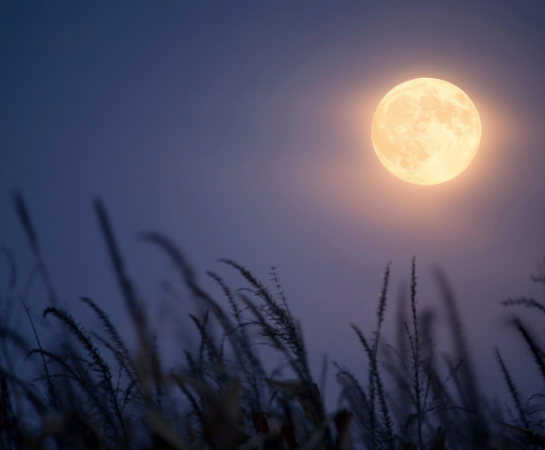
What Is a Harvest Moon and Why It Rises at Almost the Same Time Several Nights Running
On most nights of the year, the Moon rises roughly 50 minutes later than it did the night before. Around the Harvest Moon, that gap collapses to as little as 10 minutes in parts of the UK and Canada, and rarely more than 30 minutes
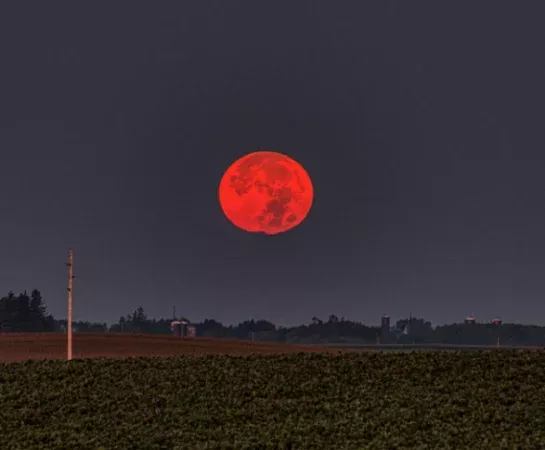
What Is a Blood Moon and Why Does the Moon Turn Red
On the night of August 27, 2026, the Moon came within a hair of disappearing entirely. Earth's shadow covered 96.2% of its surface, a partial eclipse so deep that skywatchers across the Americas, Europe, and Africa watched it turn a rusty, almost total red without
Time Tools
Quick access to timers, stopwatch, world clock and time zone tools.
Time Guides
Read useful guides about time zones, calendars, finance and astronomy.


