Major Airports in Jordan
- King Hussein International Airport (AQJ) - 01:35:18
- Marka International (Amman Civil) Airport (ADJ) - 01:35:18
- Queen Alia International Airport (AMM) - 01:35:18
Daylight saving time in Jordan
Jordan has 1 listed IANA time zones. None of them observe daylight saving time in 2026. The UTC offset remains stable throughout the year.
Best Time to Call Jordan
Business hours in Jordan (9 AM–5 PM local time) fall at these local times elsewhere:
- Beijing: 2:00 PM – 10:00 PM ( Partial overlap)
- Paris: 8:00 AM – 4:00 PM ( Convenient)
- Toronto: 2:00 AM – 10:00 AM ( Outside normal hours)
- Seoul: 3:00 PM – 11:00 PM ( Partial overlap)
- Mexico City: 12:00 AM – 8:00 AM ( Outside normal hours)
- Cairo: 9:00 AM – 5:00 PM ( Convenient)
- Bangkok: 1:00 PM – 9:00 PM ( Partial overlap)
Times shown reflect current UTC offsets and may shift by up to an hour around daylight saving transitions.
Time Difference from Jordan
Compare time in Jordan with other countries.
Most Popular Cities in Jordan
Holidays in Jordan
Official national public holidays. Regional and religious observances may vary by area.
About Time in Jordan
A Kingdom That Gave Up on Changing the Clocks
Jordan has tried, and abandoned, daylight saving time three separate times since the practice was first introduced in 1973. The country ran on seasonal clock changes from 1973 to 1978, again from 1985 to 2012, and then once more from 2014 onward, each time springing forward for the warmer months and falling back for winter, much as most of Europe still does. A brief attempt to make summer time permanent during the winter of 2012 and 2013 was quickly reversed, with the government restoring the seasonal switch by December 2013.
The final break came on 5 October 2022, when Jordan's cabinet, acting alongside a near-simultaneous announcement from neighbouring Syria, decided to lock the clocks permanently onto what had been summer time, UTC+3, rather than falling back into winter standard time that October as scheduled. The government framed the change around maximising usable daylight and easing coordination with international partners, and adjusted school start times to accommodate darker winter mornings, having students begin around 8:15 to 8:30am rather than the earlier 7:30 start some had previously kept. The decision drew genuinely mixed reactions: some experts welcomed the reduced strain on the national electricity grid, while others, including one prominent meteorologist who pointed out that standard winter time was technically the country's "original" time zone based on its longitude, questioned whether the shift served ordinary Jordanians as well as it served daylight-hour statistics.
The Dam the Nabataeans Got Right the First Time
Petra sits inside a narrow sandstone gorge that funnels flash floods with lethal force whenever seasonal rains hit the surrounding highlands, a hazard the city's Nabataean builders understood well enough to engineer around more than two thousand years ago. Between roughly the fourth century BCE and the fourth century CE, they built an elaborate network of dams, terraces, covered channels, and rock-cut cisterns across the site, diverting floodwater away from the city centre through a purpose-built tunnel while simultaneously capturing and storing enough of it to support a desert population historians estimate at twenty to forty thousand people.
The system's effectiveness was proven, unintentionally, in the twentieth century. In the early 1960s, a flash flood swept through the Siq, the narrow entrance gorge to Petra, killing a group of French tourists who had nowhere to escape the surging water. In response, Jordan's government did not design a new solution from scratch; in 1964 it simply reopened and restored the ancient Nabataean diversion tunnel through the Wadi Al-Mudhlim, routing floodwater away from the Siq using essentially the same two-thousand-year-old engineering the original builders had relied on. The modern replica remains in active use today, a rare case of a nation's flood-control infrastructure being, quite literally, an inherited design rather than an updated one.
A City Built to Catch the Winter Sun
Beyond their mastery of water, the Nabataeans who carved Petra out of rose-coloured sandstone also built with the sky in mind. A statistical study of the orientation of Petra's major monuments, published by archaeoastronomer Juan Antonio Belmonte and colleagues, found that many of the city's most important structures were positioned to catch specific solar events at specific times of year, effects that would only have been visible for a handful of days each year and only from precisely the right vantage point.
The clearest example is Ad Deir, known as the Monastery, where the setting sun during the winter solstice sends a beam of light through the entrance to illuminate a raised ceremonial platform inside, a phenomenon researchers describe as spectacular but fleeting, visible only in the days immediately surrounding the solstice itself. At that same moment, viewed from the platform, the silhouette of the mountains opposite the monument resolves into the shape of a lion's head, the sacred animal of the goddess Al-Uzza. Elsewhere in the city, the Urn Tomb shows similar solstice and equinox alignments in its own orientation, a pattern researchers suggest may have influenced its selection, centuries after the Nabataean period ended, as the site where Bishop Jason formally consecrated it as Petra's Christian cathedral on 24 June 446 CE, one built structure absorbed into an entirely different religious calendar without ever losing its original relationship with the sun.
Frequently Asked Questions
How many time zones does Jordan have?
One. The whole of Jordan follows Asia/Amman, so every city shows the same local time as the capital, Amman.
Is Jordan ahead of or behind GMT?
Jordan is currently 3 hours ahead of GMT (UTC+3).
Does Jordan use summer time?
No. Jordan does not observe daylight saving time, so its clocks stay at UTC+3 all year. Its time difference with countries that do change their clocks still shifts by an hour in spring and autumn.
How many public holidays does Jordan have in 2026?
Jordan has 14 national public holidays in 2026, when banks and government offices are usually closed. Some regions may also have their own local holidays.
How do I dial a phone number in Jordan from abroad?
From a mobile phone, type +962 and then the local number without the leading 0 used for domestic calls, if it has one. From a landline, replace the plus sign with your exit code: 011 from the US and Canada, or 00 from most of Europe, for example 00 962 followed by the number.
What language is spoken in Jordan?
The main languages of Jordan are Arabic and English.
Beyond the Clock

Why Scheduled Jobs Break at Daylight Saving Time
On Sunday, November 1, 2026, the local time 1:30 AM happens twice in New York. The first 1:30 AM is 05:30 UTC on Eastern Daylight Time. The second is an hour later, 06:30 UTC on Eastern Standard Time. Four and a half months later, on

The Hour That Happens Twice: What Actually Occurs at 1:30 AM When Clocks Fall Back
At 1:59:59 a.m. on Sunday, November 1, 2026, clocks in New York will not tick over to 2:00. They will jump back to 1:00:00 a.m., and the next 60 minutes will replay. Every time from 1:00 to 1:59 happens twice that night, once on Eastern

Why the International Space Station Runs on UTC Instead of Local Time
Astronauts aboard the International Space Station see the sun rise and set 16 times in a 24-hour period, once every 90 to 93 minutes, as the station circles Earth at roughly 28,000 kilometers per hour. No conventional time zone survives contact with that kind of

Standard Time vs Daylight Time: What’s the Actual Difference
Most people assume "Standard Time" is the normal, default setting and "Daylight Time" is some separate seasonal overlay that temporarily replaces it. That mental model is backwards in a way that federal law makes explicit, and once you see the actual legal language, the whole

Why the Moon’s Phases Don’t Actually Change Its Size
A thin crescent looks small enough to disappear. A full moon looks like it's swelling on the horizon. Neither impression is true. The Moon's diameter is 3,474 kilometers on every night of the month, whether it's a sliver or a full disc, and nothing in
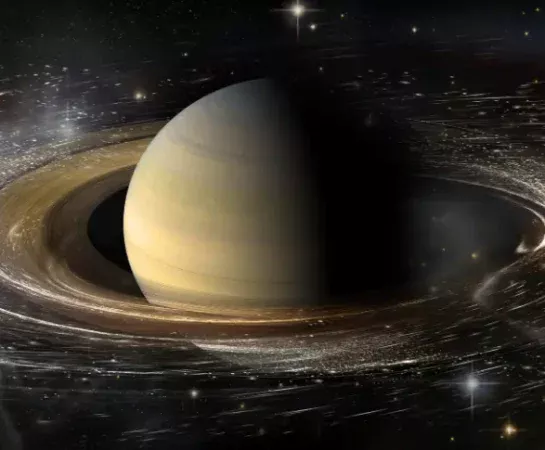
Why Saturn’s Rings Are Disappearing From View in 2025 and 2026
Saturn's rings turned edge-on to Earth on March 23, 2025, at 12:04 p.m. EDT, and for weeks the planet looked like a plain yellow ball through backyard telescopes. This is not decay or destruction. It is a geometric alignment called a ring plane crossing, and
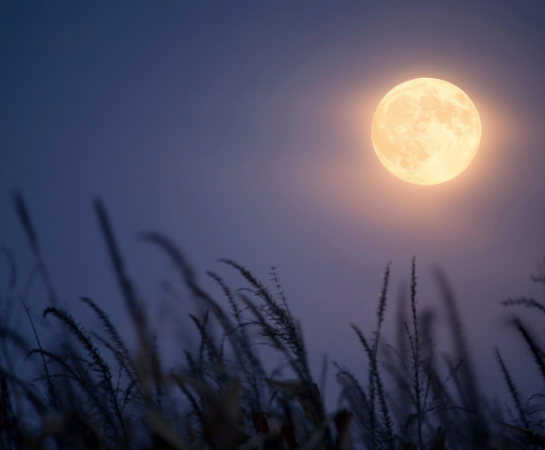
What Is a Harvest Moon and Why It Rises at Almost the Same Time Several Nights Running
On most nights of the year, the Moon rises roughly 50 minutes later than it did the night before. Around the Harvest Moon, that gap collapses to as little as 10 minutes in parts of the UK and Canada, and rarely more than 30 minutes
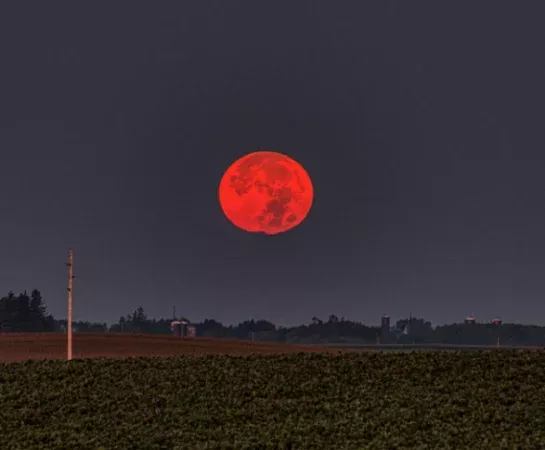
What Is a Blood Moon and Why Does the Moon Turn Red
On the night of August 27, 2026, the Moon came within a hair of disappearing entirely. Earth's shadow covered 96.2% of its surface, a partial eclipse so deep that skywatchers across the Americas, Europe, and Africa watched it turn a rusty, almost total red without
Time Tools
Quick access to timers, stopwatch, world clock and time zone tools.
Time Guides
Read useful guides about time zones, calendars, finance and astronomy.


