Airport in Idaho
Boise Air Terminal/Gowen Field (BOI / KBOI) is a major international airport serving Idaho directly.
Current local time at the airport is 17:23:41.
Daylight saving time changes in Idaho, United States
Idaho has 2 listed IANA time zones. 2 observe daylight saving time changes in 2026.
Next change: November 1, 2026
Clock moves back from 02:00 to 01:00 local time.
Best Time to Call Idaho
Business hours in Idaho (9 AM-5 PM local time) fall at these local times elsewhere:
- Sao Paulo: 12:00 PM - 8:00 PM ( Partial overlap)
- Frankfurt: 5:00 PM - 1:00 AM (next day) ( Partial overlap)
- Johannesburg: 5:00 PM - 1:00 AM (next day) ( Partial overlap)
- Singapore: 11:00 PM - 7:00 AM (next day) ( Outside normal hours)
- Hong Kong: 11:00 PM - 7:00 AM (next day) ( Outside normal hours)
- Istanbul: 6:00 PM - 2:00 AM (next day) ( Partial overlap)
- Auckland: 4:00 AM (next day) - 12:00 PM (next day) ( Outside normal hours)
Times shown reflect current UTC offsets and may shift by up to an hour around daylight saving transitions.
Time Difference from Idaho
Compare time in Idaho with major cities worldwide.
Current Time in Cities of Idaho, United States
About Time in Idaho
The Bridge Between Two Hours
Idaho is one of only thirteen states split between two time zones, and nowhere is that division more visible than at a steel tied arch bridge crossing the Salmon River just north of Riggins. Known locally as the Time Zone Bridge, and officially as the Goff Bridge, the crossing marks the point where Mountain time on the southern bank gives way to Pacific time on the northern bank, a full hour's difference over a span of a few hundred feet. The current structure replaced an original 1935 bridge that carried roughly two thousand vehicles a day; because no alternate route existed across the river during construction, crews had to physically relocate the old 1.24 million pound steel bridge sixty five feet to the west to serve as a temporary detour, completing a move planned to take three days in just thirty six hours so that Highway 95 would not stay closed for long.
The line itself follows the Salmon River, nicknamed the River of No Return, north from Riggins, placing ten counties of the Idaho Panhandle, including Kootenai, Latah, and Nez Perce, on Pacific time alongside Spokane and the rest of the inland Pacific Northwest, while the remaining three quarters of the state, including Boise, Idaho Falls, and Pocatello, runs on Mountain time. The split exists because, for much of the state's history, the mountainous terrain of central Idaho made travel between north and south so difficult that the Panhandle's economy and culture oriented toward Spokane, Washington rather than toward its own state capital, a pattern the time zone boundary still reflects today.
Four Light Bulbs and an Hour of Atomic Power
In the sagebrush desert southeast of Arco, Idaho, at 1:50 in the afternoon on December 20, 1951, a team of physicists at the Experimental Breeder Reactor-I watched four 200 watt light bulbs flicker on, powered for the first time in history by electricity generated from nuclear fission. The reactor, built to test whether a nuclear plant could produce more fissile fuel than it consumed, was not originally designed to generate usable power at all, but the demonstration succeeded so completely that by the very next day, December 21, it was producing enough electricity to run the entire EBR-I building. One witness reportedly summed up the moment with characteristic understatement: this is it.
Less than four years later, the same stretch of Idaho desert made history again. On July 17, 1955, the nearby BORAX-III reactor was connected directly to the electrical grid serving the small town of Arco, and for about an hour, the entire community ran on electricity generated solely by nuclear power, the first time any city on Earth had been lit entirely by atomic energy. Arco still marks the anniversary each year, and a sign at its city hall reads Arco, Idaho, First City in the World to Be Lit by Atomic Power, a claim that remains uncontested to this day.
A Time Change That Waits on Washington
Because Idaho's clocks are split between two time zones, any move toward permanent daylight saving time in the state has to be split as well. In 2020, the Idaho legislature passed a law allowing the ten northern counties on Pacific time to shift permanently to daylight saving time, but only on the condition that the state of Washington did the same first, since those counties' daily economic life is so tightly bound to their Washington neighbors. The bill passed the state Senate unanimously and cleared the House by a vote of 68 to 1, with lawmakers citing concrete, everyday consequences of an uncoordinated clock change.
One legislator pointed to a single engineering company with manufacturing plants in both Lewiston, Idaho and Pullman, Washington, noting that roughly a thousand of its three thousand two hundred employees already commute across the state line each day, and that keeping those two facilities on the same clock mattered more to daily operations than keeping the whole state of Idaho synchronized with itself. Washington's own legislature had already approved permanent daylight saving time, as had Oregon's, but the change for all three states remains on hold, since federal law still does not permit any state to adopt daylight saving time year round without congressional approval, leaving Idaho's northern counties waiting on a decision that ultimately rests in Washington, D.C. rather than Washington state.
Frequently Asked Questions
What time zone is Idaho in?
Idaho does not keep a single clock. Its territory uses 2 different UTC offsets: UTC-6 (MDT), UTC-7 (PDT). Boise, the main city, follows America/Boise, so check the local time of a specific city before planning a call or a trip.
Is the time in Idaho the same as in Washington?
No. Boise, the main city of Idaho, is currently 2 hours behind Washington, the capital of United States.
Do clocks change in Idaho?
Yes. The next clock change in Idaho is on November 1, 2026, when clocks move back from 02:00 to 01:00 local time.
What is the main city of Idaho?
Boise is the main city of Idaho, with a population of about 235,684. The time, sunrise and sunset shown on this page are based on Boise.
Which airport is closest to Boise?
Boise Air Terminal/Gowen Field (BOI) serves Boise directly. Flight arrival and departure times there are shown in local time.
Beyond the Clock

How Many Weeks Are in a Quarter and How 4-4-5 Fiscal Calendars Work
A quarter is 13 weeks only on paper. A calendar quarter runs 90, 91, or 92 days, which works out to somewhere between 12.86 and 13.14 weeks, and it never starts on the same weekday two years in a row. That small mismatch is why

Social Jet Lag: How Uneven Sleep Schedules Cost You a Time Zone Every Weekend
If you go to bed at 11 p.m. and wake at 6:30 a.m. on workdays, then sleep from 12:30 a.m. to 9 a.m. on weekends, your body spends every weekend about two hours west of where you live. On Monday morning, the alarm drags it

What Week Number Is It? ISO Week Numbers vs US Week Numbers
Ask a spreadsheet in Chicago and a planner in Stockholm what week Sunday, January 3, 2027 falls in, and you get two different years. Excel's default setting says week 2 of 2027. The ISO standard used across Europe says week 53 of 2026. Both answers

Time Blocking vs Time Boxing vs Task Batching: What’s the Difference
The three names sound alike and are often used interchangeably, and all three promise a more focused day. They are not competing methods. Each one answers a different question. A frequent way for a technique to disappoint is being asked to do another one's job:

Why the Moon’s Phases Don’t Actually Change Its Size
A thin crescent looks small enough to disappear. A full moon looks like it's swelling on the horizon. Neither impression is true. The Moon's diameter is 3,474 kilometers on every night of the month, whether it's a sliver or a full disc, and nothing in

Why Saturn’s Rings Are Disappearing From View in 2025 and 2026
Saturn's rings turned edge-on to Earth on March 23, 2025, at 12:04 p.m. EDT, and for weeks the planet looked like a plain yellow ball through backyard telescopes. This is not decay or destruction. It is a geometric alignment called a ring plane crossing, and
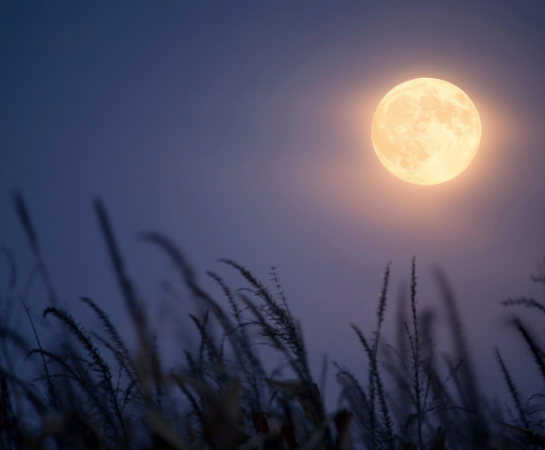
What Is a Harvest Moon and Why It Rises at Almost the Same Time Several Nights Running
On most nights of the year, the Moon rises roughly 50 minutes later than it did the night before. Around the Harvest Moon, that gap collapses to as little as 10 minutes in parts of the UK and Canada, and rarely more than 30 minutes
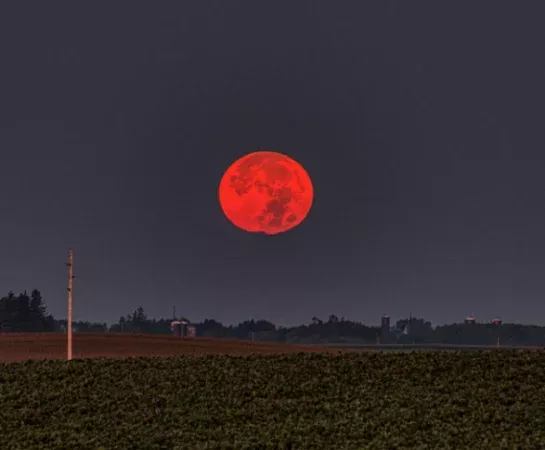
What Is a Blood Moon and Why Does the Moon Turn Red
On the night of August 27, 2026, the Moon came within a hair of disappearing entirely. Earth's shadow covered 96.2% of its surface, a partial eclipse so deep that skywatchers across the Americas, Europe, and Africa watched it turn a rusty, almost total red without
Time Tools
Quick access to timers, stopwatch, world clock and time zone tools.
Time Guides
Read useful guides about time zones, calendars, finance and astronomy.


