Major Airports in Denmark
- Aalborg Airport (AAL) - 01:14:56
- Aarhus Airport (AAR) - 01:14:56
- Billund Airport (BLL) - 01:14:56
- Copenhagen Kastrup Airport (CPH) - 01:14:56
- Odense Hans Christian Andersen Airport (ODE) - 01:14:56
Daylight saving time changes in Denmark
Denmark has 1 listed IANA time zones. 1 of them observe daylight saving time changes in 2026.
Next change: October 25, 2026
Clock moves back from 03:00 to 02:00 local time.
Best Time to Call Denmark
Business hours in Denmark (9 AM–5 PM local time) fall at these local times elsewhere:
- Beijing: 3:00 PM – 11:00 PM ( Partial overlap)
- Paris: 9:00 AM – 5:00 PM ( Convenient)
- Toronto: 3:00 AM – 11:00 AM ( Outside normal hours)
- Seoul: 4:00 PM – 12:00 AM (next day) ( Partial overlap)
- Mexico City: 1:00 AM – 9:00 AM ( Outside normal hours)
- Cairo: 10:00 AM – 6:00 PM ( Convenient)
- Bangkok: 2:00 PM – 10:00 PM ( Partial overlap)
Times shown reflect current UTC offsets and may shift by up to an hour around daylight saving transitions.
Time Difference from Denmark
Compare time in Denmark with other countries.
Most Popular Cities in Denmark
Holidays in Denmark
Official national public holidays. Regional and religious observances may vary by area.
About Time in Denmark
The 1894 Time Reform Moved Every Clock Forward
For much of the nineteenth century, civil time was still tied to astronomical observation in Copenhagen. The problem became harder to ignore as railways, telegraph services and other forms of rapid communication expanded. A common timetable only works efficiently when distant stations agree on the same minute, and local solar references were increasingly unsuited to a transport network operating across the whole country.
Parliament settled the issue with the Act on the Determination of Time of 29 March 1893. From 1 January 1894, legal time was defined as mean solar time at 15 degrees east of Greenwich, the meridian corresponding to Central European Time. The reference line passes through Bornholm, far east of Copenhagen. Contemporary historical research records that the New Year transition advanced Danish clocks by about 9 minutes and 41 seconds compared with the Copenhagen time previously in use.
The reform was more than an adjustment of a few minutes. It replaced a national reference based on the capital's local astronomy with a standard designed to fit an international system of time zones. The 1893 law proved remarkably durable. Its definition remained formally in force for almost 130 years, even after everyday precision timekeeping had long since moved from observations of mean solar time to atomic UTC.
A Law Written for the Sun Survived Into the Atomic Age
By the twenty first century, the legal definition of standard time had become technically outdated. In practice, telecommunications, navigation, finance and computer networks already relied on Coordinated Universal Time, while the statute still described time through the mean Sun at the 15th meridian east. Parliament replaced that arrangement in 2023 with a new law defining standard time directly as UTC plus one hour.
The change took effect at 02:00 on 26 March 2023 and repealed the 1893 act. It did not alter the time people saw on their clocks. Instead, it brought the legal definition into line with the system already used by modern infrastructure. The legislation explicitly excludes the Faroe Islands and Greenland, whose time arrangements are governed separately.
The timing of the reform coincided with the creation of a domestic UTC reference. Danish Fundamental Metrology established UTC(DFM) in 2022 around a hydrogen maser and began reporting its measurements to the Bureau International des Poids et Mesures. From March 2023, that realization became the basis for official standard time. DFM also operates internet time services linked directly to its atomic reference, allowing computers and technical systems to obtain traceable time locally rather than depending entirely on foreign servers or satellite navigation signals.
Summer Time Has Been Introduced, Abandoned and Reintroduced
Seasonal clock changes have never been a continuous part of the national time system. Summer time was first used in 1916 during the First World War. It returned under very different circumstances in 1940, remained in force through part of the wartime period, appeared again during the 1940s, and was later abandoned for more than three decades.
The modern sequence began on 6 April 1980, when clocks moved from 02:00 to 03:00. Government instructions issued for that transition even addressed how employers should handle the missing hour for staff working overnight. The reverse change on 28 September created an additional hour, illustrating that clock changes are not merely astronomical conventions but can affect payroll, transport schedules, computer records and any activity measured against civil time.
Current summer time follows the common European schedule. The clock advances by one hour on the last Sunday in March and returns on the last Sunday in October, with the change coordinated at 01:00 UTC across participating EU states. Standard time is therefore UTC+1, while summer time is UTC+2. The seasonal rule is legally separate from the 2023 definition of standard time, which means changing the underlying standard did not itself change the daylight saving system.
Ole Rømer Used Time Delays to Show That Light Has a Finite Speed
One of the most important time measurements associated with Danish science occurred far beyond Earth. In 1676, astronomer Ole Rømer studied the eclipses of Io, one of Jupiter's moons, while working in Paris. Io disappears behind Jupiter at predictable intervals, so repeated observations provided a natural astronomical clock. Rømer noticed that the observed eclipses appeared progressively early or late depending on the changing distance between Earth and Jupiter.
The pattern could not be explained if light travelled instantaneously. Rømer concluded that the delay came from the additional time required for light to cross the changing distance between the planets. He estimated that light needed about 22 minutes to cross a distance equal to the diameter of Earth's orbit. Modern measurements give approximately 16 minutes and 40 seconds for that journey, but the crucial achievement was establishing from timed astronomical observations that the propagation of light was finite.
The work also had a practical connection with time and longitude. Eclipses of Jupiter's moons had been investigated as potential reference events for determining longitude, because observers at different locations could compare the local time of the same astronomical event. After returning to Copenhagen, Rømer continued improving the relationship between clocks and positional astronomy. His transit instruments and meridian circle used the exact time at which a star crossed the local meridian as one of the fundamental measurements of its position.
Copenhagen Built a Public Time Signal Into the Skyline
Before radio and electronic synchronization, accurate time had to be physically distributed. From the late 1860s, Copenhagen used a time ball mounted on the tower of the former St. Nicholas Church. A large visible ball was raised and then dropped at a predetermined time, allowing people across the city to check clocks and, importantly, allowing navigators to compare marine chronometers without carrying them to an observatory.
The signal was controlled from the Copenhagen Observatory through an electrical telegraph connection. Historical research places the St. Nicholas time ball in service until 1909, when the maritime community succeeded in having the signal moved closer to the harbour. A new installation operated at the free port, where it was more useful to ships that depended on accurate chronometers for navigation.
The system belonged to a transitional era in time distribution. Astronomers determined accurate time through observations, precision clocks maintained it between observations, telegraph wires carried the signal across the city, and the falling ball converted an electrical impulse into something that could be seen from a ship. Radio signals eventually made such installations obsolete, but for decades a moving object on the skyline functioned as part of the city's time infrastructure.
A Mechanical Clock Designed to Calculate Far More Than Hours
Copenhagen City Hall contains a very different expression of precision timekeeping. Jens Olsen's World Clock was designed as a mechanical astronomical computer rather than simply a clock for displaying hours and minutes. Olsen spent years developing the calculations and design but died in 1945 before the project was completed. The finished mechanism was started on 15 December 1955 by King Frederik IX.
Municipal and museum records describe a machine containing 14,448 parts and twelve interconnected movements. It displays civil time alongside astronomical information, including the starry sky, lunar cycles and calendrical calculations. At midnight on New Year's Eve, part of the mechanism spends several minutes calculating information for the coming year, including movable religious holidays and full moons.
The most striking feature is the range of timescales represented mechanically. Some components move quickly enough to measure ordinary clock time, while the slowest gear represents an astronomical cycle extending over tens of thousands of years. The clock therefore connects several very different meanings of time in one machine: seconds used in everyday life, calendar cycles measured in months and years, and celestial motions whose periods are longer than recorded human history.
Frequently Asked Questions
How many time zones does Denmark have?
One. The whole of Denmark follows Europe/Copenhagen, so every city shows the same local time as the capital, Copenhagen.
Is Denmark ahead of or behind GMT?
Denmark is currently 2 hours ahead of GMT (UTC+2).
Does Denmark use summer time?
Yes. Copenhagen uses UTC+1 (CET) in standard time and UTC+2 (CEST) during daylight saving time, and is currently on summer time.
How many public holidays does Denmark have in 2026?
Denmark has 10 national public holidays in 2026, when banks and government offices are usually closed. Some regions may also have their own local holidays.
How do I dial a phone number in Denmark from abroad?
From a mobile phone, type +45 and then the full local number exactly as it is written, because numbers in Denmark have no domestic prefix to drop. From a landline, replace the plus sign with your exit code: 011 from the US and Canada, or 00 from most of Europe, for example 00 45 followed by the number.
What language is spoken in Denmark?
The main languages of Denmark are Danish, English and Faroese.
Beyond the Clock

Why the Year Starts on January 1
Nothing happens in the sky on January 1. The winter solstice comes about ten days earlier, Earth's closest approach to the Sun a few days later, and no lunar phase is tied to the date. January 1 is not an astronomical boundary. It is an

What Is Nowruz and Why It Always Falls on the Spring Equinox
Nowruz is the Persian New Year, celebrated by more than 300 million people across Iran, Afghanistan, Central Asia, the Caucasus, and Kurdish communities, and it begins at the exact astronomical instant of the March equinox rather than on a fixed date on any calendar grid.

When Is Yom Kippur and Why It Always Falls 10 Days After Rosh Hashanah
Yom Kippur is the tenth day of Tishrei, and Rosh Hashanah is the first, so the ten-day gap between them looks like simple arithmetic. It isn't. The Hebrew calendar has a set of centuries-old rules that quietly forbid Rosh Hashanah from landing on three specific

Why Hanukkah’s Date Moves Every Year on the Solar Calendar
In 2013, the first candle of Hanukkah was lit on the night before Thanksgiving, a coincidence rare enough that it won't happen again until 2070. Eleven years later, in 2024, the first candle fell on the evening of December 25 itself, the same alignment that

Full Moon Names by Month: Where Beaver Moon and Cold Moon Come From
The November 2026 full moon, the Beaver Moon, peaks at 9:53 AM Eastern Time on Tuesday, November 24. The December full moon, the Cold Moon, follows at 8:28 PM Eastern on Wednesday, December 23. In UTC that moment already falls on December 24, so in

Why the Moon’s Phases Don’t Actually Change Its Size
A thin crescent looks small enough to disappear. A full moon looks like it's swelling on the horizon. Neither impression is true. The Moon's diameter is 3,474 kilometers on every night of the month, whether it's a sliver or a full disc, and nothing in
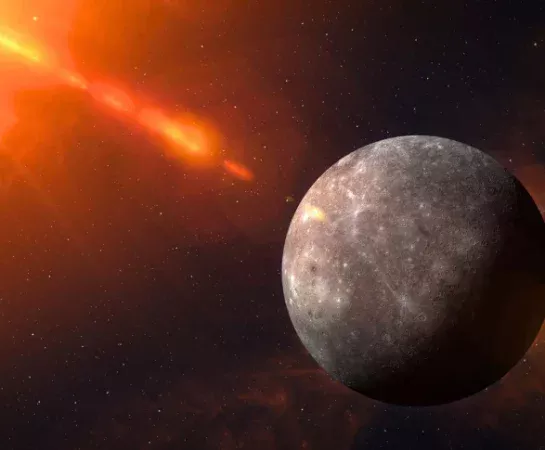
Mercury Retrograde: What’s Astronomically Real vs Astrological Myth
Mercury retrograde generates millions of searches every time it happens, and almost none of that content stops to explain what's actually occurring in space. The phenomenon itself is completely real, observable, and predictable centuries in advance. What isn't real is nearly everything attached to it

What Is Sidereal Time and How It Differs From Solar Time
Ask how long it takes Earth to spin once on its axis and the honest answer depends on what you're measuring the spin against. Measured against the sun, a full rotation takes 24 hours, the day everyone lives by. Measured against the distant stars, that
Time Tools
Quick access to timers, stopwatch, world clock and time zone tools.
Time Guides
Read useful guides about time zones, calendars, finance and astronomy.


