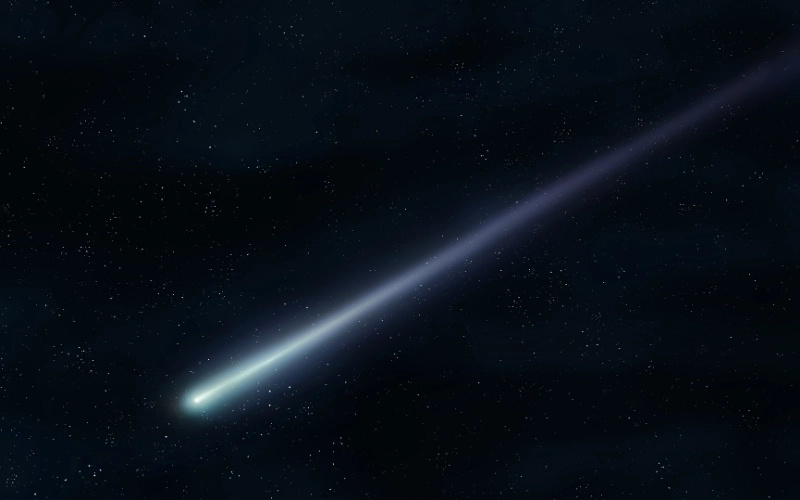
The Leonids reach their regular maximum around 23:45 UTC on November 17, 2026, according to the International Meteor Organization (IMO). For most of the Northern Hemisphere, that makes the best window the hours after midnight on the night of November 17 into the morning of November 18. Expect a modest shower: a zenithal hourly rate (ZHR) of about 15, with no storm or outburst predicted this year. A first quarter Moon sets around midnight, so the darkest and most productive hours line up with the time the radiant climbs highest.
That is the short answer. The more interesting story is why a shower famous for producing tens of thousands of meteors per hour usually delivers only a handful, and why astronomers can now forecast its rare storms to within minutes.
The 2026 Leonids at a Glance
| Detail | 2026 value |
|---|---|
| Activity period | November 6 to November 30 |
| Regular maximum (IMO) | November 17, about 23:45 UTC (solar longitude 235.27°) |
| Peak night listed by NASA and the American Meteor Society | November 16 to 17 |
| ZHR | About 15 |
| Entry speed | About 71 km/s (44 miles per second) |
| Radiant | The Sickle of Leo |
| Moon | First quarter at 11:48 UTC on November 17; sets around midnight |
| Parent comet | 55P/Tempel-Tuttle |
The two “peak nights” in the table are not a contradiction. The IMO computes the moment Earth crosses the densest part of the stream’s main body, while NASA and the American Meteor Society label the night of best viewing for observers in the Americas. The IMO calendar also cites an alternative model by Maslov that places the 2026 maximum around 16:00 UTC on November 17, almost eight hours earlier. When two credible models differ by that much, the practical move is to watch both the morning of November 17 and the morning of November 18.
What 23:45 UTC means on your clock
| City | Local time of the IMO maximum | Radiant above the horizon? |
|---|---|---|
| Los Angeles | 3:45 p.m. PST, November 17 | No (daylight) |
| New York | 6:45 p.m. EST, November 17 | No |
| London | 11:45 p.m. GMT, November 17 | Just rising |
| Berlin, Paris, Warsaw | 12:45 a.m. CET, November 18 | Low in the east |
| Tokyo | 8:45 a.m. JST, November 18 | No (daylight) |
| Sydney | 10:45 a.m. AEDT, November 18 | No (daylight) |
Europe sits closest to the nominal maximum, but even there the radiant is low at that moment. For North America, the maximum falls in the evening before Leo rises, so viewers there are watching the shower’s tail a few hours later, after midnight on November 18. With a normal ZHR of 15, this difference matters far less than local darkness and radiant height.
Why the Leonids Are Best After Midnight
The Leonid radiant, the point in the Sickle of Leo from which the meteors appear to fly, rises around midnight in mid-November. Before it rises, Earth itself blocks most of the stream. After midnight, two effects work together: the radiant climbs, and the observer is on the side of Earth facing forward along its orbit, the side that runs into the debris.
The Leonid stream moves around the Sun in the opposite direction to the planets, so Earth meets it almost head-on. That is why Leonids enter the atmosphere at about 71 km/s, the fastest of any major shower. High speed produces bright meteors and, often, persistent trains that glow for seconds after the meteor itself is gone. In the hour after the radiant rises, Leonids can also appear as Earth-grazers: long, slow-looking meteors that skim the upper atmosphere almost parallel to the horizon. What a meteor actually is, and why none of them are stars, is explained in why shooting stars aren’t stars.
In 2026 the Moon helps rather than hurts the late-night window. First quarter falls at 11:48 UTC on November 17, so on the peak night the Moon is a little more than half lit, high in the south at dusk and sinking into the west through the evening. It sets around 11 p.m. to midnight at mid-northern latitudes, at roughly the same time Leo comes up in the east. The reason a first quarter Moon is an evening object is covered in phases of the Moon.
Why a ZHR of 15 Usually Means Fewer Than 15
NASA describes typical Leonid rates as about three meteors per hour, while calendars quote a ZHR of 15. Both are correct. The ZHR is a standardized number: the count a single observer would see with the radiant directly overhead under a perfectly dark sky where stars of magnitude 6.5 are visible. Real conditions are always worse, and the IMO corrects for them with a standard formula, shown here in simplified form without the corrections for clouds and field of view.
Leonids 2026: ZHR = 15, population index r = 2.5
Radiant 30° high, dark rural sky (limiting magnitude 6.0): 15 × 0.5 ÷ 1.58 ≈ 4.7 per hour
Radiant 30° high, suburban sky (limiting magnitude 5.0): 15 × 0.5 ÷ 3.95 ≈ 1.9 per hour
Radiant 60° high, excellent sky (limiting magnitude 6.5): 15 × 0.87 ÷ 1 ≈ 13 per hour
The population index r describes how quickly the number of meteors grows as you go fainter. With r = 2.5, every one-magnitude loss in sky darkness cuts the visible count by a factor of 2.5. That is why driving from a suburb to a rural site can more than double the number of Leonids you see. In a normal year like 2026, that choice matters more than picking between November 17 and 18.
Where you look matters too. NASA advises against staring straight at Leo: meteors near the radiant appear short because they are coming almost toward you, while those 40° to 90° away draw longer, more striking streaks. Lying back and facing east or straight up covers the most sky. Give your eyes at least 20 to 30 minutes in full darkness, and avoid checking a bright phone screen, which resets that adaptation.
The 33-Year Comet Behind the Storms
The Leonids are debris from comet 55P/Tempel-Tuttle, discovered independently by Ernst Tempel in 1865 and Horace Tuttle in 1866. Its nucleus is only about 3.6 km across, according to NASA, and it orbits the Sun once every 33.17 years, a figure given in NASA Ames Research Center’s Leonid history. The comet was recovered on March 10, 1997, and passed perihelion on February 28, 1998.
Orbital period: 33.17 years
1998.16 + 33.17 ≈ 2031.3, so the next perihelion falls in 2031
The storms cluster around those returns, but not every return produces one. In 1899, after two spectacular earlier displays, astronomers widely expected a repeat and saw very little. The reason became clear only a century later.
Dust Trails: Why Storms Come in Narrow Bursts
Each time Tempel-Tuttle passes the Sun, it sheds a fresh cloud of dust. Over the following orbits, that cloud stretches into a thin ribbon along the comet’s path: a dust trail. Older trails spread and thin out, and together they make up the broad stream that produces the ordinary annual shower of about 15 per hour. A storm happens only when Earth passes directly through a young, dense trail. Because planetary gravity shifts each trail slightly over time, whether Earth hits one in a given year depends on the trail’s exact position, not simply on how close the comet is.
David Asher of Armagh Observatory and Rob McNaught of the Australian National University turned this into a forecasting method. For November 18, 1999, they predicted a peak at 02:08 UTC from a trail the comet had shed in 1899, three orbits earlier. IMO observers in Spain and France recorded the peak at about 02:05 UTC, plus or minus ten minutes, with a ZHR around 5,000. As Nature reported that month, the timing was essentially exact, while the intensity came in five to ten times higher than the forecast. Timing a storm, it turned out, is much easier than predicting how strong it will be.
The Great Leonid Storms
| Year | Where it was seen | What happened |
|---|---|---|
| 1833 (November 12 to 13) | North America | Accounts described around a thousand meteors per minute; the display led astronomers to recognize that shower meteors share a radiant |
| 1899 | Expected worldwide | A widely anticipated storm failed to appear |
| 1966 (November 17) | Central and western United States | Rates rose from about 40 per hour to about 40 per second within two hours, roughly 144,000 per hour at the peak |
| 1999 (November 18) | Europe and the Middle East | ZHR about 5,000 at 02:05 UTC, matching the predicted 02:08 UTC |
| 2001 and 2002 | Different regions each year | Further storms from older dust trails; NASA lists 2002 as the most recent Leonid storm |
NASA defines a meteor storm as a rate of at least 1,000 meteors per hour. By that measure, 1966 exceeded the threshold more than a hundredfold. Ordinary years like 2026 fall far below it, which is normal for a shower whose strength depends on a single thin ribbon of dust being in the right place.
What to Expect After 2026
With the comet returning around 2031, Leonid rates are expected to climb over the coming years as Earth encounters material shed on recent orbits. Whether that brings a true storm depends on which trails Earth actually crosses, and published comments from meteor observers currently point to enhanced rates rather than a repeat of 1966. Until then, the Leonids remain a smaller shower than the summer Perseids, but a faster one: at 71 km/s against the Perseids’ 59 km/s, and known for bright meteors and glowing trains, each Leonid that does appear tends to be worth the wait.