
In London, the day loses about four minutes of daylight every 24 hours in late September. Three months later, around the winter solstice, it changes by only a few seconds a day. The shortening is not steady, and at most latitudes it is not fastest in December, when days are shortest. It is fastest around the equinox, when day and night are roughly equal, and slowest at the solstices, when the day is at its extreme. The reason is a piece of geometry that also explains why the change is faster in Oslo than in Miami, and nearly zero at the equator.
The Sun’s Path Moves Fastest at the Equinox
Day length depends on the Sun’s declination: how far north or south of the celestial equator the Sun stands. Because Earth’s axis is tilted by about 23.44° to its orbit, the declination swings between +23.44° at the June solstice and −23.44° at the December solstice, crossing zero at the equinoxes, as explained in what the equinox and solstice are.
That swing is not uniform. It behaves like a pendulum. At the turning points, the solstices, the Sun’s declination barely changes from day to day; the word solstice comes from the Latin for “sun standing still.” In the middle of the swing, at the equinoxes, the declination changes fastest, by about 0.39° a day. That is roughly three quarters of the Sun’s own apparent diameter. Every day around the equinox, the Sun’s daily arc across the sky shifts south (in autumn) by most of a sun-width.
Rate at the equinox ≈ sin(23.44°) × 0.986° per day ≈ 0.39° per day
Rate at the solstice ≈ 0° per day
One day after the winter solstice: change of about 0.004°
How Much Daylight You Lose Per Day
A shift in declination changes the length of the Sun’s arc above your horizon. Near the equinox, the geometry reduces to a compact rule: the daily change in day length is proportional to the tangent of your latitude.
≈ 3.1 × tan(latitude) minutes per day
New York, 40.7°: 3.1 × 0.86 ≈ 2.7 minutes per day
London, 51.5°: 3.1 × 1.26 ≈ 3.9 minutes per day
Equator, 0°: tan(0°) = 0, no change
The 8 minutes per degree comes from Earth’s rotation: the Sun’s hour angle moves 15° per hour, or 4 minutes per degree, and a day has two ends, sunrise and sunset. The rule uses a simplified model that ignores atmospheric refraction; full calculations such as those of the US Naval Observatory or NOAA differ from it by seconds, not minutes, near the equinox.
| Place | Latitude | Daylight change per day at the equinox |
|---|---|---|
| Singapore | 1.3° N | About 4 seconds |
| Miami | 25.8° N | About 1.5 minutes |
| Los Angeles | 34.1° N | About 2.1 minutes |
| New York | 40.7° N | About 2.7 minutes |
| Seattle | 47.6° N | About 3.4 minutes |
| London | 51.5° N | About 3.9 minutes |
| Edinburgh | 56.0° N | About 4.6 minutes |
| Oslo | 59.9° N | About 5.4 minutes |
| Reykjavik | 64.1° N | About 6.5 minutes |
The tangent grows quickly toward the poles, which is why the seasonal change feels gradual in Florida and dramatic in Scandinavia. Over a single week around the equinox, Reykjavik loses about 45 minutes of daylight, New York about 19 and Miami about 11. In Singapore, the change is a few seconds a day and the day stays close to 12 hours all year.
The Same Season, Day by Day
The pace does not drop sharply after the equinox. It fades gradually, and most of the slowdown happens in the final weeks before the solstice. Calculated for London with the same model:
| Date (2026) | Sun’s declination | Daylight lost per day in London |
|---|---|---|
| Late September (equinox) | 0° | About 3.9 minutes |
| Late October | About −13° | About 3.7 minutes |
| Late November | About −20° | About 2.8 minutes |
| Early December | About −22.6° | About 1.6 minutes |
| December 21 (solstice) | −23.44° | A few seconds |
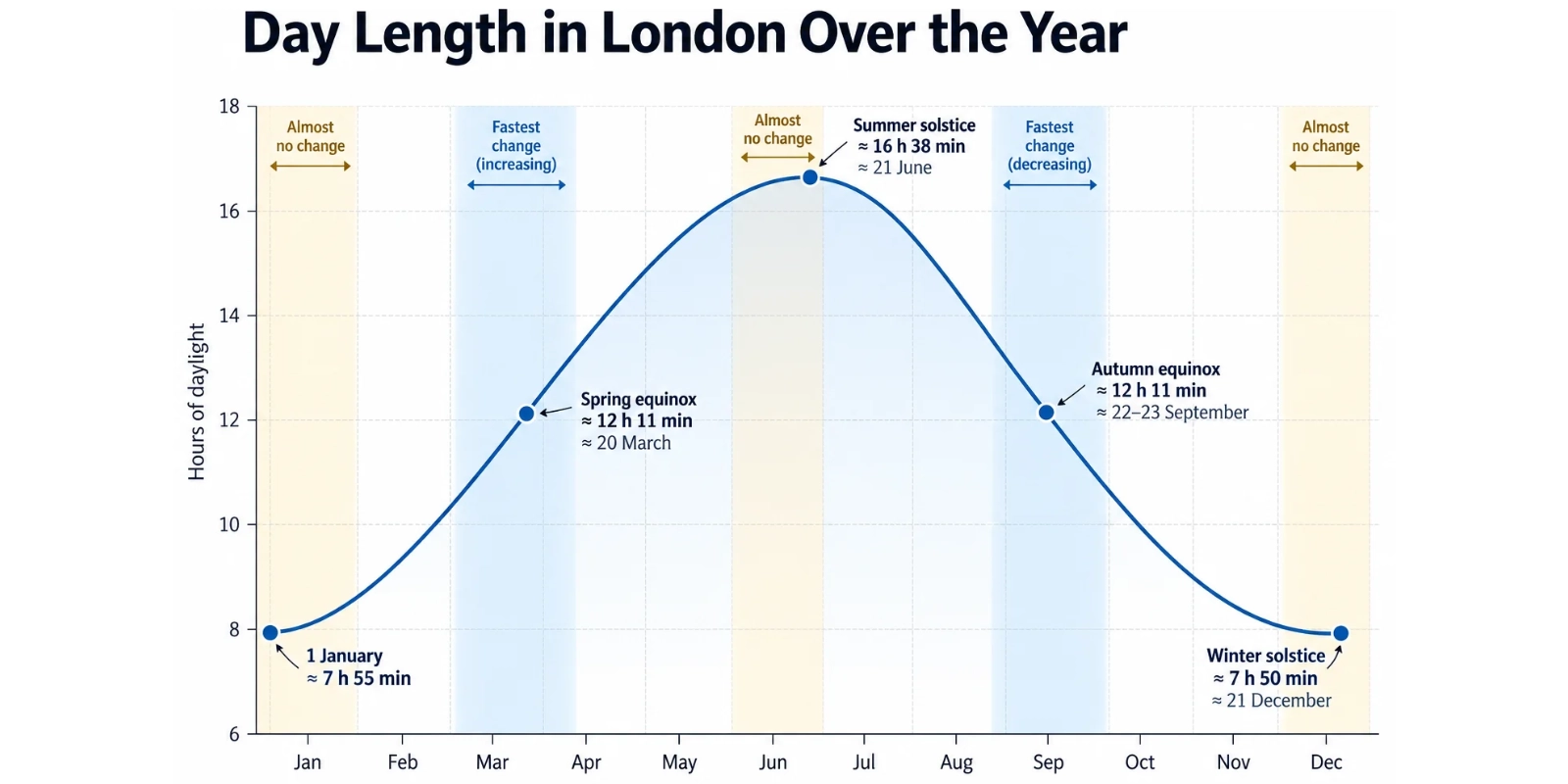
At the end of October, London is still losing daylight at more than 90 percent of the equinox pace, even though the equinox is five weeks past. Two effects pull in opposite directions. The Sun’s declination is now changing more slowly, but at higher declinations each degree of change costs more daylight, because the Sun’s arc is shorter and meets the horizon at a shallower angle. Near the equinox the slowing of the Sun barely registers; close to the solstice it wins decisively, and the loss falls from minutes to seconds over the last three weeks.
Right after the solstice, the change is tiny. On the first day after December 21, the Sun’s declination moves by about 0.004°, and London’s day lengthens by roughly 3 seconds. The second day adds about three times as much, and the gains keep accelerating until they reach their peak again around the March equinox.
Why the Equator Barely Notices
At the equator, the horizon cuts every daily path of the Sun exactly in half, whatever the declination. The Sun is above the horizon for half of its circle every day of the year, so day length stays the same. With the effects of refraction and the Sun’s disk included, the equatorial day lasts about 12 hours and 7 minutes year-round. Seasonal change in daylight is entirely a mid- and high-latitude experience.
The same refraction explains why the equinox itself is not a day of exactly 12 hours. The atmosphere bends sunlight so the Sun appears above the horizon when it is geometrically just below it, and sunrise and sunset are timed by the top edge of the Sun rather than its center. Together these add several minutes: at 50° N, the equinox day lasts about 12 hours and 10 minutes. Day and night become equal a few days after the September equinox and a few days before the March one.
Above About 61° the Peak Moves
The tangent rule holds well at mid-latitudes, but the full geometry has a twist farther north. The same calculation shows that above roughly 61° of latitude, the equinox is no longer the date of fastest change. There, the growing cost of each degree of declination outweighs the slowing of the Sun’s motion, so the fastest daily losses shift later into autumn. Inside the Arctic Circle, they come in the weeks before polar night, when the Sun’s daily arc shrinks toward nothing. This threshold comes from the simplified model; refraction and terrain shift the exact numbers, and the US Naval Observatory notes that at high latitudes, calculated daylight can even depend on longitude.
Mornings and Evenings Do Not Lose Equally
Day length changes symmetrically around solar noon, but solar noon itself drifts on the clock through the year. Around the September equinox, the equation of time is increasing by roughly 20 seconds a day, so solar noon moves earlier on the clock. The result is that evenings darken faster than mornings: in London in late September, sunset moves earlier by about 2.3 minutes a day while sunrise moves later by about 1.6 minutes. The mechanics of that drift are covered in why sunrise time changes every day.
The same drift reshapes the end of the season. In December, solar noon moves later on the clock, which is why the earliest sunset arrives one to two weeks before the winter solstice, depending on latitude, even though the shortest day is on the solstice itself, as explained in why the earliest sunset comes before the solstice. In the Southern Hemisphere, the pattern runs in reverse: Sydney, at 33.9° S, is now gaining about two minutes of daylight a day, close to its fastest pace of the year.