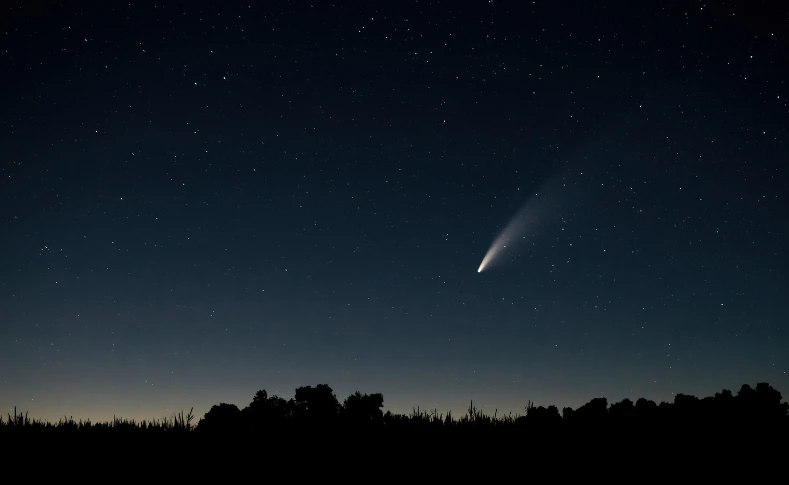
Every culture that ever looked up at night built a tradition around the streak of light crossing the sky in under a second, wishing on it, naming it, treating it as a small cosmic event worth a moment’s attention. Almost none of that tradition is about what’s actually happening. A shooting star involves no star at all. It’s a fragment of rock or metal, usually smaller than a pea, disintegrating in the upper atmosphere roughly 100 kilometers overhead, which is a location closer to your rooftop than it is to any actual star in any meaningful sense.
What’s Actually Burning
Astronomers use three different words for three different phases of the same object’s short life, and the mix-up starts with people using them interchangeably. Out in space, drifting debris from a comet or asteroid is called a meteoroid, most no bigger than a grain of sand, occasionally as large as a pea or small pebble. The moment one of these hits Earth’s atmosphere and produces the visible streak of light, that streak is the meteor, the light show itself, not the object. If any fragment survives the trip and lands on the ground, only then does it earn a third name, meteorite. Most meteoroids never make it that far. They’re simply too small and moving too fast to survive.
| Stage | What it’s called | Where it is |
|---|---|---|
| Before atmospheric entry | Meteoroid | Orbiting the Sun in space |
| During atmospheric entry | Meteor | ~75–120 km altitude, mesosphere |
| After surviving to the ground | Meteorite | Earth’s surface |
Why It Glows at All
Meteoroids enter the atmosphere at genuinely extreme speeds, anywhere from about 11 kilometers per second, roughly Earth’s escape velocity, up to 72 kilometers per second for objects meeting Earth head-on. At those speeds, collisions with air molecules generate far more energy than the object’s tiny mass would suggest.
That energy doesn’t come from the meteoroid burning in the way a candle burns. Friction with air molecules heats the surface past its melting point, and the object sheds material through a process called ablation, vaporizing and shedding molten droplets as it plows forward. The vapor cloud collides with surrounding air, ionizing both the shed material and the atmosphere around it, and it’s the light released as those ionized atoms settle back down that produces the visible streak. The glowing trail you see is actually larger than the meteoroid itself, since it’s the surrounding plasma cloud lighting up, not the solid object glowing on its own. Only a fraction of the total energy, somewhere between 0.1 and 1 percent, actually converts into visible light. The rest goes into heat and ionization, which is also why the process destroys most meteoroids within a fraction of a second.
The Distance Problem That Makes “Star” the Wrong Word
This is where the naming really breaks down. Meteors become visible somewhere between about 75 and 120 kilometers up, occasionally as high as 160 kilometers for unusually bright fireballs. That’s within the mesosphere, technically closer to the ground than the International Space Station, which orbits around 400 kilometers up. A real star isn’t a rock burning up in Earth’s own air, it’s an enormous ball of plasma undergoing nuclear fusion, and even the nearest one beyond our own Sun sits 4.24 light-years away, a distance so large that comparing it to a 100-kilometer altitude is close to meaningless.
| Meteor | Actual star (e.g. nearest, Proxima Centauri) | |
|---|---|---|
| Distance from you | ~75–120 km | ~4.24 light-years (about 40 trillion km) |
| Size | Grain of sand to pea-sized | Roughly 1/7th the diameter of the Sun |
| Duration of the light | Under a second, typically | Billions of years |
What you’re wishing on isn’t a star falling out of the sky, it’s dust disintegrating closer to your rooftop than to space. worldtimedata
Colors Tell You What’s Actually Burning Up
The color of a meteor is essentially a spectroscopy reading performed from millions of kilometers away, on debris that formed somewhere entirely different in the solar system. Sodium and iron in the vaporizing material burn yellow. Calcium and silicon produce orange. Magnesium burns blue to green. Nickel produces a distinct green as well. That’s why different annual meteor showers, which are really just Earth passing through the debris trail of a specific comet or asteroid, tend to have their own characteristic color signature. The Perseid meteor shower comes from Comet Swift-Tuttle’s debris, rich in sodium and magnesium, and often flashes bright white before trailing off into green. Meteors from the Geminid shower run yellow, occasionally punctuated by blue flashes, from denser, rockier debris entirely unlike a comet’s.
The Shower That Shouldn’t Exist
Nearly every major meteor shower traces back to a comet shedding icy debris as it swings near the Sun. The Geminids, one of the strongest showers of the year, break that pattern completely. Their parent body is 3200 Phaethon, a rocky asteroid with no ice to sublimate and, until recently, no confirmed explanation for how it produces a debris trail at all. A 2023 study attributed to Karl Battams and colleagues proposed that sodium on Phaethon’s surface fizzes off as the asteroid heats up near the Sun, ejecting the material that eventually becomes the Geminids, rather than the dust-shedding process that powers cometary showers. It remains the only major annual shower, alongside the Quadrantids, sourced from an asteroid rather than a comet, and it’s still considered one of the unresolved puzzles in meteor science.
Why Predawn Hours Produce More of Them
Meteor rates genuinely climb between midnight and dawn, and the reason has nothing to do with darkness getting deeper. Earth orbits the Sun in a fixed direction, and in the hours after midnight, the ground beneath your feet has rotated to face into that direction of travel, the same side of the planet that’s now plowing forward through space. Meteoroids in Earth’s path get swept up head-on rather than having to catch up from behind, the same reason a car’s windshield collects more bugs than its rear bumper. Rates typically peak close to 6 AM local time, right before the sky brightens enough to wash the fainter ones out. It’s a mechanical effect of orbital geometry, not a property of the night sky itself, similar in spirit to why the visibility of other celestial phenomena, like the northern lights, depends on geometry rather than darkness alone, even though the underlying physics of ionized atoms glowing is genuinely related.
None of this happens in isolation, either. Earth intercepts an estimated 5 to 300 tonnes of meteoric material every single day, according to atmospheric physics research, almost all of it burning up as exactly the kind of streak this entire tradition of wishing is built around. Unlike the fixed points overhead that don’t move, such as Polaris, or the steady glow of Venus tracking predictably across the evening sky, a shooting star is the one bright object up there that’s disappearing at the exact moment you notice it, which might be the real reason the wish-making habit never went away even after the astronomy caught up with it.